Lariviere Patrick J, Ashraf A H M Zuberi, Gifford Isaac, Tanguma Sylvia L, Barrick Jeffrey E, Moran Nancy A
Department of Integrative Biology, The University of Texas at Austin, Austin, TX 78712, USA.
Department of Molecular Biosciences, The University of Texas at Austin, Austin, TX 78712, USA.
bioRxiv. 2024 Oct 14:2024.10.14.618124. doi: 10.1101/2024.10.14.618124.
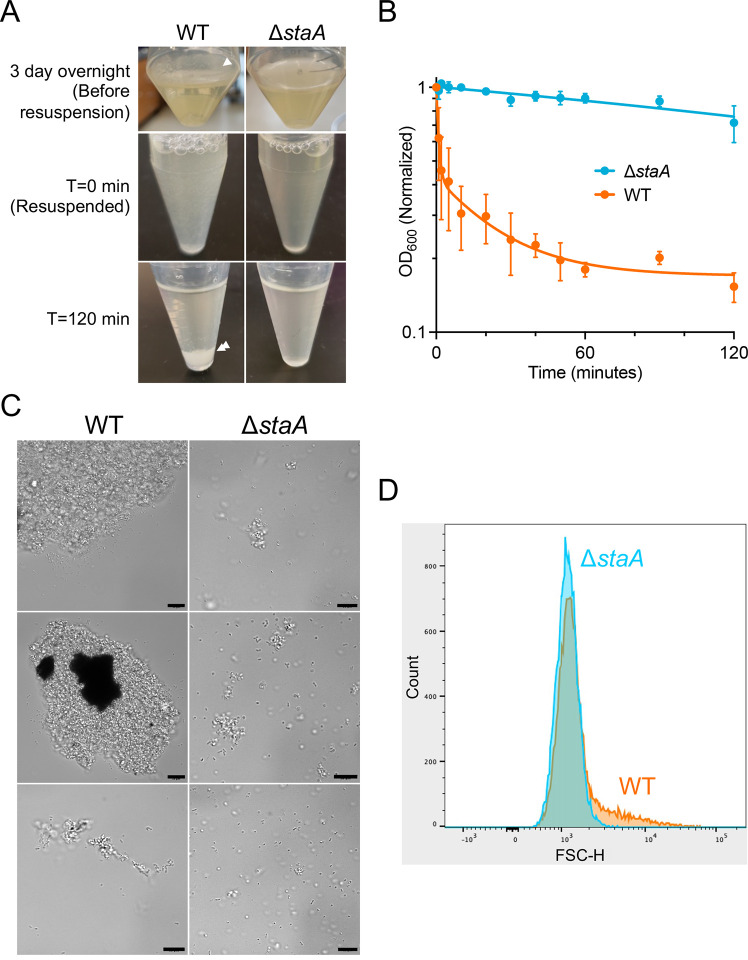
Bacterial biofilms are stable multicellular structures that can enable long term host association. Yet, the role of biofilms in supporting gut mutualism is still not fully understood. Here, we investigate , a beneficial bacterial symbiont of honey bees, and find that biofilm formation is required for its colonization of the bee gut. We constructed fifteen mutants containing knockouts of genes known to promote colonization with putative roles in biofilm formation. Genes required for colonization included and , encoding trimeric autotransporter adhesins (TAAs) and , encoding a lytic transglycosylase. Intriguingly, TAAs are considered virulence factors in pathogens but support mutualism by the symbiont , biofilm formation was reduced in Δ cells and abolished in the other two mutants. Loss of also reduced auto-aggregation and cell-cell connections. Based on structural predictions, StaA/B are massive (>300 nm) TAAs with many repeats in their stalk regions. Further, we find that StaA/B are conserved across species, suggesting that StaA/B-dependent colonization is characteristic of this symbiont lineage. Finally, deletion increases sensitivity to bactericidal antimicrobials, suggesting that the biofilm indirectly buffers against antibiotic stress. In all, the inability of two biofilm-deficient strains (Δ and Δ) to effectively mono-colonize bees indicates that biofilm formation is required for colonization of the bee gut. We envision the bee gut system as a genetically tractable model for studying the physical basis of biofilm-mutualist-gut interactions.
细菌生物膜是稳定的多细胞结构,能够实现与宿主的长期关联。然而,生物膜在支持肠道共生中的作用仍未完全明确。在此,我们研究了蜜蜂的一种有益细菌共生体,发现生物膜形成是其在蜜蜂肠道定殖所必需的。我们构建了15个突变体,这些突变体包含已知在生物膜形成中具有假定作用且能促进定殖的基因敲除。定殖所需的基因包括编码三聚体自转运黏附素(TAAs)的 和 ,以及编码溶菌转糖基酶的 。有趣的是,TAAs在病原体中被视为毒力因子,但该共生体通过它来支持共生,在Δ 细胞中生物膜形成减少,在其他两个突变体中则被消除。 的缺失也降低了自聚集和细胞间连接。基于结构预测,StaA/B是巨大的(>300 nm)TAAs,其茎部区域有许多重复序列。此外,我们发现StaA/B在 物种中是保守的,这表明依赖StaA/B的定殖是该共生谱系的特征。最后, 的缺失增加了对杀菌性抗菌药物的敏感性,这表明生物膜间接缓冲了抗生素应激。总之,两种生物膜缺陷菌株(Δ 和Δ )无法有效单一定殖蜜蜂,这表明 生物膜形成是其在蜜蜂肠道定殖所必需的。我们设想将蜜蜂肠道系统作为一个遗传上易于处理的模型,用于研究生物膜 - 共生体 - 肠道相互作用的物理基础。