Ding Jing, Bai Xue, Wang Xuelin, Shi Haining, Cai Xuepeng, Luo Xuenong, Liu Mingyuan, Liu Xiaolei
Key Laboratory of Zoonosis Research, Ministry of Education, Institute of Zoonosis/College of Veterinary Medicine, Jilin University, Changchun, China.
Mucosal Immunology Laboratory, Pediatric Gastroenterology Unit, Massachusetts General Hospital East, Boston, MA, United States.
Front Microbiol. 2017 Oct 31;8:2069. doi: 10.3389/fmicb.2017.02069. eCollection 2017.
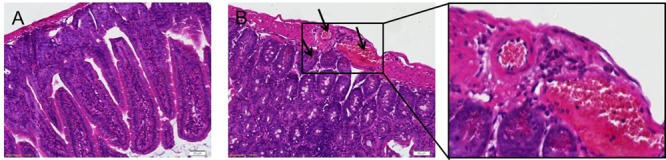
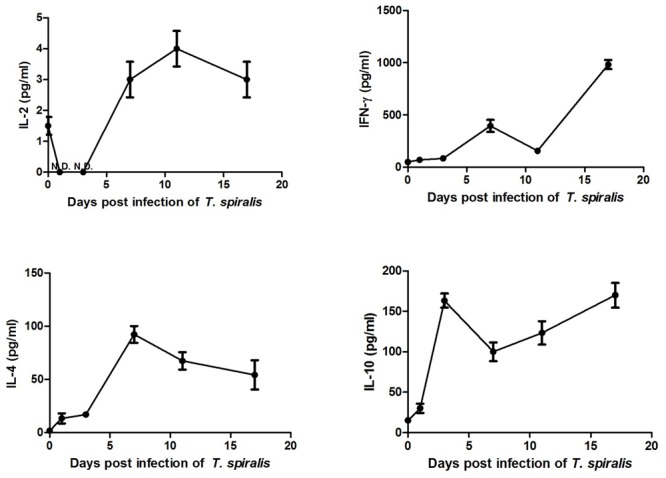
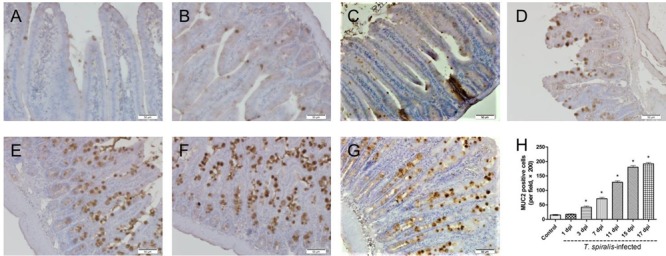
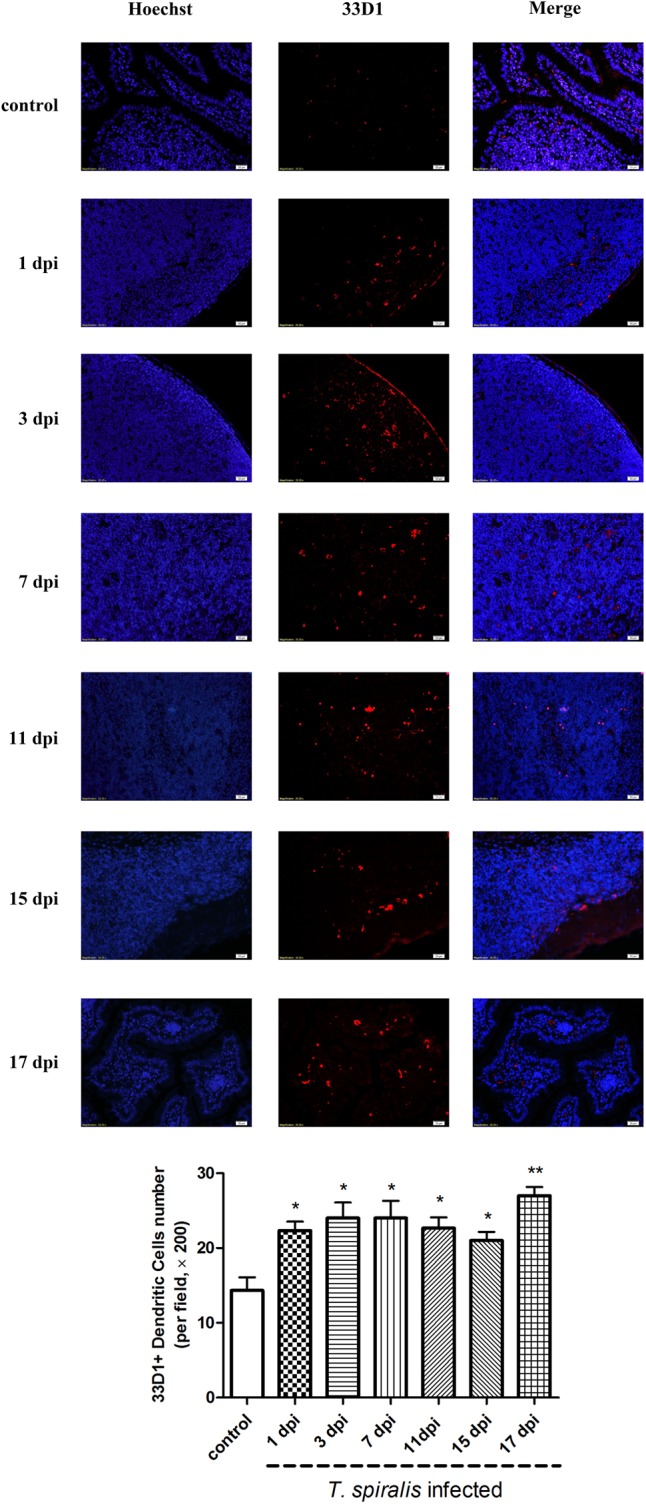
The intestinal phase is critical for trichinellosis caused by (), as it determines both process and consequences of the disease. Several previous studies have reported that induces the initial predominance of a Th1 response during the intestine stage and a subsequent predominance of a Th2 response during the muscle stage. In the present study, immune cells and cytokine profile were investigated in the intestine of mice infected with . The results showed that the number of eosinophils, goblet cells, mucosal mast cells, and 33D1+ dendritic cells (DCs) increased during the intestinal phase of the infection. Among these, eosinophils, goblet cells, and mucosal mast cells continued to increase until 17 days post infection (dpi), and the number of 33D1+ DCs increased compared to wild type; however, it did not change with the days of infection. The mRNA and protein levels of Th1 cytokines IL-2, IL-12, and IFN-γ and the Th2 cytokines IL-4, IL-5, IL-10, IL-13, and TGF-β were all increased in the tissues of the small intestine in infected mice; however, in general, Th2 cytokines increased more than Th1 cytokines. In conclusion, our findings suggest that infection can induce an increase of small intestine mucosal immune cells and add further evidence to show that the intestinal mucosal immune system of infected mice was induced toward mixed Th1/Th2 phenotypes with the predominance of Th2 response at the early stage of infection.
肠期对于由()引起的旋毛虫病至关重要,因为它决定了疾病的进程和后果。先前的几项研究报告称,()在肠道阶段诱导Th1反应最初占主导地位,而在肌肉阶段随后Th2反应占主导地位。在本研究中,对感染()的小鼠肠道中的免疫细胞和细胞因子谱进行了研究。结果表明,在感染的肠期,嗜酸性粒细胞、杯状细胞、黏膜肥大细胞和33D1 +树突状细胞(DCs)的数量增加。其中,嗜酸性粒细胞、杯状细胞和黏膜肥大细胞在感染后17天(dpi)前持续增加,33D1 + DCs的数量与野生型相比增加;然而,它并未随感染天数而变化。感染小鼠小肠组织中Th1细胞因子IL-2、IL-12和IFN-γ以及Th2细胞因子IL-4、IL-5、IL-10、IL-13和TGF-β的mRNA和蛋白质水平均升高;然而,总体而言,Th2细胞因子的增加幅度大于Th1细胞因子。总之,我们的研究结果表明,()感染可诱导小肠黏膜免疫细胞增加,并进一步证明感染小鼠的肠道黏膜免疫系统被诱导为Th1/Th2混合表型,在感染早期以Th2反应为主。