Udayappan Shanthadevi D, Kovatcheva-Datchary Petia, Bakker Guido J, Havik Stefan R, Herrema Hilde, Cani Patrice D, Bouter Kristien E, Belzer Clara, Witjes Julia J, Vrieze Anne, de Sonnaville Eleanore Susanne Victoria, Chaplin Alice, van Raalte Daniel H, Aalvink Steven, Dallinga-Thie Geesje M, Heilig Hans G H J, Bergström Göran, van der Meij Suzan, van Wagensveld Bart A, Hoekstra Joost B L, Holleman Frits, Stroes Erik S G, Groen Albert K, Bäckhed Fredrik, de Vos Willem M, Nieuwdorp Max
Department of Vascular Medicine, Academic Medical Center, Amsterdam, The Netherlands.
Wallenberg Laboratory, University of Gothenburg, Sahlgrenska University Hospital, Gothenburg, Sweden.
PLoS One. 2017 Nov 22;12(11):e0181693. doi: 10.1371/journal.pone.0181693. eCollection 2017.
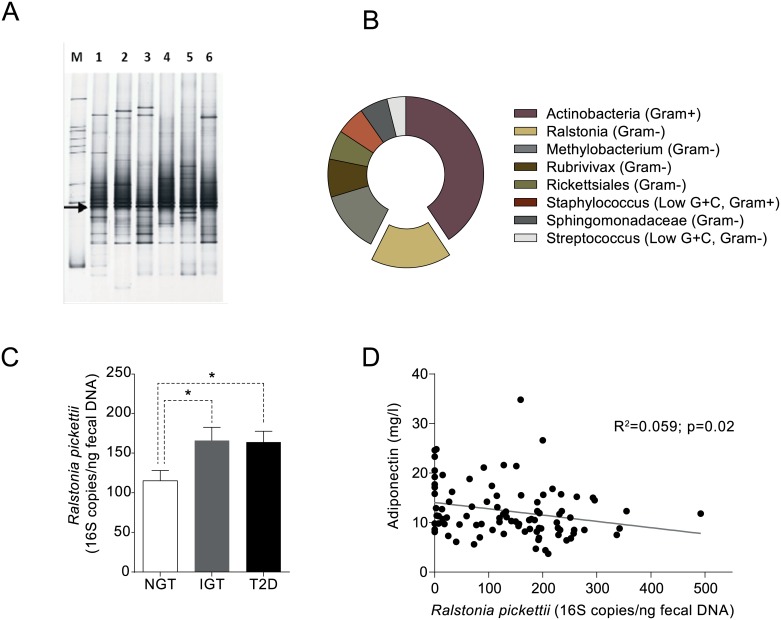
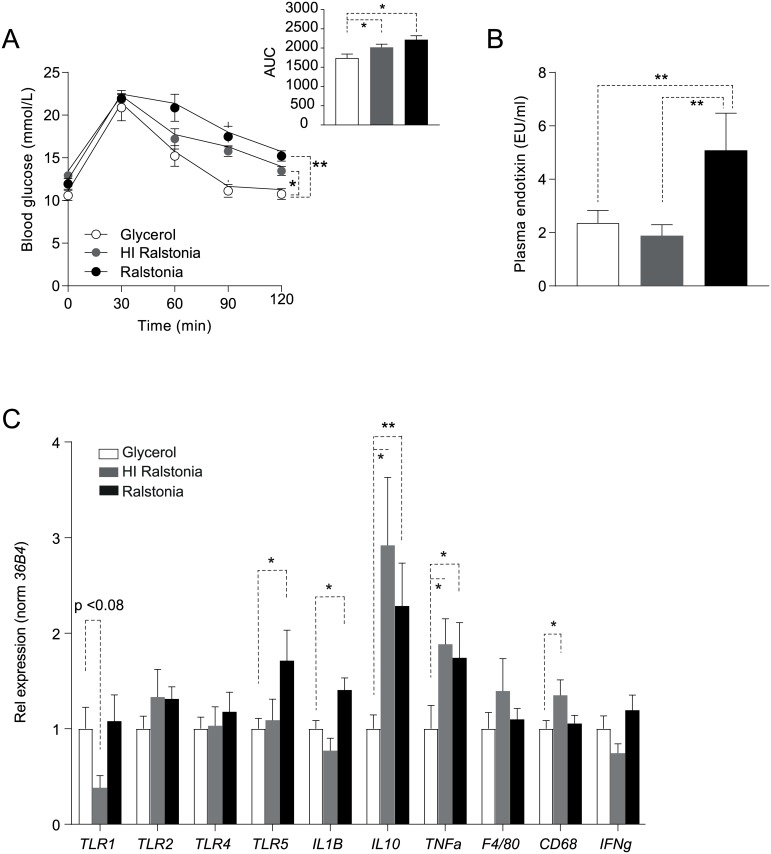
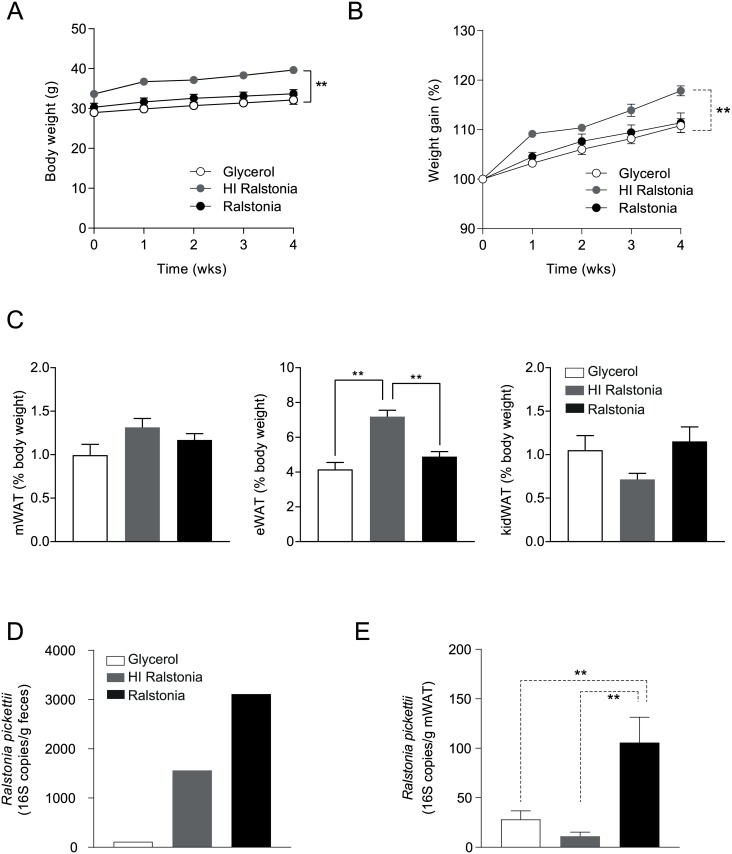
An altered intestinal microbiota composition has been implicated in the pathogenesis of metabolic disease including obesity and type 2 diabetes mellitus (T2DM). Low grade inflammation, potentially initiated by the intestinal microbiota, has been suggested to be a driving force in the development of insulin resistance in obesity. Here, we report that bacterial DNA is present in mesenteric adipose tissue of obese but otherwise healthy human subjects. Pyrosequencing of bacterial 16S rRNA genes revealed that DNA from the Gram-negative species Ralstonia was most prevalent. Interestingly, fecal abundance of Ralstonia pickettii was increased in obese subjects with pre-diabetes and T2DM. To assess if R. pickettii was causally involved in development of obesity and T2DM, we performed a proof-of-concept study in diet-induced obese (DIO) mice. Compared to vehicle-treated control mice, R. pickettii-treated DIO mice had reduced glucose tolerance. In addition, circulating levels of endotoxin were increased in R. pickettii-treated mice. In conclusion, this study suggests that intestinal Ralstonia is increased in obese human subjects with T2DM and reciprocally worsens glucose tolerance in DIO mice.
肠道微生物群组成的改变与包括肥胖症和2型糖尿病(T2DM)在内的代谢性疾病的发病机制有关。由肠道微生物群潜在引发的低度炎症被认为是肥胖症中胰岛素抵抗发展的驱动力。在此,我们报告在肥胖但其他方面健康的人类受试者的肠系膜脂肪组织中存在细菌DNA。对细菌16S rRNA基因进行焦磷酸测序显示,革兰氏阴性菌罗尔斯通氏菌属的DNA最为普遍。有趣的是,在患有糖尿病前期和T2DM的肥胖受试者中,皮氏罗尔斯通氏菌的粪便丰度增加。为了评估皮氏罗尔斯通氏菌是否与肥胖症和T2DM的发展存在因果关系,我们在饮食诱导肥胖(DIO)小鼠中进行了一项概念验证研究。与用赋形剂处理的对照小鼠相比,用皮氏罗尔斯通氏菌处理的DIO小鼠的葡萄糖耐量降低。此外,用皮氏罗尔斯通氏菌处理的小鼠循环内毒素水平升高。总之,这项研究表明,患有T2DM的肥胖人类受试者肠道中的罗尔斯通氏菌增加,并且反过来会使DIO小鼠的葡萄糖耐量恶化。