School of Cancer and Pharmaceutical Sciences, Translational Oncology & Urology Research, King's College London, London, UK.
Faculty of Medicine, KU Leuven, Leuven, Belgium.
BMC Cancer. 2017 Nov 22;17(1):784. doi: 10.1186/s12885-017-3773-8.
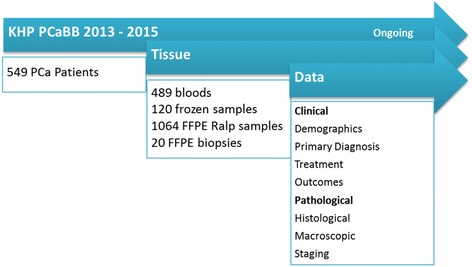
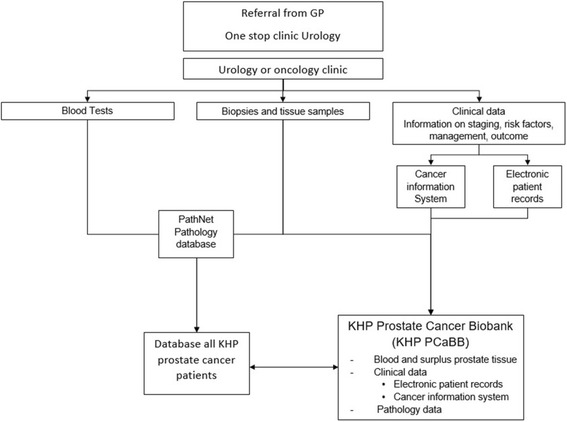
The KHP PCaBB was established in 2013 and recruits donors from the Urology or Oncology Departments at Guy's Hospital in London (UK). Prostate cancer patients may be approached to give their consent for biobanking at any point in their treatment pathway, which allows residual material from their earlier diagnosis to be transferred and used by the Biobank. Currently, patients are specifically asked to donate samples of blood and surplus prostate tissue as well as permitting access to their clinical and pathological data that continues to be added throughout the course of their disease. Between 2013 and 2015, 549 prostate cancer patients gave their consent to the biobank and, the tissue repository collected 489 blood samples, 120 frozen prostate tissue samples and 1064 formalin fixed paraffin embedded diagnostic blocks.Prostate cancer has become a chronic disease in a large proportion of men, with many men receiving multiple subsequent treatments, and their treatment trajectory often spanning over decades. Therefore, this resource aims to provide an ideal research platform to explore potential variations in treatment response as well as disease markers in the different risk categories for prostate cancer.A recent audit of the KHP PCaBB revealed that between 2013 and 2015, 1796 patients were diagnosed with prostate cancer at King's Health Partners (KHP), out of which 549 (30.6%) gave their consent to KHP PCaBB. Comparisons between demographic and clinical characteristics of patients who had consented compared to the total patient population revealed that the KHP PCaBB is demographically representative of the total prostate cancer patient population seen in Guy's and St Thomas' NHS Foundation Trust (GSTT). We observed no differences in distribution of ethnicity (p = 0.507) and socioeconomic status (p = 0.097). Some differences were observed in clinical characteristics, specifically with treatment type - which differed significantly between the patients who had given consent and total patient population.The KHP PCaBB has thereby amassed a rich data and tissue repository that is largely reflective of both the demographic and clinical diversity within the total prostate cancer patient population seen at KHP, making it an ideal platform for prostate cancer research.
KHP PCaBB 于 2013 年成立,招募自伦敦盖伊医院(英国)泌尿科或肿瘤科的捐赠者。前列腺癌患者在其治疗过程中的任何阶段都可以同意将其生物样本库中的剩余材料转移并由生物库使用。目前,患者特别被要求捐献血液和多余的前列腺组织样本,并允许访问他们的临床和病理数据,这些数据在疾病过程中不断增加。2013 年至 2015 年间,549 名前列腺癌患者同意参与生物库,组织库共收集了 489 份血液样本、120 份冷冻前列腺组织样本和 1064 份福尔马林固定石蜡包埋诊断块。前列腺癌在很大一部分男性中已成为一种慢性病,许多男性接受多次后续治疗,其治疗轨迹往往跨越数十年。因此,该资源旨在为探索不同前列腺癌风险类别中的潜在治疗反应和疾病标志物提供理想的研究平台。最近对 KHP PCaBB 的审核显示,2013 年至 2015 年间,King's Health Partners(KHP)诊断出 1796 名前列腺癌患者,其中 549 名(30.6%)同意参与 KHP PCaBB。对已同意的患者与总患者人群的人口统计学和临床特征进行比较后发现,KHP PCaBB 在人口统计学上代表了在 Guy's 和 St Thomas'NHS 基金会信托(GSTT)中看到的总前列腺癌患者人群。我们没有观察到种族(p=0.507)和社会经济地位(p=0.097)分布的差异。在临床特征方面观察到了一些差异,特别是治疗类型-这在已同意的患者和总患者人群之间有显著差异。KHP PCaBB 因此积累了丰富的数据和组织库,在很大程度上反映了 KHP 中总前列腺癌患者人群的人口统计学和临床多样性,使其成为前列腺癌研究的理想平台。