Emerging Pathogens Institute, University of Florida, Gainesville, FL, USA.
Department of Geography, University of Florida, Gainesville, FL, USA.
Malar J. 2017 Nov 22;16(1):479. doi: 10.1186/s12936-017-2121-4.
Quantifying mosquito biting rates for specific locations enables estimation of mosquito-borne disease risk, and can inform intervention efforts. Measuring biting itself is fraught with ethical concerns, so the landing rate of mosquitoes on humans is often used as a proxy measure. Southern coastal Ecuador was historically endemic for malaria (Plasmodium falciparum and Plasmodium vivax), although successful control efforts in the 2000s eliminated autochthonous transmission (since 2011). This study presents an analysis of data collected during the elimination period.
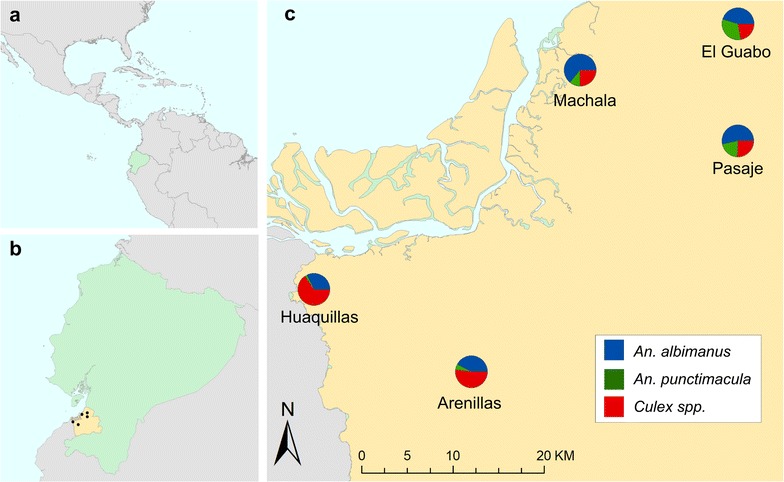
Human landing catch (HLC) data for three mosquito taxa: two malaria vectors, Anopheles albimanus and Anopheles punctimacula, and grouped Culex spp. were examined for this study. These data were collected by the National Vector Control Service of the Ministry of Health over a 5-year time span (2007-2012) in five cities in southern coastal Ecuador, at multiple households, in all months of the year, during dusk-dawn (18:00-6:00) hours, often at both indoor and outdoor locations. Hurdle models were used to determine if biting activity was fundamentally different for the three taxa, and to identify spatial and temporal factors influencing bite rate. Due to the many different approaches to studying and quantifying bite rates in the literature, a glossary of terms was created, to facilitate comparative studies in the future.
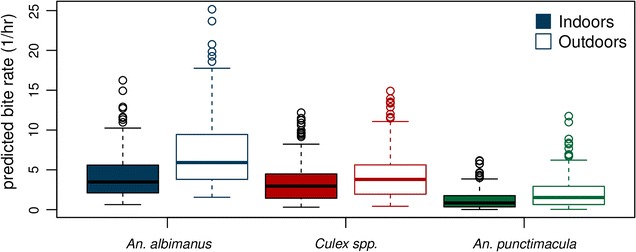
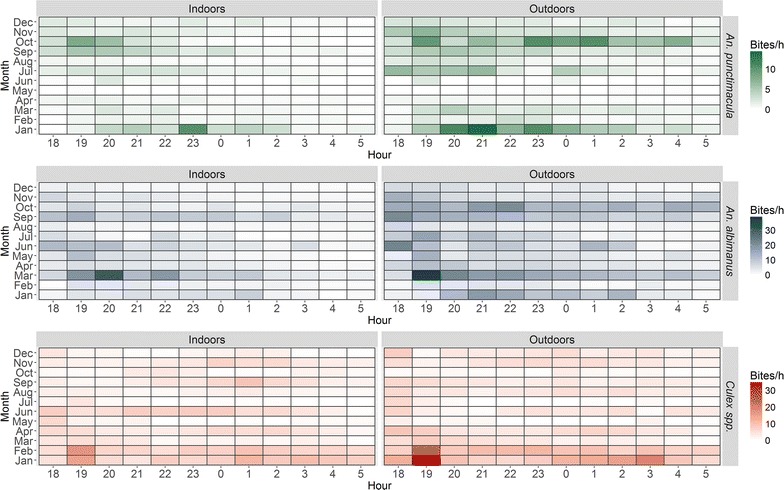
Biting trends varied significantly with species and time. All taxa exhibited exophagic feeding behavior, and outdoor locations increased both the odds and incidence of bites across taxa. Anopheles albimanus was most frequently observed biting, with an average of 4.7 bites/h. The highest and lowest respective months for significant biting activity were March and July for An. albimanus, July and August for An. punctimacula, and February and July for Culex spp.
Fine-scale differences in endophagy and exophagy, and temporal differences among months and hours exist in biting patterns among mosquito taxa in southern coastal Ecuador. This analysis provides detailed information for targeting vector control activities, and household level vector prevention strategies. These data were collected as part of routine vector surveillance conducted by the Ministry of Health, and such data have not been collected since. Reinstating such surveillance measures would provide important information to aid in preventing malaria re-emergence.
量化特定地点的蚊虫叮咬率可以估算蚊虫传播疾病的风险,并为干预措施提供信息。由于存在伦理问题,直接测量蚊虫叮咬本身较为困难,因此通常使用蚊虫在人群中的降落率作为替代指标。厄瓜多尔南部沿海地区曾有疟疾(恶性疟原虫和间日疟原虫)流行,但 21 世纪 00 年代的成功控制措施消除了本地传播(自 2011 年以来)。本研究分析了消除期间收集的数据。
本研究对三种蚊虫进行了人类诱捕法(HLC)数据分析:两种疟疾传播媒介,阿蚊(Anopheles albimanus)和 punctimacula 蚊(Anopheles punctimacula),以及 Culex 蚊属。这些数据是由卫生部国家病媒控制服务机构在厄瓜多尔南部沿海的五个城市收集的,在五年期间(2007-2012 年),在多个家庭中,在一年中的所有月份,在黄昏至黎明(18:00-6:00)时间内,经常在室内和室外地点进行收集。使用障碍模型来确定三种蚊虫的叮咬活动是否存在根本差异,并确定影响叮咬率的空间和时间因素。由于文献中存在许多不同的方法来研究和量化叮咬率,因此创建了术语表,以方便未来的比较研究。
叮咬趋势因物种和时间而异。所有蚊种都表现出外食性摄食行为,室外地点增加了所有蚊种的叮咬几率和发生率。阿蚊最常被观察到叮咬,平均每小时叮咬 4.7 次。有显著叮咬活动的最高和最低月份分别是 3 月和 7 月的阿蚊、7 月和 8 月的 punctimacula 蚊以及 2 月和 7 月的 Culex 蚊属。
厄瓜多尔南部沿海地区蚊种的内食和外食存在细微差异,月份和时间的叮咬模式存在差异。本分析为针对病媒控制活动和家庭层面的病媒预防策略提供了详细信息。这些数据是作为卫生部常规病媒监测收集的一部分,此后未再进行收集。重新实施此类监测措施将提供重要信息,以帮助预防疟疾再次出现。