Orjuela Lorena I, Ahumada Martha L, Avila Ivonni, Herrera Sócrates, Beier John C, Quiñones Martha L
Departamento de Salud Pública, Facultad de Medicina, Universidad Nacional de Colombia, Bogotá, DC, Colombia.
Grupo de Entomología Instituto Nacional de Salud, Bogotá, DC, Colombia.
Malar J. 2015 Jun 24;14:256. doi: 10.1186/s12936-015-0764-6.
Anopheles calderoni was first recognized in Colombia in 2010 as this species had been misidentified as Anopheles punctimacula due to morphological similarities. An. calderoni is considered a malaria vector in Peru and has been found naturally infected with Plasmodium falciparum in Colombia. However, its biting behaviour, population dynamics and epidemiological importance have not been well described for Colombia.
To assess the contribution of An. calderoni to malaria transmission and its human biting behaviour and spatial/temporal distribution in the southwest of Colombia, human landing catches (HLC) and larval collections were carried out in a cross-sectional, entomological study in 22 localities between 2011 and 2012, and a longitudinal study was performed in the Boca de Prieta locality in Olaya Herrera municipality between July 2012 and June 2013. All mosquitoes determined as An. calderoni were tested by ELISA to establish infection with Plasmodium spp.
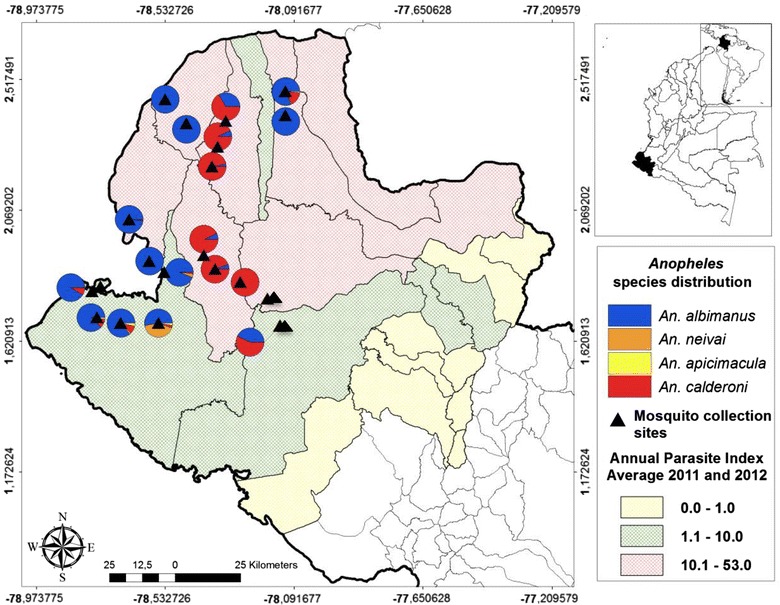
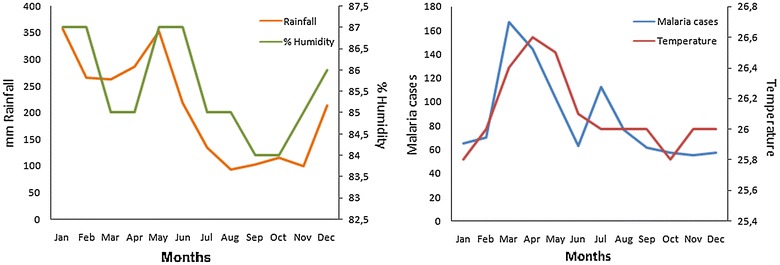
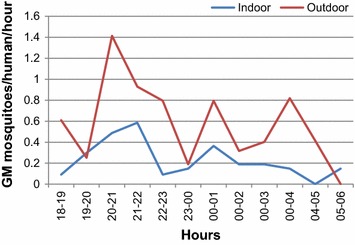
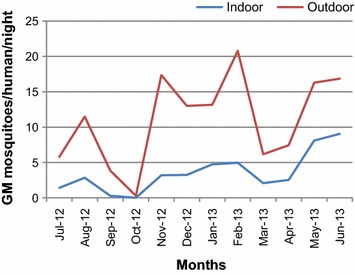
Larvae of An. calderoni were found in four localities in 12 out of 244 breeding sites inspected. An. calderoni adults were collected in 14 out of 22 localities during the cross-sectional study and represented 41.3% (459 of 1,111) of the collected adult specimens. Other species found were Anopheles albimanus (54.7%), Anopheles apicimacula (2.1%), Anopheles neivai (1.7%), and Anopheles argyritarsis (0.2%). In the localities that reported the highest malaria Annual Parasite Index (>10/1,000 inhabitants) during the year of sampling, An. calderoni was the predominant species (>90% of the specimens collected). In the longitudinal study, 1,528 An. calderoni were collected by HLC with highest biting rates in February, May and June 2013, periods of high precipitation. In general, the species showed a preference to bite outdoors (p < 0.001). In Boca de Prieta, two specimens of An. calderoni were ELISA positive for Plasmodium circumsporozoite protein: one for P. falciparum and one for Plasmodium vivax VK-210. This represents an overall sporozoite rate of 0.1% and an annual entomological inoculation rate of 2.84 infective bites/human/year.
This study shows that An. calderoni is a primary malaria vector in the southwest of Colombia. Its observed preference for outdoor biting is a major challenge for malaria control.
2010年在哥伦比亚首次发现了卡尔德龙按蚊,由于形态相似,该物种此前一直被误鉴定为点斑按蚊。卡尔德龙按蚊在秘鲁被认为是疟疾传播媒介,在哥伦比亚也发现其天然感染了恶性疟原虫。然而,在哥伦比亚,其叮咬行为、种群动态和流行病学重要性尚未得到充分描述。
为评估卡尔德龙按蚊对疟疾传播的贡献及其在哥伦比亚西南部的人类叮咬行为和时空分布,于2011年至2012年在22个地点开展了一项横断面昆虫学研究,进行了人饵诱捕(HLC)和幼虫采集,并于2012年7月至2013年6月在奥拉亚埃雷拉市的博卡德普列塔地点进行了一项纵向研究。所有鉴定为卡尔德龙按蚊的蚊子均通过酶联免疫吸附测定(ELISA)检测是否感染疟原虫属。
在检查的244个孳生地中的4个地点发现了卡尔德龙按蚊幼虫。在横断面研究中,22个地点中的14个地点采集到了卡尔德龙按蚊成虫,占所采集成虫标本的41.3%(1111只中的459只)。发现的其他物种有白纹按蚊(54.7%)、尖斑按蚊(2.1%)、内瓦按蚊(1.7%)和银足按蚊(0.2%)。在采样当年报告疟疾年度寄生虫指数最高(>10/1000居民)的地点,卡尔德龙按蚊是优势物种(>所采集标本的90%)。在纵向研究中,通过人饵诱捕共采集到1528只卡尔德龙按蚊,2013年2月、5月和6月降雨量大时叮咬率最高。总体而言,该物种表现出偏好户外叮咬的习性(p<0.001)。在博卡德普列塔,有两只卡尔德龙按蚊标本的疟原虫环子孢子蛋白ELISA检测呈阳性:一只感染恶性疟原虫,一只感染间日疟原虫VK-210。这代表总体子孢子率为0.1%,年度昆虫学接种率为2.84次感染性叮咬/人/年。
本研究表明,卡尔德龙按蚊是哥伦比亚西南部的主要疟疾传播媒介。观察到的其对户外叮咬的偏好对疟疾控制是一项重大挑战。