Verguet Stéphane, Tarr Gillian, Gauvreau Cindy L, Mishra Sujata, Jha Prabhat, Liu Lingrui, Xiao Yue, Qiu Yingpeng, Zhao Kun
Department of Global Health and Population, Harvard T.H. Chan School of Public Health, Boston, Massachusetts, USA.
Department of Epidemiology, University of Washington, Seattle, Washington, USA.
J Glob Health. 2017 Dec;7(2):020701. doi: 10.7189/jogh.07.020701.
Tobacco taxation and smoke-free workplaces reduce smoking, tobacco-related premature deaths and associated out-of-pocket health care expenditures. We examine the distributional consequences of a price increase in tobacco products through an excise tax hike, and of an implementation of smoke-free workplaces, in China.
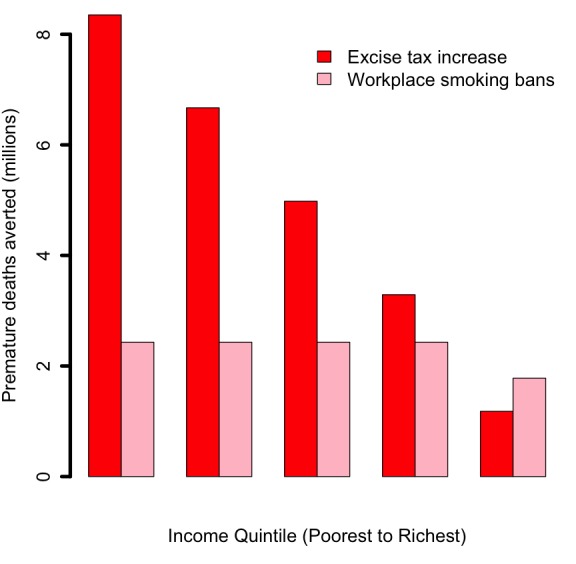
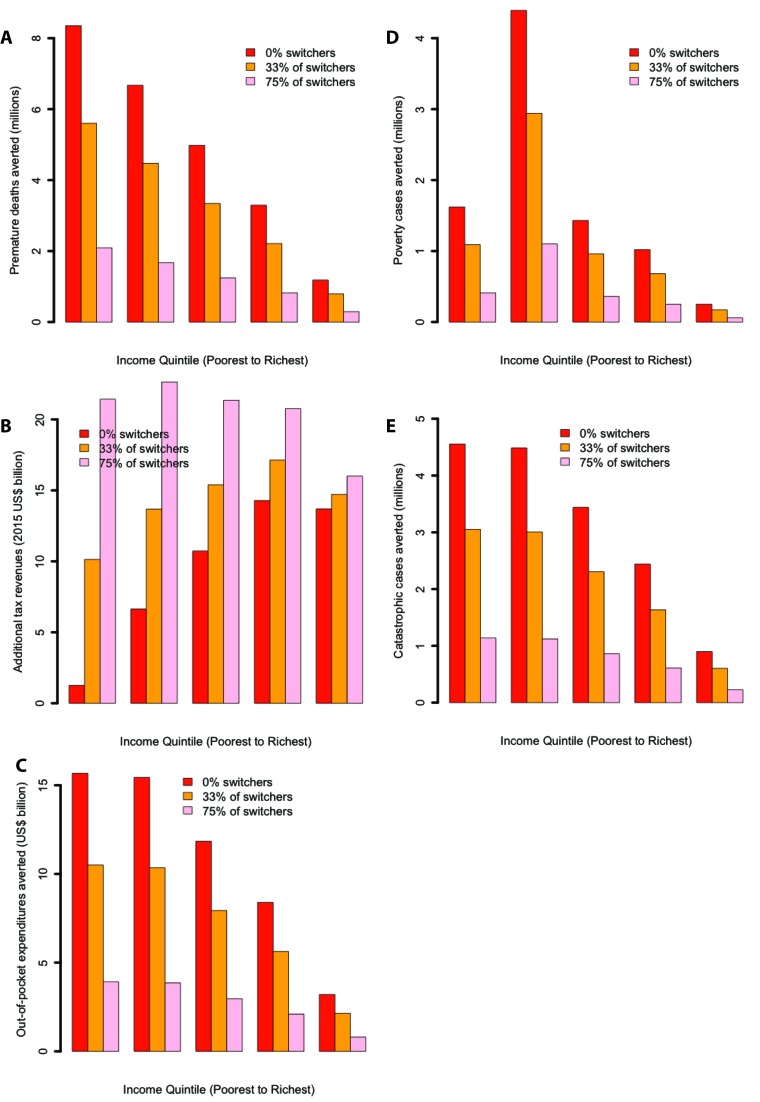
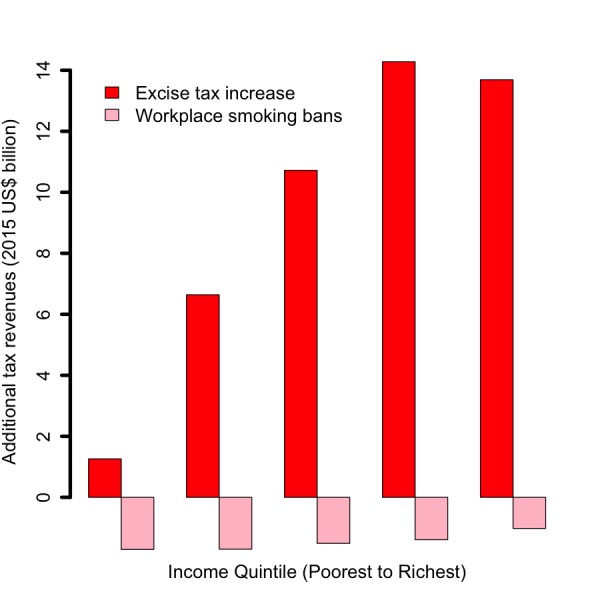
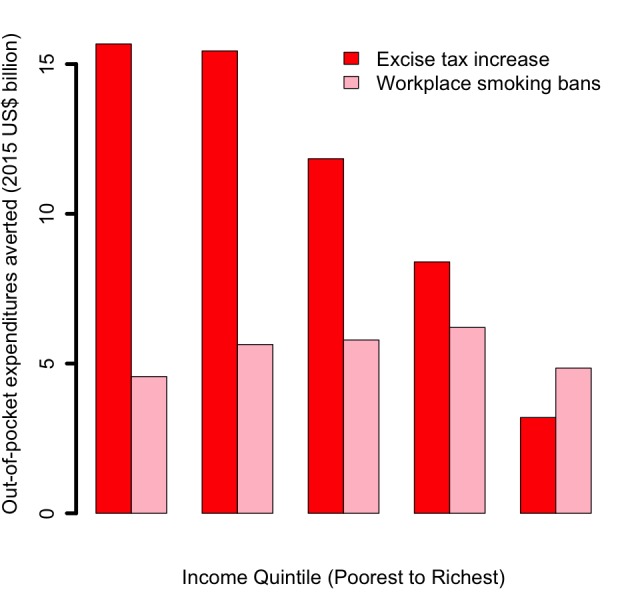
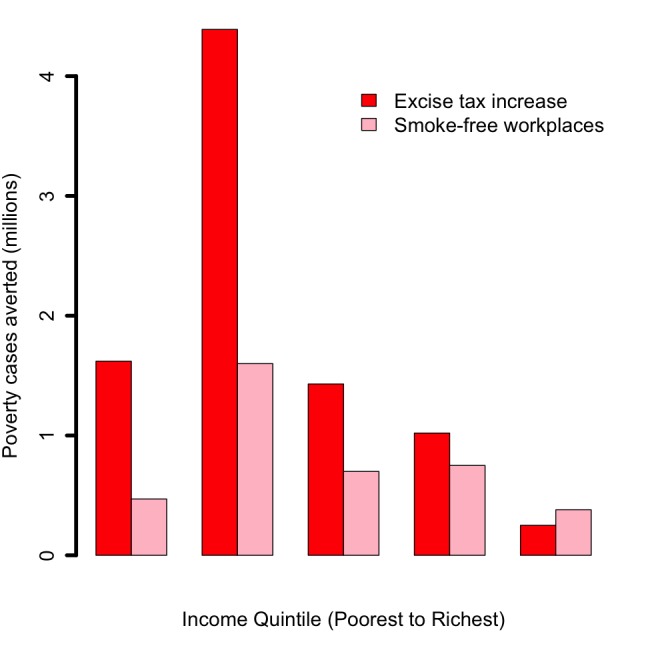
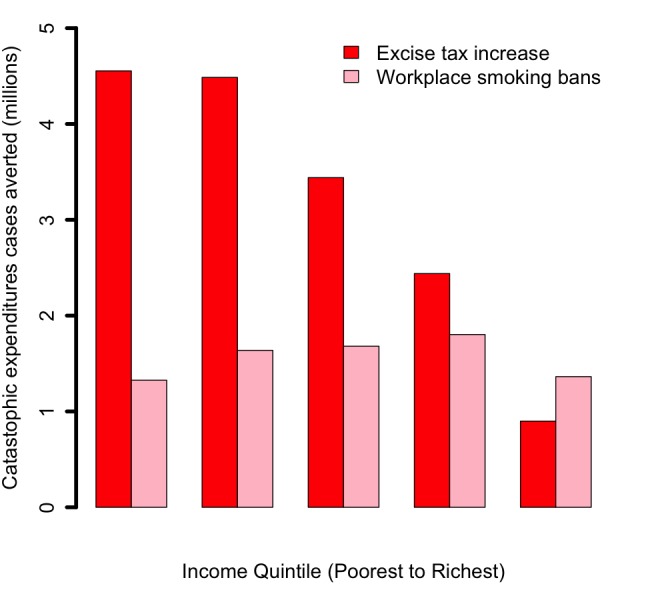
We use extended cost-effectiveness analysis (ECEA) to evaluate, across income quintiles of the male population (the large majority of Chinese smokers), the premature deaths averted, the change in tax revenues generated, and the financial risk protection procured (eg, poverty cases averted, defined as the number of individuals no longer facing tobacco-related out-of-pocket expenditures for disease treatment, that would otherwise impoverish them), that would follow a 75% increase in cigarette prices through substantial increments in excise tax fully passed onto consumers, and a nationwide total implementation of workplace smoking bans.
A 75% increase in cigarette prices would avert about 24 million premature deaths among the current Chinese male population, with a third among the bottom income quintile, increase additional tax revenues by US$ 46 billion annually, and prevent around 9 million poverty cases, 19% of which among the bottom income quintile. Implementation of smoking bans in workplaces would avert about 12 million premature deaths, with a fifth among the bottom income quintile, decrease tax revenues by US$ 7 billion annually, and prevent around 4 million poverty cases, 12% of which among the bottom income quintile.
Increased excise taxes on tobacco products and workplace smoking bans can procure large health and economic benefits to the Chinese population, especially among the poor.
烟草税和无烟工作场所可减少吸烟、与烟草相关的过早死亡以及相关的自付医疗保健支出。我们研究了在中国通过提高消费税导致烟草产品价格上涨以及实施无烟工作场所所产生的分配后果。
我们使用扩展成本效益分析(ECEA),针对男性人口(中国吸烟者的绝大多数)的收入五分位数,评估通过将消费税大幅提高并完全转嫁给消费者使香烟价格上涨75%以及在全国范围内全面实施工作场所禁烟后,可避免的过早死亡、产生的税收收入变化以及获得的财务风险保护(例如,避免的贫困案例,定义为不再面临与烟草相关的疾病治疗自付费用否则会使其陷入贫困的个体数量)。
香烟价格上涨75%将避免当前中国男性人口中约2400万例过早死亡,其中三分之一发生在收入最低的五分位数人群中,每年增加额外税收收入460亿美元,并预防约900万例贫困案例,其中19%发生在收入最低的五分位数人群中。在工作场所实施禁烟将避免约1200万例过早死亡,其中五分之一发生在收入最低的五分位数人群中,每年减少税收收入70亿美元,并预防约400万例贫困案例,其中12%发生在收入最低的五分位数人群中。
提高烟草产品消费税和实施工作场所禁烟可为中国人口,尤其是贫困人口带来巨大的健康和经济效益。