Janežič Ana, Locatelli Igor, Kos Mitja
Chair of Social Pharmacy, Faculty of Pharmacy, University of Ljubljana, Ljubljana, Slovenia, EU.
PLoS One. 2017 Nov 30;12(11):e0187835. doi: 10.1371/journal.pone.0187835. eCollection 2017.
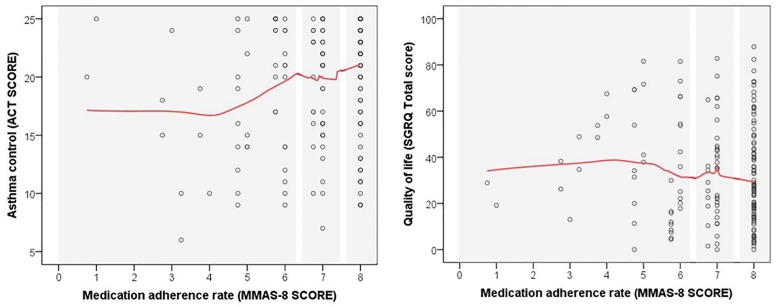
The 8-item Morisky Medication Adherence Scale (MMAS-8) is reliable and valid in patients with hypertension, but to our knowledge validity has not been established for patients with asthma. The aim of the study was to determine the criterion validity of the MMAS-8 in patients with asthma. In the cross-sectional study patients older than 12 year were recruited when dispensed asthma medications in community pharmacies. Criterion validity of the scale was assessed through associations with asthma control and quality of life. Asthma control was assessed by the Asthma Control Test (ACT) and quality of life was evaluated by the Saint George Respiratory Questionnaire (SGRQ). A total of 208 patients (mean age 56 years, 59% female) were included in the study. Almost all patients were prescribed inhaled corticosteroids (96%). Asthma was not controlled in 37% of the patients and 22% experienced at least one exacerbation requiring emergency room visit, hospitalization or treatment with oral corticosteroid therapy in the previous year. The 8-item MMAS was significantly associated with asthma control and quality of life. Patients who scored 8 points, <8 to >6 points and ≤6 points on the scale were considered to have high, medium and low adherence, respectively. High, medium and low adherence was found in 53%, 23% and 24% of the patients, respectively. As adherence improved from low to medium or from medium to high, the odds of asthma control increased by 1.7 times (OR 1.65, p = 0.027). Patients with high and medium adherence had SGRQ scores that were 6.1 and 5.3 points lower, respectively, compared with patients with low adherence. The MMAS-8 was found to be valid for assessing medication adherence and predicting health outcomes in patients with asthma.
8项版的莫利斯基药物依从性量表(MMAS-8)在高血压患者中具有可靠性和有效性,但据我们所知,其在哮喘患者中的有效性尚未得到证实。本研究的目的是确定MMAS-8在哮喘患者中的效标效度。在这项横断面研究中,年龄超过12岁的患者在社区药房领取哮喘药物时被招募。通过与哮喘控制和生活质量的相关性来评估该量表的效标效度。哮喘控制情况通过哮喘控制测试(ACT)进行评估,生活质量通过圣乔治呼吸问卷(SGRQ)进行评估。共有208名患者(平均年龄56岁,59%为女性)纳入研究。几乎所有患者都被处方吸入性糖皮质激素(96%)。37%的患者哮喘未得到控制,22%的患者在上一年至少经历过一次需要急诊就诊、住院或接受口服糖皮质激素治疗的加重发作。8项版的MMAS与哮喘控制和生活质量显著相关。在该量表上得分8分、<8至>6分和≤6分的患者分别被认为具有高、中、低依从性。高、中、低依从性的患者分别占53%、23%和24%。随着依从性从低提高到中或从中提高到高,哮喘得到控制的几率增加1.7倍(OR 1.65,p = 0.027)。与低依从性患者相比,高依从性和中等依从性患者的SGRQ得分分别低6.1分和5.3分。研究发现,MMAS-8在评估哮喘患者的药物依从性和预测健康结局方面是有效的。