Ushiyama Naoko, Kurobe Yasushi, Momose Kimito
Department of Rehabilitation, Fujimi Kogen Medical Center: 1100 Ochiai, Fujimi town, Nagano 399-0214, Japan.
Department of Health Sciences, Graduate School of Medicine, Shinshu University, Japan.
J Phys Ther Sci. 2017 Nov;29(11):1987-1992. doi: 10.1589/jpts.29.1987. Epub 2017 Nov 24.
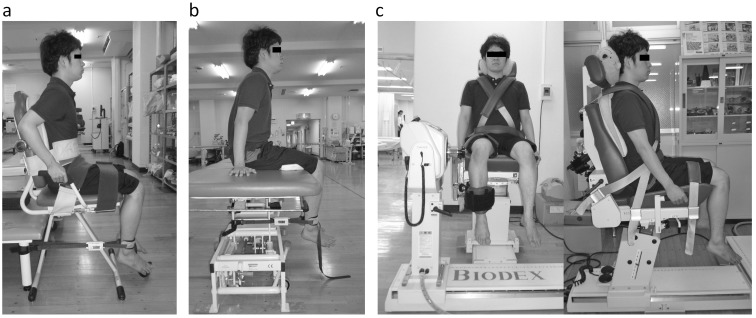
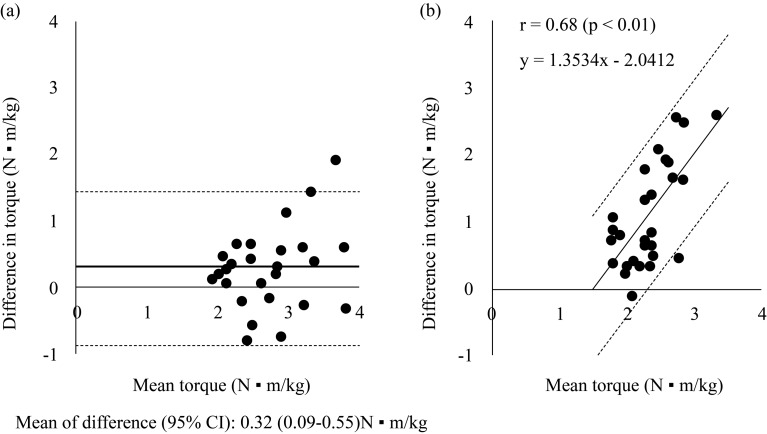
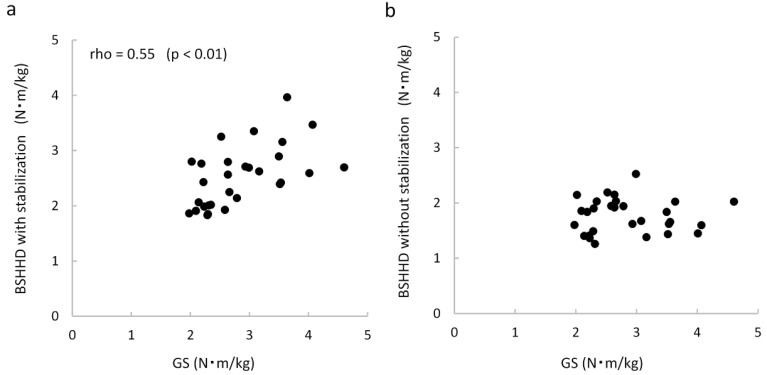
[Purpose] To determine the validity of knee extension muscle strength measurements using belt-stabilized hand-held dynamometry with and without body stabilization compared with the gold standard isokinetic dynamometry in healthy adults. [Subjects and Methods] Twenty-nine healthy adults (mean age, 21.3 years) were included. Study parameters involved right side measurements of maximal isometric knee extension strength obtained using belt-stabilized hand-held dynamometry with and without body stabilization and the gold standard. Measurements were performed in all subjects. [Results] A moderate correlation and fixed bias were found between measurements obtained using belt-stabilized hand-held dynamometry with body stabilization and the gold standard. No significant correlation and proportional bias were found between measurements obtained using belt-stabilized hand-held dynamometry without body stabilization and the gold standard. The strength identified using belt-stabilized hand-held dynamometry with body stabilization may not be commensurate with the maximum strength individuals can generate; however, it reflects such strength. In contrast, the strength identified using belt-stabilized hand-held dynamometry without body stabilization does not reflect the maximum strength. Therefore, a chair should be used to stabilize the body when performing measurements of maximal isometric knee extension strength using belt-stabilized hand-held dynamometry in healthy adults. [Conclusion] Belt-stabilized hand-held dynamometry with body stabilization is more convenient than the gold standard in clinical settings.
[目的] 与金标准等速肌力测试法相比,确定在健康成年人中使用带稳定装置的手持测力计,在有或没有身体稳定支撑的情况下测量膝关节伸展肌力的有效性。[对象与方法] 纳入29名健康成年人(平均年龄21.3岁)。研究参数包括使用带稳定装置的手持测力计,在有和没有身体稳定支撑的情况下以及金标准测试法测量右侧最大等长膝关节伸展肌力。对所有受试者进行测量。[结果] 使用带身体稳定支撑的带稳定装置的手持测力计测量结果与金标准之间存在中度相关性和固定偏差。使用无身体稳定支撑的带稳定装置的手持测力计测量结果与金标准之间未发现显著相关性和比例偏差。使用带身体稳定支撑的带稳定装置的手持测力计确定的肌力可能与个体能够产生的最大肌力不相称;然而,它反映了这种力量。相比之下,使用无身体稳定支撑的带稳定装置的手持测力计确定的肌力并不能反映最大肌力。因此,在健康成年人中使用带稳定装置的手持测力计测量最大等长膝关节伸展肌力时,应使用椅子来稳定身体。[结论] 在临床环境中,带身体稳定支撑的带稳定装置的手持测力计比金标准更方便。