Soares Juliana Mikaelly Dias, Pereira Leal Ana Ediléia Barbosa, Silva Juliane Cabral, Almeida Jackson R G S, de Oliveira Helinando Pequeno
Federal University of Sao Francisco Valley, PE, Brazil.
Department of Physiology, Federal University of Sergipe, São Cristóvão, SE, Brazil.
Pharmacogn Mag. 2017 Oct-Dec;13(52):639-646. doi: 10.4103/pm.pm_87_17. Epub 2017 Nov 13.
The development of alternatives for insulin secretion control or represents an important aspect to be investigated. In this direction, natural products have been progressively explored with this aim. In particular, flavonoids are potential candidates to act as insulin secretagogue.
To study the influence of flavonoid on overall modulation mechanisms of insulin secretion.
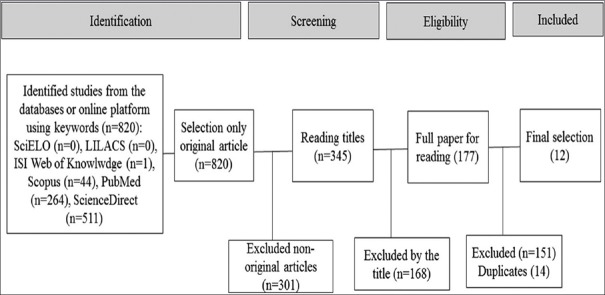
The research was conducted in the following databases and platforms: PubMed, Scopus, ISI Web of Knowledge, SciELO, LILACS, and ScienceDirect, and the MeSH terms used for the search were flavonoids, flavones, islets of Langerhans, and insulin-secreting cells.
Twelve articles were included and represent the basis of discussion on mechanisms of insulin secretion of flavonoids. Papers in ISI Web of Knowledge were in number of 1, Scopus 44, PubMed 264, ScienceDirect 511, and no papers from LILACS and SciELO databases.
According to the literature, the majority of flavonoid subclasses can modulate insulin secretion through several pathways, in an indication that corresponding molecule is a potential candidate for active materials to be applied in the treatment of diabetes.
The action of natural products on insulin secretion represents an important investigation topic due to their importance in the diabetes controlIn addition to their typical antioxidant properties, flavonoids contribute to the insulin secretionThe modulation of insulin secretion is induced by flavonoids according to different mechanisms. K channels: ATP-sensitive K channels, GLUT4: Glucose transporter 4, ERK1/2: Extracellular signal-regulated protein kinases 1 and 2, L-VDCCs: L-type voltage-dependent Ca channels, GLUT1: Glucose transporter 1, AMPK: Adenosine monophosphate-activated protein kinase, PTP1B: Protein tyrosine phosphatase 1B, GLUT2: Glucose transporter 2, cAMP: Cyclic adenosine monophosphate, PKA: Protein kinase A, PTK: Protein tyrosine kinase, CaMK II: Ca/calmodulin-dependent protein kinase II, GSIS: Glucose-stimulated insulin secretion, Insig-1: Insulin-induced gene 1, IRS-2: Insulin receptor substrate 2, PDX-1: Pancreatic and duodenal homeobox 1, SREBP-1c: Sterol regulatory element binding protein-1c, DMC: Dihydroxy-6'-methoxy-3',5'-dimethylchalcone, GLP-1: Glucagon-like peptide-1, GLP-1R: Glucagon-like peptide 1 receptor.
开发胰岛素分泌控制的替代方法是一个需要研究的重要方面。在这一方向上,人们逐渐探索天然产物以实现这一目标。特别是,黄酮类化合物是潜在的胰岛素促分泌剂。
研究黄酮类化合物对胰岛素分泌整体调节机制的影响。
研究在以下数据库和平台进行:PubMed、Scopus、ISI 科学网、SciELO、LILACS 和 ScienceDirect,搜索所用的医学主题词为黄酮类化合物、黄酮、胰岛和胰岛素分泌细胞。
纳入了 12 篇文章,这些文章是关于黄酮类化合物胰岛素分泌机制讨论的基础。ISI 科学网有 1 篇论文,Scopus 有 44 篇,PubMed 有 264 篇,ScienceDirect 有 511 篇,LILACS 和 SciELO 数据库没有论文。
根据文献,大多数黄酮类亚类可通过多种途径调节胰岛素分泌,这表明相应分子是用于糖尿病治疗的活性物质的潜在候选物。
天然产物对胰岛素分泌的作用是一个重要的研究课题,因为它们在糖尿病控制中具有重要意义。除了其典型的抗氧化特性外,黄酮类化合物有助于胰岛素分泌。黄酮类化合物根据不同机制诱导胰岛素分泌的调节。K 通道:ATP 敏感性钾通道,GLUT4:葡萄糖转运蛋白 4,ERK1/2:细胞外信号调节蛋白激酶 1 和 2,L-VDCCs:L 型电压依赖性钙通道,GLUT1:葡萄糖转运蛋白 1,AMPK:腺苷单磷酸激活蛋白激酶,PTP1B:蛋白酪氨酸磷酸酶 1B,GLUT2:葡萄糖转运蛋白 2,cAMP:环磷酸腺苷,PKA:蛋白激酶 A,PTK:蛋白酪氨酸激酶,CaMK II:钙/钙调蛋白依赖性蛋白激酶 II,GSIS:葡萄糖刺激的胰岛素分泌,Insig-1:胰岛素诱导基因 1,IRS-2:胰岛素受体底物 2,PDX-1:胰腺和十二指肠同源盒 1,SREBP-1c:固醇调节元件结合蛋白-1c,DMC:二羟基-6'-甲氧基-3',5'-二甲基查耳酮,GLP-1:胰高血糖素样肽-1,GLP-1R:胰高血糖素样肽 1 受体。