Taviano Maria Fernanda, Melchini Antonietta, Filocamo Angela, Costa Chiara, Catania Stefania, Raciti Roberto, Saha Shikha, Needs Paul, Bisignano Giuseppe Giovanni, Miceli Natalizia
Department of Scienze Chimiche, Biologiche, Farmaceutiche ed Ambientali, University of Messina, Messina, Italy.
Institute of Food Research, Norwich NR4 7UA, UK.
Pharmacogn Mag. 2017 Oct-Dec;13(52):738-743. doi: 10.4103/pm.pm_245_16. Epub 2017 Nov 13.
Mill. (Brassicaceae) is commonly utilized as an ingredient in salads and also as a folk remedy to treat various diseases.
The objective of this study was to establish the contribution of the glucosinolate (GLS) fraction to the overall antioxidant, cytoprotection against oxidative insult and antimicrobial properties of the hydro-alcoholic extract of leaves from Sicily (Italy), characterized phytochemically.
The antioxidant activity was evaluated by different systems. The cytoprotective effect against hydrogen peroxide (HO)-induced oxidative stress was tested in human peripheral blood mononuclear cells (PBMCs). The antimicrobial potential against bacteria and fungi was assayed by standard methods.
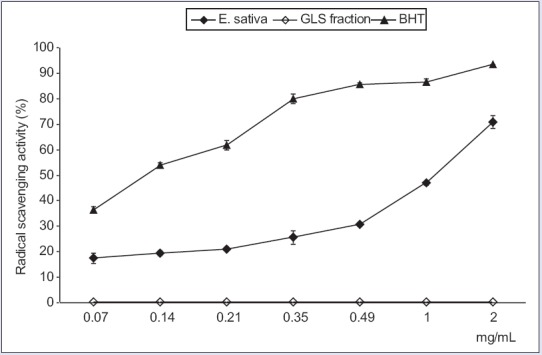
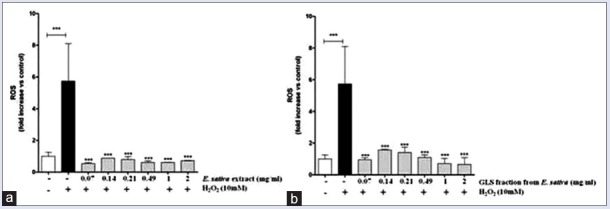
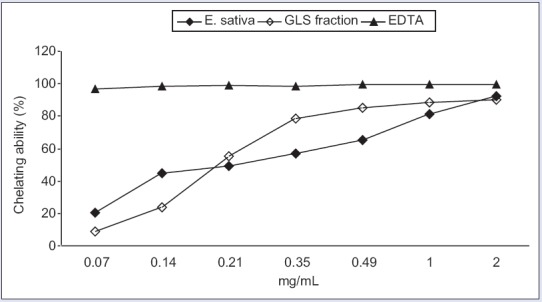
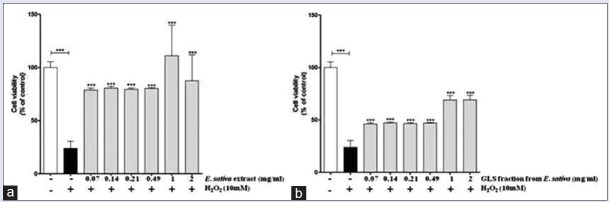
extract exhibited both radical scavenging (50% inhibitory concentration [IC] 1.04 ± 0.04 mg/mL) and ferrous ions-chelating activity (IC 0.327 ± 0.0032 mg/mL) and mild reducing power; the GLS fraction showed chelating ability only (IC 0.225 ± 0.009 mg/mL). In the experimental model of HO-induced oxidative stress in human PBMCs, a significant cytoprotective effect and a suppression of reactive oxygen species production by both extract and GLS fraction were observed ( < 0.001). extract displayed moderate antimicrobial activity against Gram-positive bacteria, and was the most sensitive strain (minimum inhibitory concentration 0.125 mg/mL), whereas the GLS fraction was not active.
GLSs are not involved in the primary antioxidant activity of leaf extract but they are, almost in part, responsible for its ferrous ion-chelating properties. Iron-chelating compounds in extract may protect cells under conditions of oxidative stress, and GLSs might play a chief role in this effect.
Mill. leaf extract exhibited antioxidant activity in different systems, whereas the glucosinolate (GLS) fraction showed Fe-chelating ability onlyA significant cytoprotective effect and a suppression of intracellular reactive oxygen species production by both extract and GLS fraction were observed in human peripheral blood mononuclear cells extract displayed moderate antimicrobial activity against Gram-positive bacteria, whereas the GLS fraction was not active. GLS: Glucosinolate; HO: Hydrogen peroxide; PBMCs: Peripheral blood mononuclear cells; IC: 50% inhibitory concentration; MIC: Minimum inhibitory concentration.
十字花科的[植物名称未给出,原文Mill. (Brassicaceae)有误,推测可能是某种十字花科植物]常用于制作沙拉,也是治疗多种疾病的民间药物。
本研究旨在确定硫代葡萄糖苷(GLS)部分对来自意大利西西里岛的[植物名称未给出,原文Mill. (Brassicaceae)有误,推测可能是某种十字花科植物]叶水醇提取物的整体抗氧化、抗氧化损伤细胞保护及抗菌特性的贡献,并对其进行植物化学特征分析。
通过不同体系评估抗氧化活性。在人外周血单核细胞(PBMCs)中测试对过氧化氢(H₂O₂)诱导的氧化应激的细胞保护作用。采用标准方法测定对细菌和真菌的抗菌潜力。
提取物表现出自由基清除能力(半数抑制浓度[IC₅₀]为1.04±0.04mg/mL)和亚铁离子螯合活性(IC₅₀为0.327±0.0032mg/mL)以及温和的还原能力;GLS部分仅表现出螯合能力(IC₅₀为0.225±0.009mg/mL)。在人PBMCs中H₂O₂诱导的氧化应激实验模型中,观察到提取物和GLS部分均具有显著的细胞保护作用并抑制活性氧生成(P<0.001)。提取物对革兰氏阳性菌显示出中等抗菌活性,[细菌名称未给出,原文有误,推测可能是某种细菌]是最敏感菌株(最低抑菌浓度为0.125mg/mL),而GLS部分无活性。
GLS不参与[植物名称未给出,原文Mill. (Brassicaceae)有误,推测可能是某种十字花科植物]叶提取物的主要抗氧化活性,但几乎部分地负责其亚铁离子螯合特性。[植物名称未给出,原文Mill. (Brassicaceae)有误,推测可能是某种十字花科植物]提取物中的铁螯合化合物可能在氧化应激条件下保护细胞,且GLS可能在这种作用中起主要作用。
[植物名称未给出,原文Mill. (Brassicaceae)有误,推测可能是某种十字花科植物]叶提取物在不同体系中表现出抗氧化活性,而硫代葡萄糖苷(GLS)部分仅表现出铁螯合能力。在人外周血单核细胞中观察到提取物和GLS部分均具有显著的细胞保护作用并抑制细胞内活性氧生成。提取物对革兰氏阳性菌显示出中等抗菌活性,而GLS部分无活性。(GLS:硫代葡萄糖苷;H₂O₂:过氧化氢;PBMCs:外周血单核细胞;IC₅₀:半数抑制浓度;MIC:最低抑菌浓度)