Usman Abdulmumini, Ball Jacob D, Rojas Diana Patricia, Berhane Araia, Ghebrat Yohannes, Mebrahtu Goitom, Gebresellasie Azmera, Zehaie Assefash, Mufunda Jacob, Liseth Olivia, Haque Ubydul, Chanda Emmanuel
WHO Eritrea Country Office, Asmara, Eritrea.
Department of Epidemiology, University of Florida, Gainesville, FL USA.
Glob Health Res Policy. 2016 Oct 27;1:17. doi: 10.1186/s41256-016-0016-5. eCollection 2016.
The geographic distribution and burden of dengue is increasing globally. This study aims to evaluate dengue outbreaks and to substantiate the need for strengthened surveillance, reporting and control in Eritrea.
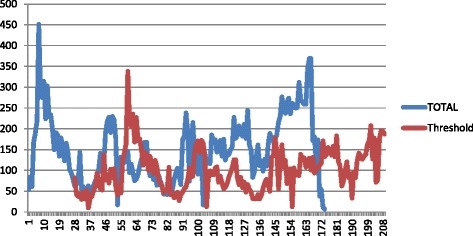
Data from two cross-sectional dengue epidemic investigations in 2005 and 2010 were analyzed. Samples were tested for dengue virus-specific IgM and IgG antibodies using capture enzyme-linked immunosorbent assays. Dengue vectors' breeding attributes were characterized and epidemic risk indices determined. National routine surveillance weekly reports from 2005 to the second quarter of 2015 were analyzed for spatiotemporal trends.
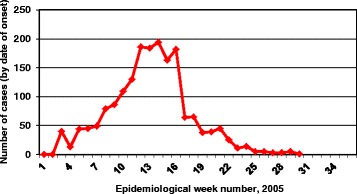
Dengue outbreaks increased in Eritrea from 2005 to 2015 with clinical presentation varying markedly among patients. The house and container indices for were 40 and 39.6 % respectively, with containers having varying significantly ( < 0.04). Serum from 33.3 % ( = 15) and 88 % ( = 26) of clinical dengue cases in Aroget sub-Zoba (district) of Gash Barka Zoba (region) contained anti-DENV IgM antibody in 2005 and 2006, respectively. The national surveillance data from 2005 to 2015 indicate an overall spatiotemporal increase of dengue fever.
The increase in dengue outbreaks has been confirmed in Eritrea and necessitates strengthening of surveillance and health worker and laboratory capacity, as well as targeted vector control interventions.
登革热的地理分布范围和负担在全球范围内不断增加。本研究旨在评估厄立特里亚的登革热疫情,并证实加强监测、报告和控制的必要性。
分析了2005年和2010年两次横断面登革热疫情调查的数据。使用捕获酶联免疫吸附测定法检测样本中的登革热病毒特异性IgM和IgG抗体。对登革热媒介的繁殖特性进行了表征,并确定了疫情风险指数。分析了2005年至2015年第二季度的国家常规监测周报的时空趋势。
2005年至2015年,厄立特里亚的登革热疫情有所增加,患者的临床表现差异显著。房屋指数和容器指数分别为40%和39.6%,不同容器的指数差异显著(P<0.04)。2005年和2006年,加什-巴尔卡区阿罗盖特分区临床登革热病例的血清中,分别有33.3%(n=15)和88%(n=26)含有抗登革病毒IgM抗体。2005年至2015年的国家监测数据表明,登革热发热总体呈时空增加趋势。
厄立特里亚登革热疫情的增加已得到证实,有必要加强监测、提高卫生工作者和实验室能力,以及实施有针对性的病媒控制干预措施。