Choudhary Moaz M, France Thomas J, Teknos Theodoros N, Kumar Pawan
Department of Otolaryngology-Head and Neck Surgery and Comprehensive Cancer Center, The Ohio State University, Columbus, OH 43210, USA.
World J Otorhinolaryngol Head Neck Surg. 2016 Jul 20;2(2):90-97. doi: 10.1016/j.wjorl.2016.05.002. eCollection 2016 Jun.
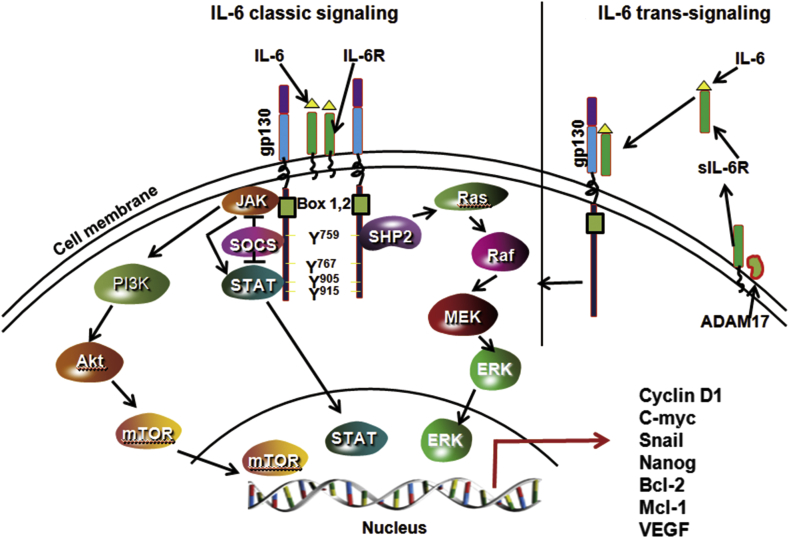
Interleukin-6 (IL-6) is a pleiotropic cytokine which plays an important role in a number of cellular processes including proliferation, survival, differentiation, migration and invasion. IL-6 mediates its downstream effects by activating a number of signaling cascades including JAK/STAT, PI3K/AKT and MAPK pathways. In addition to its effects on tumor cells, IL-6 also regulates tumor progression and tumor metastasis by modulating tumor angiogenesis and tumor lymphangiogenesis. A number of studies have shown that IL-6 levels are markedly upregulated in cancer patients. We and others have shown that high IL-6 expression independently predicts tumor recurrence, tumor metastasis and poor survival in head and neck cancer patients. Therefore targeting IL-6 signaling is a potential therapeutic strategy for the treatment of head and neck squamous cell carcinoma (HNSCC). In this review, we discuss the current understanding of the role of IL-6 in HNSCC progression and potential therapeutic strategies to target IL-6 signaling for the treatment of head and neck cancer patients.
白细胞介素-6(IL-6)是一种多效性细胞因子,在包括增殖、存活、分化、迁移和侵袭在内的许多细胞过程中发挥重要作用。IL-6通过激活包括JAK/STAT、PI3K/AKT和MAPK途径在内的多种信号级联反应来介导其下游效应。除了对肿瘤细胞的作用外,IL-6还通过调节肿瘤血管生成和肿瘤淋巴管生成来调节肿瘤进展和肿瘤转移。多项研究表明,癌症患者体内的IL-6水平明显上调。我们和其他人已经表明,高IL-6表达独立预测头颈癌患者的肿瘤复发、肿瘤转移和不良生存。因此,靶向IL-6信号传导是治疗头颈部鳞状细胞癌(HNSCC)的一种潜在治疗策略。在这篇综述中,我们讨论了目前对IL-6在HNSCC进展中的作用的理解,以及针对IL-6信号传导治疗头颈癌患者的潜在治疗策略。