Department of Biological Engineering, Massachusetts Institute of Technology, Cambridge, MA, 02139, USA.
Center for Microbiome Informatics and Therapeutics, Massachusetts Institute of Technology, Cambridge, MA, 02139, USA.
Nat Commun. 2017 Dec 5;8(1):1784. doi: 10.1038/s41467-017-01973-8.
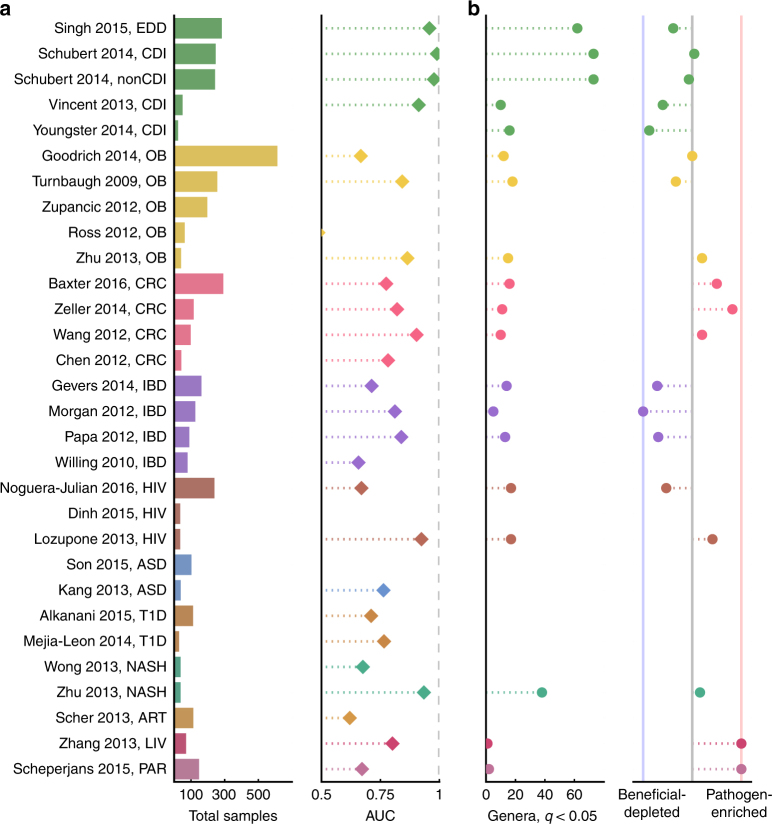
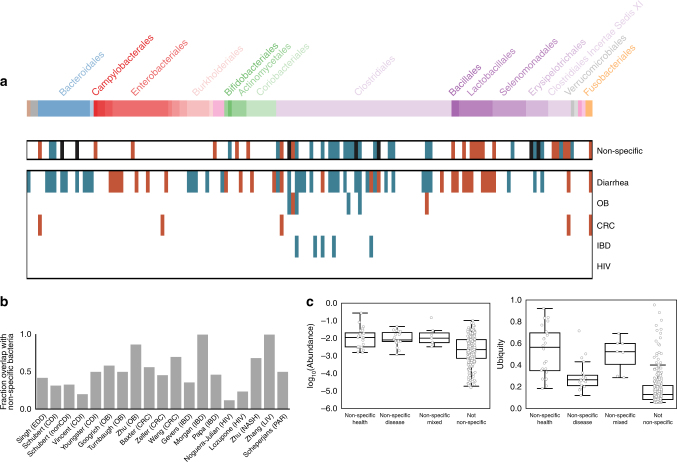
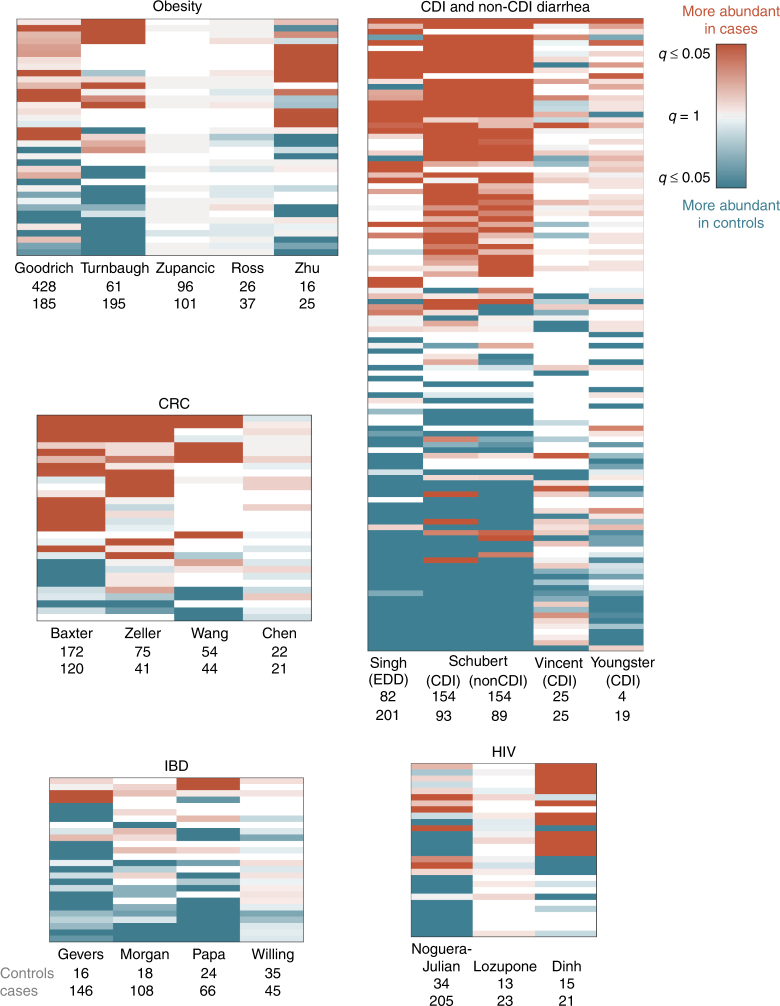
Hundreds of clinical studies have demonstrated associations between the human microbiome and disease, yet fundamental questions remain on how we can generalize this knowledge. Results from individual studies can be inconsistent, and comparing published data is further complicated by a lack of standard processing and analysis methods. Here we introduce the MicrobiomeHD database, which includes 28 published case-control gut microbiome studies spanning ten diseases. We perform a cross-disease meta-analysis of these studies using standardized methods. We find consistent patterns characterizing disease-associated microbiome changes. Some diseases are associated with over 50 genera, while most show only 10-15 genus-level changes. Some diseases are marked by the presence of potentially pathogenic microbes, whereas others are characterized by a depletion of health-associated bacteria. Furthermore, we show that about half of genera associated with individual studies are bacteria that respond to more than one disease. Thus, many associations found in case-control studies are likely not disease-specific but rather part of a non-specific, shared response to health and disease.
数百项临床研究表明了人类微生物组与疾病之间的关联,但我们仍不清楚如何将这些知识推广。个别研究的结果可能不一致,而且由于缺乏标准的处理和分析方法,比较已发表的数据更加复杂。在这里,我们介绍 MicrobiomeHD 数据库,其中包含 28 项已发表的关于十种疾病的病例对照肠道微生物组研究。我们使用标准化方法对这些研究进行跨疾病荟萃分析。我们发现了一些特征性的疾病相关微生物组变化模式。一些疾病与 50 多种属有关,而大多数疾病仅显示 10-15 种属水平的变化。一些疾病与潜在致病性微生物的存在有关,而另一些疾病则与健康相关细菌的消耗有关。此外,我们还表明,与个别研究相关的大约一半的属是对一种以上疾病有反应的细菌。因此,在病例对照研究中发现的许多关联可能不是疾病特异性的,而是对健康和疾病的非特异性、共同反应的一部分。