Osorio-Guarín Jaime A, Berdugo-Cely Jhon, Coronado Roberto Antonio, Zapata Yeny Patricia, Quintero Constanza, Gallego-Sánchez Gerardo, Yockteng Roxana
Centro de Investigación Tibaitatá, Corporación Colombiana de Investigación Agropecuaria - Corpoica, Cundinamarca, Colombia.
International Center for Tropical Agriculture, Palmira, Colombia.
Front Plant Sci. 2017 Nov 21;8:1994. doi: 10.3389/fpls.2017.01994. eCollection 2017.
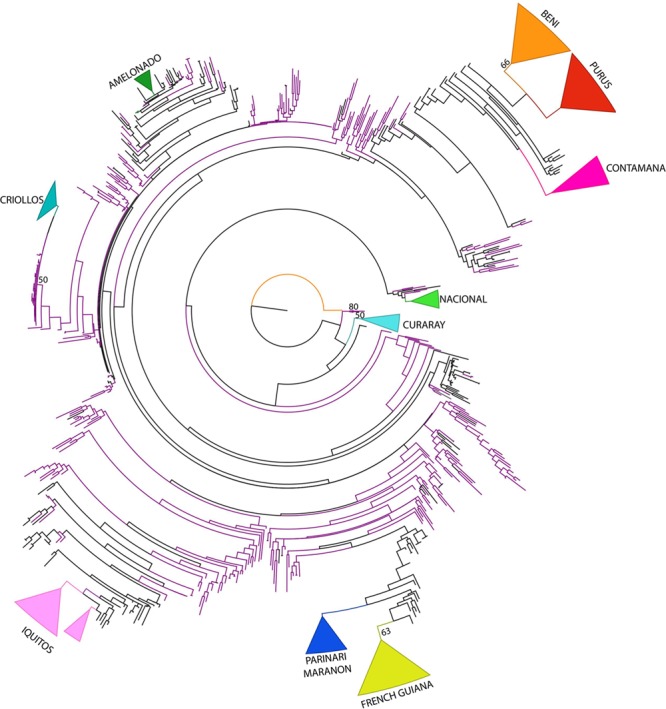
Beans of the species L., also known as cacao, are the raw material to produce chocolate. Colombian cacao has been classified as a fine flavor cacao that represents the 5% of cacao world's production. Colombian genetic resources from this species are conserved in and in-field germplasm banks, since has recalcitrant seeds to desication and long-term storage. Currently, the collection of of the Colombian Corporation of Agricultural Research (CORPOICA) has approximately 700 germplasm accessions. We conducted a molecular analysis of Corpoica's cacao collection and a morphological characterization of some accessions with the goal to study its genetic diversity and population structure and, to select interesting accessions for the cacao's breeding program. Phenotypic evaluation was performed based on 18 morphological traits and 4 biochemical traits. PCA analysis of morphological traits explained 60.6% of the total variation in seven components and 100% of the total variation of biochemical traits in four components, grouping the collection in 4 clusters for both variables. We explored 565 accessions from Corpoica's germplasm and 252 accessions from reference populations using 96 single nucleotide polymorphism (SNP) molecular markers. Molecular patterns of cacao Corpoica's collection were obtained amplifying specific alleles in a Fluidigm platform that used integrated circuits of fluids. Corpoica's collection showed highest genetic diversity [Expected Heterozygosity ( = 0.314), Observed Heterozygosity ( = 0.353)] that is reduced when reference populations were included in the dataset ( = 0.294, = 0.261). The collection was divided into four clusters based on population structure analysis. Cacao accessions from distinct groups showed some taxonomic concordance and reflected their geographic origins. For instance, accessions classified as Criollo were clearly differentiated in one group and we identified two new Colombian genetic groups. Using a number of allelic variations based on 87 SNP markers and 22 different morphological/biochemical traits, a core collection with a total of 232 accessions was selected as a primary genetic resource for cacao breeders.
可可树(Theobroma cacao L.)的种子,也就是我们熟知的可可豆,是制作巧克力的原材料。哥伦比亚可可豆被归类为优质风味可可豆,占全球可可豆产量的5%。由于该物种的种子对干燥和长期储存具有顽拗性,哥伦比亚的该物种遗传资源保存在离体和田间种质库中。目前,哥伦比亚农业研究公司(CORPOICA)的种质收集库中大约有700份种质资源。我们对CORPOICA的可可种质收集库进行了分子分析,并对部分种质进行了形态学特征鉴定,目的是研究其遗传多样性和群体结构,并为可可育种计划选择有价值的种质。基于18个形态学性状和4个生化性状进行了表型评估。形态学性状的主成分分析(PCA)在七个成分中解释了总变异的60.6%,生化性状的总变异在四个成分中解释率为100%,两个变量均将收集的种质分为4个聚类。我们使用96个单核苷酸多态性(SNP)分子标记,对CORPOICA种质库中的565份种质和参考群体中的252份种质进行了研究。通过在使用流体集成电路的Fluidigm平台上扩增特定等位基因,获得了CORPOICA可可种质的分子模式。CORPOICA的种质收集库显示出最高的遗传多样性[期望杂合度(He = 0.314),观察杂合度(Ho = 0.353)],当数据集中纳入参考群体时,遗传多样性降低(He = 0.294,Ho = 0.261)。基于群体结构分析,该收集库被分为四个聚类。来自不同组的可可种质显示出一定的分类学一致性,并反映了它们的地理起源。例如,被归类为克里奥罗(Criollo)的种质在一个组中明显区分出来,并且我们鉴定出了两个新的哥伦比亚遗传组。基于87个SNP标记的多个等位变异和22个不同的形态学/生化性状,共选择了232份种质组成核心收集库,作为可可育种者的主要遗传资源。