Aserse Aregu Amsalu, Woyke Tanja, Kyrpides Nikos C, Whitman William B, Lindström Kristina
Department of Environmental Sciences, University of Helsinki, Helsinki, Finland.
Joint Genome Institute, Walnut Creek, USA.
Stand Genomic Sci. 2017 Dec 5;12:74. doi: 10.1186/s40793-017-0283-x. eCollection 2017.
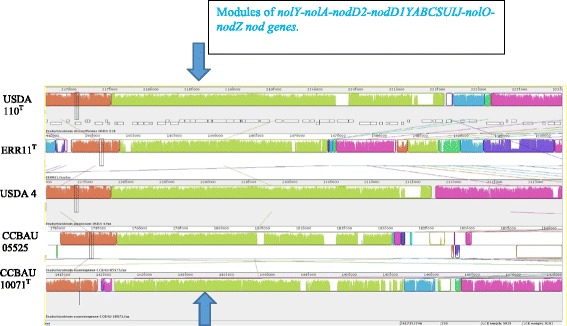
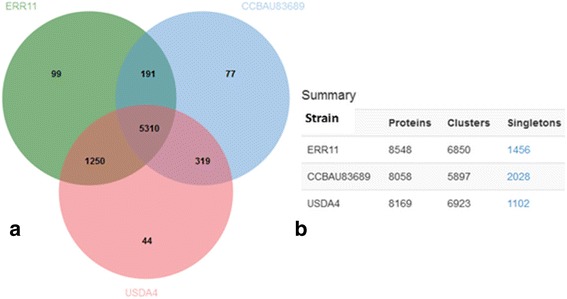
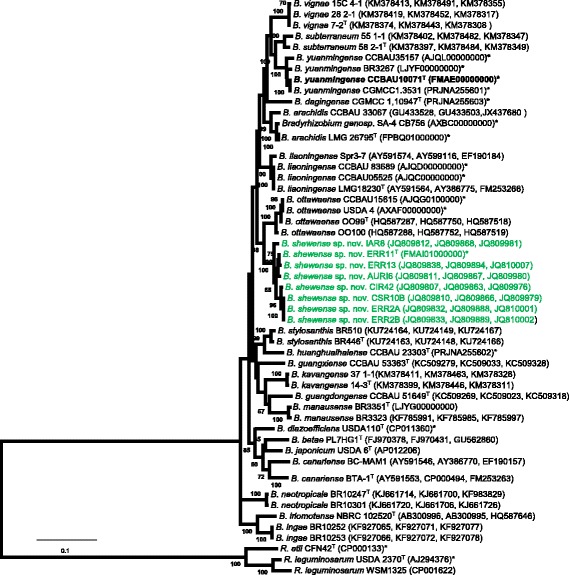
The type strain of the prospective 10.1601/nm.30737 sp. nov. ERR11, was isolated from a nodule of the leguminous tree native to Ethiopia. The type strain 10.1601/nm.1463 10.1601/strainfinder?urlappend=%3Fid%3DCCBAU+10071 , was isolated from the nodules of in Beijing, China. The genomes of ERR11 and 10.1601/strainfinder?urlappend=%3Fid%3DCCBAU+10071 were sequenced by DOE-JGI and deposited at the DOE-JGI genome portal as well as at the European Nucleotide Archive. The genome of ERR11 is 9,163,226 bp in length and has 102 scaffolds, containing 8548 protein-coding and 86 RNA genes. The 10.1601/strainfinder?urlappend=%3Fid%3DCCBAU+10071 genome is arranged in 108 scaffolds and consists of 8,201,522 bp long and 7776 protein-coding and 85 RNA genes. Both genomes contain symbiotic genes, which are homologous to the genes found in the complete genome sequence of 10.1601/nm.24498 10.1601/strainfinder?urlappend=%3Fid%3DUSDA+110 . The genes encoding for nodulation and nitrogen fixation in ERR11 showed high sequence similarity with homologous genes found in the draft genome of peanut-nodulating 10.1601/nm.27386 10.1601/strainfinder?urlappend=%3Fid%3DLMG+26795 . The nodulation genes of ERR11 and 10.1601/strainfinder?urlappend=%3Fid%3DCCBAU+10071 are organized in a similar way to the homologous genes identified in the genomes of 10.1601/strainfinder?urlappend=%3Fid%3DUSDA+110 10.1601/nm.25806 10.1601/strainfinder?urlappend=%3Fid%3DUSDA+4 and 10.1601/nm.1462 10.1601/strainfinder?urlappend=%3Fid%3DCCBAU+05525. The genomes harbor and genes that code the expression of hydrogenase, an enzyme that helps rhizobia to uptake hydrogen released by the N-fixation process and genes encoding denitrification functions and for nitrate and nitric oxide reduction, respectively. The genome of ERR11 also contains genes encoding nitrous oxide reductase. Based on multilocus sequence analysis of housekeeping genes, the novel species, which contains eight strains formed a unique group close to the 10.1601/nm.25806 branch. Genome Average Nucleotide Identity (ANI) calculated between the genome sequences of ERR11 and closely related sequences revealed that strains belonging to 10.1601/nm.25806 branch (10.1601/strainfinder?urlappend=%3Fid%3DUSDA+4 and 10.1601/strainfinder?urlappend=%3Fid%3DCCBAU+15615), were the closest strains to the strain ERR11 with 95.2% ANI. Type strain ERR11 showed the highest DDH predicted value with 10.1601/strainfinder?urlappend=%3Fid%3DCCBAU+15615 (58.5%), followed by 10.1601/strainfinder?urlappend=%3Fid%3DUSDA+4 (53.1%). Nevertheless, the ANI and DDH values obtained between ERR11 and 10.1601/strainfinder?urlappend=%3Fid%3DCCBAU+15615 or 10.1601/strainfinder?urlappend=%3Fid%3DUSDA+4 were below the cutoff values (ANI ≥ 96.5%; DDH ≥ 70%) for strains belonging to the same species, suggesting that ERR11 is a new species. Therefore, based on the phylogenetic analysis, ANI and DDH values, we formally propose the creation of 10.1601/nm.30737 sp. nov. with strain ERR11 (10.1601/strainfinder?urlappend=%3Fid%3DHAMBI+3532 =10.1601/strainfinder?urlappend=%3Fid%3DLMG+30162 ) as the type strain.
潜在的新物种10.1601/nm.30737 sp. nov. 的模式菌株ERR11,是从原产于埃塞俄比亚的豆科树木的根瘤中分离得到的。模式菌株10.1601/nm.1463 10.1601/strainfinder?urlappend=%3Fid%3DCCBAU+10071 ,是从中国北京的[具体植物名称未给出]的根瘤中分离得到的。ERR11和10.1601/strainfinder?urlappend=%3Fid%3DCCBAU+10071 的基因组由美国能源部联合基因组研究所(DOE-JGI)进行测序,并保存在DOE-JGI基因组数据库以及欧洲核苷酸档案库中。ERR11的基因组长度为9,163,226 bp,有102个支架,包含8548个蛋白质编码基因和86个RNA基因。10.1601/strainfinder?urlappend=%3Fid%3DCCBAU+10071 的基因组排列在108个支架中,由8,201,522 bp长的序列组成,包含7776个蛋白质编码基因和85个RNA基因。两个基因组都包含共生基因,这些基因与在10.1601/nm.24498 10.1601/strainfinder?urlappend=%3Fid%3DUSDA+110 的全基因组序列中发现的基因同源。ERR11中编码结瘤和固氮的基因与在花生根瘤菌10.1601/nm.27386 10.1601/strainfinder?urlappend=%3Fid%3DLMG+26795 的基因组草图中发现的同源基因具有高度序列相似性。ERR11和10.1601/strainfinder?urlappend=%3Fid%3DCCBAU+10071 的结瘤基因的组织方式与在10.1601/strainfinder?urlappend=%3Fid%3DUSDA+110 、10.1601/nm.25806 10.1601/strainfinder?urlappend=%3Fid%3DUSDA+4 和10.1601/nm.1462 10.1601/strainfinder?urlappend=%3Fid%3DCCBAU+05525 的基因组中鉴定出的同源基因相似。这些基因组含有编码氢化酶表达的[具体基因名称未给出]和[具体基因名称未给出]基因,氢化酶是一种帮助根瘤菌摄取固氮过程中释放的氢气的酶,以及分别编码将硝酸盐和一氧化氮还原为反硝化功能的[具体基因名称未给出]和[具体基因名称未给出]基因。ERR11的基因组还包含编码一氧化二氮还原酶的[具体基因名称未给出]基因。基于管家基因的多位点序列分析,包含八个菌株的新物种形成了一个独特的群体,靠近10.1601/nm.25806分支。ERR11的基因组序列与密切相关序列之间计算的基因组平均核苷酸同一性(ANI)表明,属于10.1601/nm.25806分支的菌株(10.1601/strainfinder?urlappend=%3Fid%3DUSDA+4 和10.1601/strainfinder?urlappend=%3Fid%3DCCBAU+15615)是与菌株ERR11最接近的菌株,ANI为95.2%。模式菌株ERR11与10.1601/strainfinder?urlappend=%3Fid%3DCCBAU+15615 的预测DDH值最高(58.5%),其次是10.1601/strainfinder?urlappend=%3Fid%