Department of Computational Medicine and Bioinformatics.
Department of Neurology and Michigan Alzheimer's Disease Center, University of Michigan.
Alzheimer Dis Assoc Disord. 2018 Jan-Mar;32(1):18-27. doi: 10.1097/WAD.0000000000000228.
Clinical trials increasingly aim to retard disease progression during presymptomatic phases of Mild Cognitive Impairment (MCI) and thus recruiting study participants at high risk for developing MCI is critical for cost-effective prevention trials. However, accurately identifying those who are destined to develop MCI is difficult. Collecting biomarkers is often expensive.
We used only noninvasive clinical variables collected in the National Alzheimer's Coordinating Center (NACC) Uniform Data Sets version 2.0 and applied machine learning techniques to build a low-cost and accurate Mild Cognitive Impairment (MCI) conversion prediction calculator. Cross-validation and bootstrap were used to select as few variables as possible accurately predicting MCI conversion within 4 years.
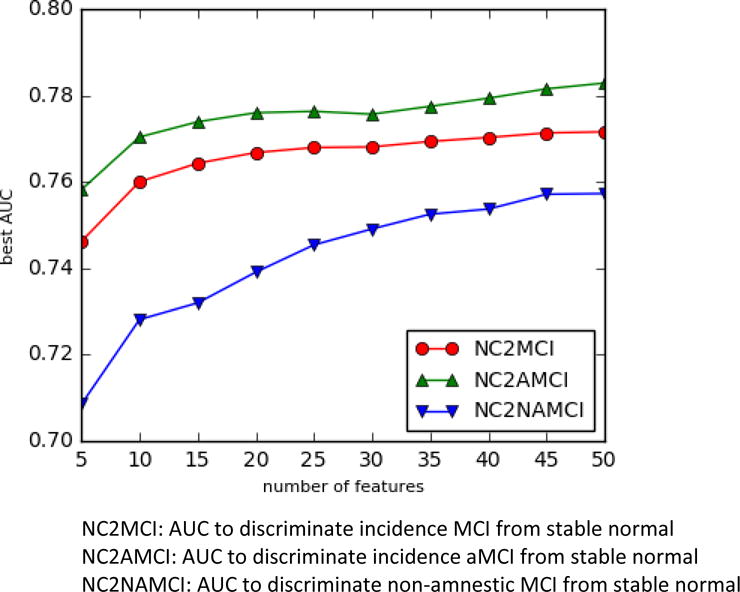
A total of 31,872 unique subjects, 748 clinical variables, and additional 128 derived variables in NACC data sets were used. About 15 noninvasive clinical variables are identified for predicting MCI/aMCI/naMCI converters, respectively. Over 75% Receiver Operating Characteristic Area Under the Curves (ROC AUC) was achieved. By bootstrap we created a simple spreadsheet calculator which estimates the probability of developing MCI within 4 years with a 95% confidence interval.
We achieved reasonably high prediction accuracy using only clinical variables. The approach used here could be useful for study enrichment in preclinical trials where enrolling participants at risk of cognitive decline is critical for proving study efficacy, and also for developing a shorter assessment battery.
临床试验越来越旨在延缓轻度认知障碍(MCI)的无症状阶段的疾病进展,因此招募有发生 MCI 高风险的研究参与者对于具有成本效益的预防试验至关重要。然而,准确识别那些注定会发展为 MCI 的人是困难的。收集生物标志物通常很昂贵。
我们仅使用国家阿尔茨海默病协调中心(NACC)统一数据集中的 2.0 版本收集的非侵入性临床变量,并应用机器学习技术构建一个低成本且准确的轻度认知障碍(MCI)转换预测计算器。交叉验证和引导法用于选择尽可能少的变量,以准确预测 4 年内 MCI 的转换。
共使用了 NACC 数据集中的 31872 个独特个体、748 个临床变量和另外 128 个衍生变量。确定了约 15 个非侵入性临床变量,分别用于预测 MCI/aMCI/naMCI 转化者。超过 75%的接收器操作特性曲线(ROC AUC)得到了实现。通过引导法,我们创建了一个简单的电子表格计算器,可估计在 4 年内发生 MCI 的概率,置信区间为 95%。
我们仅使用临床变量就实现了相当高的预测准确性。这里使用的方法在临床试验前阶段可能非常有用,在这些阶段中,招募有认知能力下降风险的参与者对于证明研究疗效以及开发更短的评估工具包至关重要。