• 文献检索
  • 文档翻译
  • 深度研究
  • 学术资讯
  • Suppr Zotero 插件Zotero 插件
  • 邀请有礼
  • 套餐&价格
  • 历史记录
应用&插件
Suppr Zotero 插件Zotero 插件浏览器插件Mac 客户端Windows 客户端微信小程序
定价
高级版会员购买积分包购买API积分包
服务
文献检索文档翻译深度研究API 文档MCP 服务
关于我们
关于 Suppr公司介绍联系我们用户协议隐私条款
关注我们

Suppr 超能文献

核心技术专利:CN118964589B侵权必究
粤ICP备2023148730 号-1Suppr @ 2026

文献检索

告别复杂PubMed语法,用中文像聊天一样搜索,搜遍4000万医学文献。AI智能推荐,让科研检索更轻松。

立即免费搜索

文件翻译

保留排版,准确专业,支持PDF/Word/PPT等文件格式,支持 12+语言互译。

免费翻译文档

深度研究

AI帮你快速写综述,25分钟生成高质量综述,智能提取关键信息,辅助科研写作。

立即免费体验

危重症患者尽管推荐了肠内和肠外摄入,但仍存在维生素 C 缺乏和 Hypovitaminosis C。

Hypovitaminosis C and vitamin C deficiency in critically ill patients despite recommended enteral and parenteral intakes.

机构信息

Department of Pathology, University of Otago, Christchurch, PO Box 4345, Christchurch, 8140, New Zealand.

Department of Intensive Care Medicine, Christchurch Hospital, Private Bag 4710, Christchurch, 8140, New Zealand.

出版信息

Crit Care. 2017 Dec 11;21(1):300. doi: 10.1186/s13054-017-1891-y.

DOI:10.1186/s13054-017-1891-y
PMID:29228951
原文链接:https://pmc.ncbi.nlm.nih.gov/articles/PMC5725835/
Abstract

BACKGROUND

Vitamin C is an essential water-soluble nutrient which cannot be synthesised or stored by humans. It is a potent antioxidant with anti-inflammatory and immune-supportive roles. Previous research has indicated that vitamin C levels are depleted in critically ill patients. In this study we have assessed plasma vitamin C concentrations in critically ill patients relative to infection status (septic shock or non-septic) and level of inflammation (C-reactive protein concentrations). Vitamin C status was also assessed relative to daily enteral and parenteral intakes to determine if standard intensive care unit (ICU) nutritional support is adequate to meet the vitamin C needs of critically ill patients.

METHODS

Forty-four critically ill patients (24 with septic shock, 17 non-septic, 3 uncategorised) were recruited from the Christchurch Hospital Intensive Care Unit. We measured concentrations of plasma vitamin C and a pro-inflammatory biomarker (C-reactive protein) daily over 4 days and calculated patients' daily vitamin C intake from the enteral or total parenteral nutrition they received. We compared plasma vitamin C and C-reactive protein concentrations between septic shock and non-septic patients over 4 days using a mixed effects statistical model, and we compared the vitamin C status of the critically ill patients with known vitamin C bioavailability data using a four-parameter log-logistic response model.

RESULTS

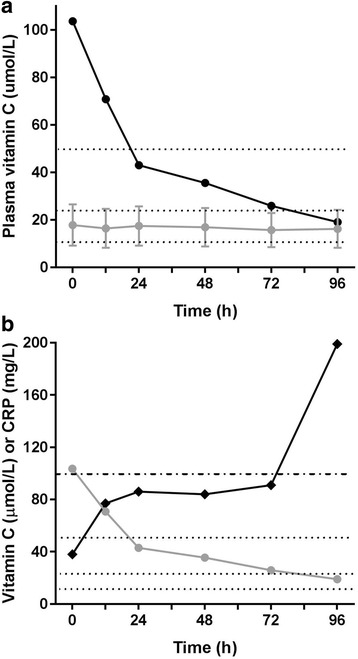
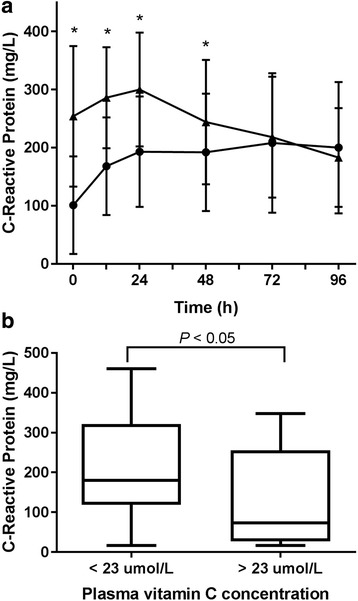
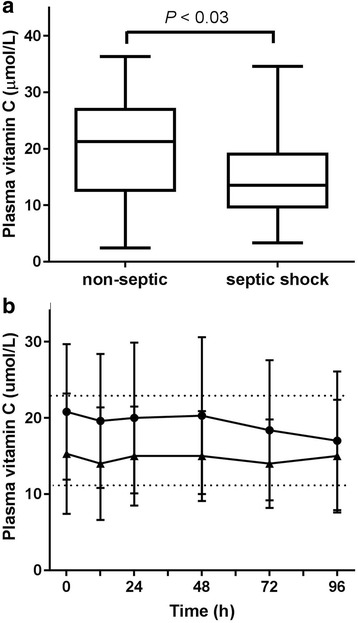
Overall, the critically ill patients exhibited hypovitaminosis C (i.e., < 23 μmol/L), with a mean plasma vitamin C concentration of 17.8 ± 8.7 μmol/L; of these, one-third had vitamin C deficiency (i.e., < 11 μmol/L). Patients with hypovitaminosis C had elevated inflammation (C-reactive protein levels; P < 0.05). The patients with septic shock had lower vitamin C concentrations and higher C-reactive protein concentrations than the non-septic patients (P < 0.05). Nearly 40% of the septic shock patients were deficient in vitamin C, compared with 25% of the non-septic patients. These low vitamin C levels were apparent despite receiving recommended intakes via enteral and/or parenteral nutritional therapy (mean 125 mg/d).

CONCLUSIONS

Critically ill patients have low vitamin C concentrations despite receiving standard ICU nutrition. Septic shock patients have significantly depleted vitamin C levels compared with non-septic patients, likely resulting from increased metabolism due to the enhanced inflammatory response observed in septic shock.

摘要

背景

维生素 C 是一种必需的水溶性营养素,人体无法合成或储存。它是一种有效的抗氧化剂,具有抗炎和免疫支持作用。先前的研究表明,危重症患者的维生素 C 水平会耗尽。在这项研究中,我们评估了危重症患者的血浆维生素 C 浓度与感染状态(感染性休克或非感染性)和炎症水平(C 反应蛋白浓度)的关系。还评估了维生素 C 状态与每日肠内和肠外摄入的关系,以确定标准重症监护病房(ICU)营养支持是否足以满足危重症患者的维生素 C 需求。

方法

从克赖斯特彻奇医院重症监护病房招募了 44 名危重症患者(24 名感染性休克,17 名非感染性,3 名未分类)。我们在 4 天内每天测量血浆维生素 C 和促炎生物标志物(C 反应蛋白)的浓度,并根据他们接受的肠内或全胃肠外营养计算患者的每日维生素 C 摄入量。我们使用混合效应统计模型比较了 4 天内感染性休克和非感染性患者的血浆维生素 C 和 C 反应蛋白浓度,并使用四参数对数逻辑响应模型将危重症患者的维生素 C 状态与已知的维生素 C 生物利用度数据进行了比较。

结果

总体而言,危重症患者表现出维生素 C 不足(即<23 μmol/L),平均血浆维生素 C 浓度为 17.8±8.7 μmol/L;其中三分之一患者存在维生素 C 缺乏症(即<11 μmol/L)。维生素 C 不足的患者炎症水平升高(C 反应蛋白水平;P<0.05)。感染性休克患者的维生素 C 浓度较低,C 反应蛋白浓度较高,而非感染性患者(P<0.05)。近 40%的感染性休克患者存在维生素 C 缺乏症,而非感染性患者为 25%。尽管通过肠内和/或肠外营养治疗给予了推荐的摄入量(平均 125mg/d),但仍存在这些低维生素 C 水平。

结论

尽管接受了标准 ICU 营养支持,危重症患者的维生素 C 浓度仍较低。感染性休克患者的维生素 C 水平明显低于非感染性休克患者,这可能是由于感染性休克中观察到的炎症反应增强导致代谢增加所致。
https://cdn.ncbi.nlm.nih.gov/pmc/blobs/e438/5725835/c4eee2f2bcaa/13054_2017_1891_Fig4_HTML.jpg
https://cdn.ncbi.nlm.nih.gov/pmc/blobs/e438/5725835/33fda4b420a2/13054_2017_1891_Fig1_HTML.jpg
https://cdn.ncbi.nlm.nih.gov/pmc/blobs/e438/5725835/d84ffaac3224/13054_2017_1891_Fig2_HTML.jpg
https://cdn.ncbi.nlm.nih.gov/pmc/blobs/e438/5725835/c98756a8ae42/13054_2017_1891_Fig3_HTML.jpg
https://cdn.ncbi.nlm.nih.gov/pmc/blobs/e438/5725835/c4eee2f2bcaa/13054_2017_1891_Fig4_HTML.jpg
https://cdn.ncbi.nlm.nih.gov/pmc/blobs/e438/5725835/33fda4b420a2/13054_2017_1891_Fig1_HTML.jpg
https://cdn.ncbi.nlm.nih.gov/pmc/blobs/e438/5725835/d84ffaac3224/13054_2017_1891_Fig2_HTML.jpg
https://cdn.ncbi.nlm.nih.gov/pmc/blobs/e438/5725835/c98756a8ae42/13054_2017_1891_Fig3_HTML.jpg
https://cdn.ncbi.nlm.nih.gov/pmc/blobs/e438/5725835/c4eee2f2bcaa/13054_2017_1891_Fig4_HTML.jpg

相似文献

1
Hypovitaminosis C and vitamin C deficiency in critically ill patients despite recommended enteral and parenteral intakes.危重症患者尽管推荐了肠内和肠外摄入,但仍存在维生素 C 缺乏和 Hypovitaminosis C。
Crit Care. 2017 Dec 11;21(1):300. doi: 10.1186/s13054-017-1891-y.
2
Pharmacokinetic data support 6-hourly dosing of intravenous vitamin C to critically ill patients with septic shock.药代动力学数据支持对患有败血症性休克的重症患者每 6 小时静脉注射维生素 C。
Crit Care Resusc. 2019 Dec;21(4):236-42.
3
[Guidelines for specialized nutritional and metabolic support in the critically-ill patient. Update. Consensus of the Spanish Society of Intensive Care Medicine and Coronary Units-Spanish Society of Parenteral and Enteral Nutrition (SEMICYUC-SENPE): patient with sepsis].[危重症患者特殊营养与代谢支持指南。更新版。西班牙重症监护医学与冠心病监护病房学会-西班牙肠外与肠内营养学会(SEMICYUC-SENPE)共识:脓毒症患者]
Med Intensiva. 2011 Nov;35 Suppl 1:72-6. doi: 10.1016/S0210-5691(11)70015-8.
4
Supplemental parenteral nutrition in critically ill patients: a study protocol for a phase II randomised controlled trial.危重症患者的补充肠外营养:一项II期随机对照试验的研究方案
Trials. 2015 Dec 24;16:587. doi: 10.1186/s13063-015-1118-y.
5
Changes of plasma acetylcholine and inflammatory markers in critically ill patients during early enteral nutrition: A prospective observational study.危重症患者早期肠内营养期间血浆乙酰胆碱和炎症标志物的变化:一项前瞻性观察研究。
J Crit Care. 2019 Aug;52:219-226. doi: 10.1016/j.jcrc.2019.05.008. Epub 2019 May 10.
6
Current clinical nutrition practices in critically ill patients in Latin America: a multinational observational study.拉丁美洲危重症患者的当前临床营养实践:一项多国家观察性研究。
Crit Care. 2017 Aug 25;21(1):227. doi: 10.1186/s13054-017-1805-z.
7
Nutrition of the critically ill patient and effects of implementing a nutritional support algorithm in ICU.重症患者的营养及在重症监护病房实施营养支持算法的效果。
J Clin Nurs. 2006 Feb;15(2):168-77. doi: 10.1111/j.1365-2702.2006.01262.x.
8
Taurine Concentrations Decrease in Critically Ill Patients With Shock Given Enteral Nutrition.接受肠内营养的休克重症患者体内牛磺酸浓度降低。
JPEN J Parenter Enteral Nutr. 2016 Feb;40(2):264-72. doi: 10.1177/0148607114567199. Epub 2015 Jan 13.
9
Enteral nutritional therapy in septic patients in the intensive care unit: compliance with nutritional guidelines for critically ill patients.重症监护病房脓毒症患者的肠内营养治疗:对危重症患者营养指南的依从性
Rev Bras Ter Intensiva. 2013 Mar;25(1):17-24. doi: 10.1590/s0103-507x2013000100005.
10
Supplemental parenteral nutrition versus usual care in critically ill adults: a pilot randomized controlled study.危重症成人补充性肠外营养与常规治疗的对比:一项先导随机对照研究。
Crit Care. 2018 Jan 23;22(1):12. doi: 10.1186/s13054-018-1939-7.

引用本文的文献

1
Effects of Vitamin C Supplementation on Total Antioxidant Status, Inflammation, and Histopathological Changes in Aged Rats.补充维生素C对老年大鼠总抗氧化状态、炎症及组织病理学变化的影响
J Biochem Mol Toxicol. 2025 Jun;39(6):e70324. doi: 10.1002/jbt.70324.
2
Early administration of vitamin C in patients with sepsis or septic shock in emergency departments: a multicenter, double-blind, randomized controlled trial: the C-EASIE trial.急诊科脓毒症或感染性休克患者早期应用维生素C:一项多中心、双盲、随机对照试验:C-EASIE试验
Crit Care. 2025 Apr 23;29(1):160. doi: 10.1186/s13054-025-05383-x.
3
The Prevalence, Risk Factors, and Clinical Outcomes of Vitamin C Deficiency in Adult Hospitalised Patients: A Retrospective Observational Study.

本文引用的文献

1
Vitamin C Status Correlates with Markers of Metabolic and Cognitive Health in 50-Year-Olds: Findings of the CHALICE Cohort Study.维生素 C 状态与 50 岁人群代谢和认知健康标志物相关:CHALICE 队列研究的结果。
Nutrients. 2017 Aug 3;9(8):831. doi: 10.3390/nu9080831.
2
Surviving Sepsis Campaign: International Guidelines for Management of Sepsis and Septic Shock: 2016.拯救脓毒症运动:脓毒症与脓毒性休克管理国际指南:2016版
Crit Care Med. 2017 Mar;45(3):486-552. doi: 10.1097/CCM.0000000000002255.
3
Hydrocortisone, Vitamin C, and Thiamine for the Treatment of Severe Sepsis and Septic Shock: A Retrospective Before-After Study.
成年住院患者维生素C缺乏的患病率、危险因素及临床结局:一项回顾性观察研究
Nutrients. 2025 Mar 25;17(7):1131. doi: 10.3390/nu17071131.
4
Elevated Levels of IL-1Ra, IL-1β, and Oxidative Stress in COVID-19: Implications for Inflammatory Pathogenesis.新型冠状病毒肺炎中白细胞介素-1受体拮抗剂、白细胞介素-1β水平升高及氧化应激:对炎症发病机制的影响
J Clin Med. 2025 Apr 5;14(7):2489. doi: 10.3390/jcm14072489.
5
Micronutrient-deficient diets and possible environmental enteric dysfunction in Buruli ulcer endemic communities in Ghana: Lower dietary diversity and reduced serum zinc and vitamin C implicate micronutrient status a possible susceptibility factor.加纳布鲁里溃疡流行社区的微量营养素缺乏饮食及可能存在的环境肠道功能障碍:较低的饮食多样性以及血清锌和维生素C水平降低表明微量营养素状况可能是一个易感性因素。
PLoS Negl Trop Dis. 2025 Mar 12;19(3):e0012871. doi: 10.1371/journal.pntd.0012871. eCollection 2025 Mar.
6
Untargeted Metabolomics Comparison and Nutrition Evaluation of Geographical Indication Newhall Navel Oranges in China.中国地理标志产品赣南脐橙的非靶向代谢组学比较与营养评价
Foods. 2025 Jan 22;14(3):355. doi: 10.3390/foods14030355.
7
Enhanced Vitamin C Delivery: A Systematic Literature Review Assessing the Efficacy and Safety of Alternative Supplement Forms in Healthy Adults.强化维生素C的递送:一项评估健康成年人中替代补充剂形式的疗效和安全性的系统文献综述。
Nutrients. 2025 Jan 14;17(2):279. doi: 10.3390/nu17020279.
8
A Comparison of the Efficacy of High-Dose Vitamin C Infusion and Thiamine (Vitamin B1) Infusion in Patients With Sepsis: A Prospective Randomized Controlled Trial.大剂量维生素C输注与硫胺素(维生素B1)输注对脓毒症患者疗效的比较:一项前瞻性随机对照试验
Cureus. 2024 Dec 7;16(12):e75296. doi: 10.7759/cureus.75296. eCollection 2024 Dec.
9
What do we know about micronutrients in critically ill patients? A narrative review.关于危重症患者的微量营养素,我们了解多少?一篇叙述性综述。
JPEN J Parenter Enteral Nutr. 2025 Jan;49(1):33-58. doi: 10.1002/jpen.2700. Epub 2024 Nov 18.
10
Evaluation of Parenteral Vitamin C's Effectiveness in Critically Ill Patients: A Systematic Review and Critical Appraisal.肠外维生素C对危重症患者有效性的评估:一项系统评价与批判性分析
Cureus. 2024 Aug 19;16(8):e67184. doi: 10.7759/cureus.67184. eCollection 2024 Aug.
氢化可的松、维生素C和硫胺素治疗严重脓毒症和脓毒性休克:一项前后对照的回顾性研究。
Chest. 2017 Jun;151(6):1229-1238. doi: 10.1016/j.chest.2016.11.036. Epub 2016 Dec 6.
4
Marginal Ascorbate Status (Hypovitaminosis C) Results in an Attenuated Response to Vitamin C Supplementation.边缘性抗坏血酸状态(维生素C缺乏)导致对维生素C补充的反应减弱。
Nutrients. 2016 Jun 3;8(6):341. doi: 10.3390/nu8060341.
5
Dose-Response Analysis Using R.使用R进行剂量反应分析。
PLoS One. 2015 Dec 30;10(12):e0146021. doi: 10.1371/journal.pone.0146021. eCollection 2015.
6
Ascorbate-dependent vasopressor synthesis: a rationale for vitamin C administration in severe sepsis and septic shock?依赖抗坏血酸盐的血管升压药合成:重症脓毒症和脓毒性休克中维生素C给药的理论依据?
Crit Care. 2015 Nov 27;19:418. doi: 10.1186/s13054-015-1131-2.
7
Regulation of the Epigenome by Vitamin C.维生素C对表观基因组的调控
Annu Rev Nutr. 2015;35:545-64. doi: 10.1146/annurev-nutr-071714-034228. Epub 2015 May 6.
8
Ascorbate as a co-factor for fe- and 2-oxoglutarate dependent dioxygenases: physiological activity in tumor growth and progression.抗坏血酸作为铁依赖型和 2-氧代戊二酸依赖型双加氧酶的辅助因子:在肿瘤生长和进展中的生理活性。
Front Oncol. 2014 Dec 10;4:359. doi: 10.3389/fonc.2014.00359. eCollection 2014.
9
Bioavailability of vitamin C from kiwifruit in non-smoking males: determination of 'healthy' and 'optimal' intakes.非吸烟男性食用猕猴桃后维生素C的生物利用度:“健康”和“最佳”摄入量的测定。
J Nutr Sci. 2012 Oct 23;1:e14. doi: 10.1017/jns.2012.15. eCollection 2012.
10
Phase I safety trial of intravenous ascorbic acid in patients with severe sepsis.静脉注射抗坏血酸治疗严重脓毒症患者的 I 期安全性试验。
J Transl Med. 2014 Jan 31;12:32. doi: 10.1186/1479-5876-12-32.