Rogers Anna J, Akama Eliud, Weke Elly, Blackburn Justin, Owino George, Bukusi Elizabeth A, Oyaro Patrick, Kwena Zachary A, Cohen Craig R, Turan Janet M
Department of Health Care Organization and Policy, University of Alabama at Birmingham School of Public Health, Birmingham, AL, USA.
Centre for Microbiology Research, Kenya Medical Research Institute, Nairobi, Kenya.
J Int AIDS Soc. 2017 Dec;20(4). doi: 10.1002/jia2.25036.
Repeat HIV testing during the late antenatal period is crucial to identify and initiate treatment for pregnant women with incident HIV infection to prevent perinatal HIV transmission and keep mothers alive. In 2012, the Kenya Ministry of Health adopted international guidelines suggesting that pregnant women be offered retesting three months after an initial negative HIV test. Our objectives were to determine the current rate of antenatal repeat HIV testing; identify successes, missed opportunities and factors associated with retesting; and estimate the incidence of HIV during pregnancy.
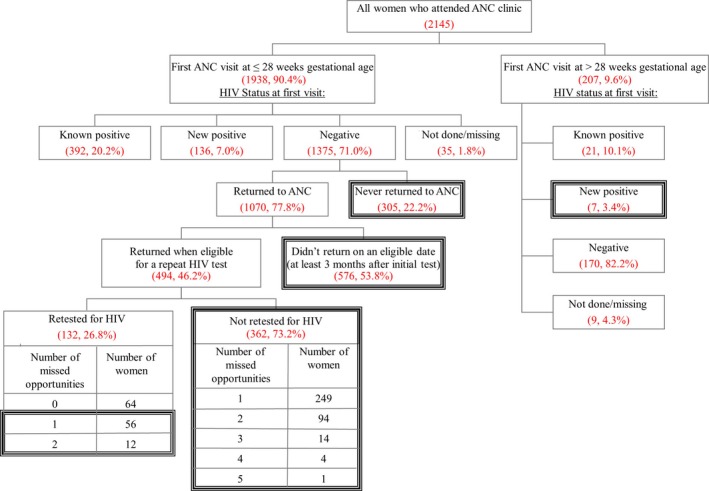
Retrospective analysis of longitudinal data was conducted for a cohort of 2145 women attending antenatal care clinic at a large district hospital in southwestern Kenya. Data were abstracted from registers for all women who attended the clinic from the years 2011 to 2014.
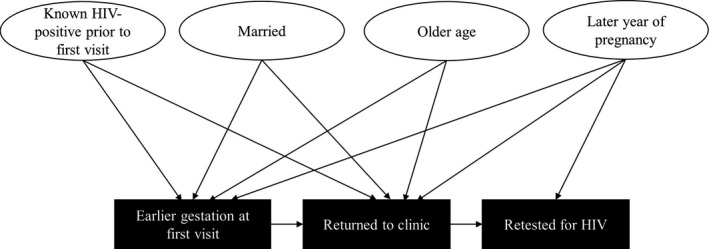
Although 90.2% of women first came to clinic prior to their third trimester and 27.5% had at least four clinic visits, 58.0% of all women went to delivery without a retest. Missed opportunities for retesting included not returning to clinic at all, not returning when eligible, or late gestational age (>28 weeks) at first clinic visit making them ineligible for retesting (accounting for 14.2%, 26.8% and 9.6% of all clinic attendees respectively); and failure to be retested even when eligible at one or more visits (accounting for 73.2% of eligible returnees). Being unmarried and aged 20 or younger was associated with an increase in mean gestational age of first visit by 2.52 weeks (95% CI: 1.56, 3.48) and a 2.59 increased odds (95% CI: 1.90, 3.54) of failing to return to clinic, compared to those who were married and over 20 years of age. On retest, two women tested HIV positive, suggesting an incidence rate of 4.4 per 100 person-years. After adjusting for potential confounders, only later year of last menstrual period (2013 vs. 2012 and 2011) was associated with retesting.
Adoption of retesting guidelines in 2012 appears to have successfully increased retesting rates, but missed opportunities to identify incident HIV infection during pregnancy may contribute to continuing high rates of perinatal HIV transmission in southwestern Kenya.
在孕晚期重复进行HIV检测对于识别并启动对新发HIV感染孕妇的治疗至关重要,这有助于预防围产期HIV传播并挽救母亲生命。2012年,肯尼亚卫生部采用了国际指南,建议在首次HIV检测呈阴性的孕妇三个月后进行重新检测。我们的目标是确定当前产前重复HIV检测的比例;识别重新检测的成功案例、错失的机会以及与重新检测相关的因素;并估计孕期HIV的发病率。
对肯尼亚西南部一家大型地区医院产前保健诊所的2145名妇女队列进行纵向数据的回顾性分析。数据从2011年至2014年期间所有到该诊所就诊妇女的登记册中提取。
尽管90.2%的妇女在孕晚期之前首次前来诊所就诊,27.5%的妇女至少就诊四次,但所有妇女中有58.0%未进行重新检测就分娩了。重新检测错失的机会包括根本未返回诊所、符合条件时未返回、或首次就诊时孕周较大(>28周)而无资格进行重新检测(分别占所有诊所就诊者的14.2%、26.8%和9.6%);以及即使在一次或多次就诊时符合条件也未进行重新检测(占符合条件返回者的73.2%)。未婚且年龄在20岁及以下者与首次就诊的平均孕周增加2.52周(95%置信区间:1.56,3.48)以及未返回诊所的几率增加2.59倍(95%置信区间:1.90,3.54)相关,相比已婚且年龄超过20岁者。重新检测时,两名妇女HIV检测呈阳性,提示发病率为每100人年4.4例。在对潜在混杂因素进行调整后,仅末次月经年份较晚(2013年与2012年和2011年相比)与重新检测相关。
2012年采用重新检测指南似乎成功提高了重新检测率,但孕期识别新发HIV感染错失的机会可能导致肯尼亚西南部围产期HIV传播持续处于高发病率。