Schulte-Herbrüggen Björn, Cowlishaw Guy, Homewood Katherine, Rowcliffe J Marcus
Zoological Society of London, Institute of Zoology, London, United Kingdom.
University College London, Department of Anthropology, London, United Kingdom.
PLoS One. 2017 Dec 13;12(12):e0188109. doi: 10.1371/journal.pone.0188109. eCollection 2017.
Wildlife is an important source of protein for many people in developing countries. Yet wildlife depletion due to overexploitation is common throughout the humid tropics and its effect on protein security, especially for vulnerable households, is poorly understood. This is problematic for both sustainable rural development and conservation management.
This study investigates a key dimension of protein security in a cash-crop farming community living in a wildlife-depleted farm-forest landscape in SW Ghana, a region where protein-energy malnutrition persists. Specifically, we monitored protein sufficiency, defined as whether consumption met daily requirements, as benchmarked by recommended daily allowance (RDA). We focus on whether more vulnerable households were less likely to be able to meet their protein needs, where vulnerability was defined by wealth, agricultural season and gender of the household head. Our central hypothesis was: (a) vulnerable households are less likely to consume sufficient protein. In the context that most plant proteins were home-produced, so likely relatively accessible to all households, while most animal proteins were purchased, so likely less accessible to vulnerable households, we tested two further hypotheses: (b) vulnerable households depend more on plant protein to cover their protein needs; and (c) vulnerable households are less likely to earn sufficient cash income to meet their protein needs through purchased animal sources.
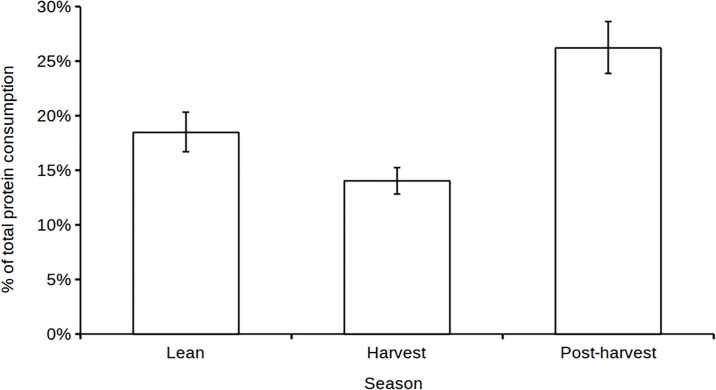
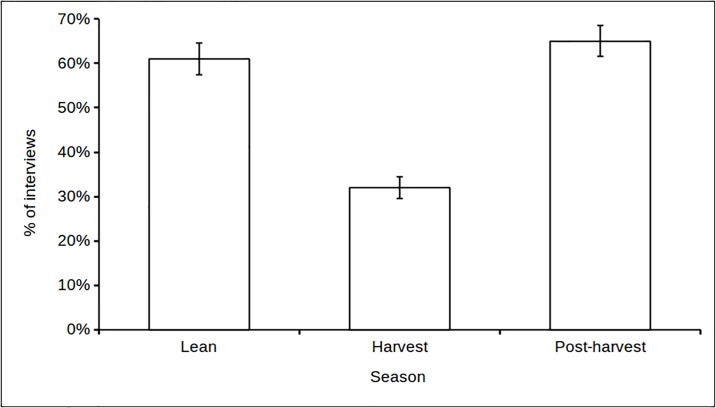
Between 14% and 60% of households (depending on plant protein content assumptions) consumed less than the RDA for protein, but neither protein consumption nor protein sufficiency co-varied with household vulnerability. Fish, livestock and food crops comprised 85% of total protein intake and strongly affected protein sufficiency. However, bushmeat remained an important protein source (15% of total consumption), especially during the post-harvest season when it averaged 26% of total protein consumption. Across the year, 89% of households experienced at least one occasion when they had insufficient income to cover their protein needs through animal protein purchases. The extent of this income shortage was highest during the lean season and among poorer households.
These findings indicate that despite wildlife depletion, bushmeat continues to make a substantial contribution to protein consumption, especially during the agricultural lean season. Income shortages among farmers limit their ability to purchase bushmeat or its substitutes, suggesting that wildlife depletion may cause malnutrition.
野生动物是发展中国家许多人重要的蛋白质来源。然而,在整个湿润热带地区,过度开发导致野生动物数量减少的情况很常见,而其对蛋白质安全的影响,尤其是对脆弱家庭的影响,却鲜为人知。这对可持续农村发展和保护管理都存在问题。
本研究调查了加纳西南部一个以经济作物种植为主的社区的蛋白质安全关键维度,该地区野生动物数量已减少,且蛋白质 - 能量营养不良问题持续存在。具体而言,我们监测了蛋白质充足情况,即根据推荐每日摄入量(RDA)作为基准,判断消费量是否满足每日需求。我们关注更脆弱的家庭是否更难以满足其蛋白质需求,其中脆弱性由财富、农业季节和户主性别来定义。我们的核心假设是:(a)脆弱家庭摄入足够蛋白质的可能性较小。鉴于大多数植物蛋白是自家生产的,所以所有家庭获取的可能性相对较大,而大多数动物蛋白是购买的,因此脆弱家庭获取的可能性可能较小,我们进一步检验了两个假设:(b)脆弱家庭更多地依赖植物蛋白来满足其蛋白质需求;以及(c)脆弱家庭通过购买动物蛋白来源获得足够现金收入以满足其蛋白质需求的可能性较小。
14%至60%的家庭(取决于对植物蛋白含量的假设)蛋白质摄入量低于RDA,但蛋白质消费量和蛋白质充足情况均与家庭脆弱性不存在协变关系。鱼类、牲畜和粮食作物占总蛋白质摄入量的85%,并对蛋白质充足情况有强烈影响。然而,丛林肉仍然是重要的蛋白质来源(占总消费量的15%),特别是在收获后季节,此时其平均占总蛋白质消费量的26%。全年有89%的家庭至少有一次没有足够收入通过购买动物蛋白来满足其蛋白质需求。这种收入短缺的程度在淡季和较贫困家庭中最高。
这些研究结果表明,尽管野生动物数量减少,但丛林肉仍继续对蛋白质消费做出重大贡献,特别是在农业淡季。农民的收入短缺限制了他们购买丛林肉或其替代品的能力,这表明野生动物数量减少可能导致营养不良。