Centre for Dementia Prevention,University of Edinburgh,Edinburgh,UK.
Postgraduate Education Centre,Royal Infirmary of Edinburgh,Edinburgh,UK.
Int Psychogeriatr. 2018 Aug;30(8):1177-1187. doi: 10.1017/S1041610217002824. Epub 2017 Dec 18.
ABSTRACTBackground:Smoking is a well-established risk factor for dementia, but the effects of passive smoking are unclear. We aimed to examine links between passive smoking and dementia or cognitive impairment.
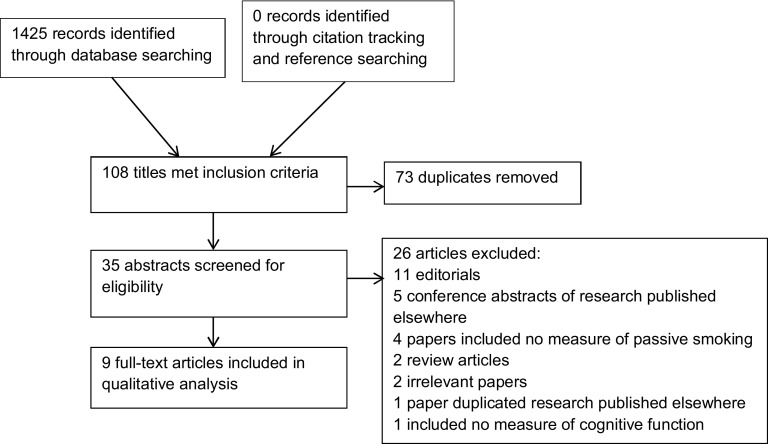
We searched seven medical research databases: MEDLINE, Web of Science (Core Collection), Cochrane, EMBASE, PsycINFO, Scopus, and CINAHL Plus. Studies were included if they examined measures of passive smoking and either cognitive impairment or dementia.
Of 1,425 records found, nine papers of varying methodologies were included after screening against inclusion criteria. Eight papers reported weak associations between passive smoking and either cognitive impairment or dementia. One paper only found this association alongside carotid artery stenosis. The papers' quality was variable, with only two deemed high quality.
There is limited weak observational evidence linking passive smoking with an increased risk of cognitive impairment or dementia. However, the studies were methodologically diverse and of inconsistent quality, preventing firm conclusions.
目的:摘要背景:吸烟是痴呆的一个既定危险因素,但被动吸烟的影响尚不清楚。我们旨在研究被动吸烟与痴呆或认知障碍之间的联系。
方法:我们搜索了七个医学研究数据库:MEDLINE、Web of Science(核心合集)、Cochrane、EMBASE、PsycINFO、Scopus 和 CINAHL Plus。如果研究检查了被动吸烟措施以及认知障碍或痴呆的任何一种情况,则将其纳入研究。
结果:在筛选出符合纳入标准的记录后,共找到了 1425 篇记录,其中有 9 篇论文因不同的方法学而被纳入。8 篇论文报告了被动吸烟与认知障碍或痴呆之间的弱关联。有一篇论文仅发现这种关联与颈动脉狭窄并存。这些论文的质量各不相同,只有两篇被认为是高质量的。
结论:有有限的观察性证据表明,被动吸烟与认知障碍或痴呆的风险增加有关。然而,这些研究在方法学上存在差异,且质量不一致,因此无法得出明确的结论。