Laboratory of Epidemiology and Population Sciences, National Institute on Aging, NIA/NIH/IRP, Baltimore, MD 21224, USA.
Department of Research Programs, Fort Belvoir Community Hospital, Fort Belvoir, VA 22060, USA.
Aging (Albany NY). 2023 Sep 25;15(18):9310-9340. doi: 10.18632/aging.205058.
Pathways explaining racial/ethnic disparities in dementia risk are under-evaluated.
We examine those disparities and their related pathways among UK Biobank study respondents (50-74 y, = 323,483; 3.6% non-White minorities) using a series of Cox proportional hazards and generalized structural equations models (GSEM).
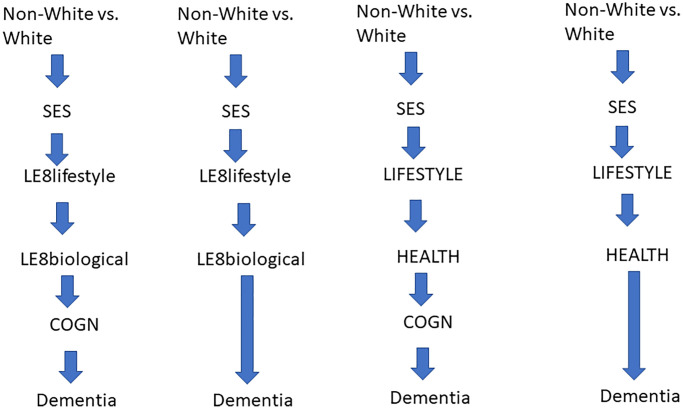
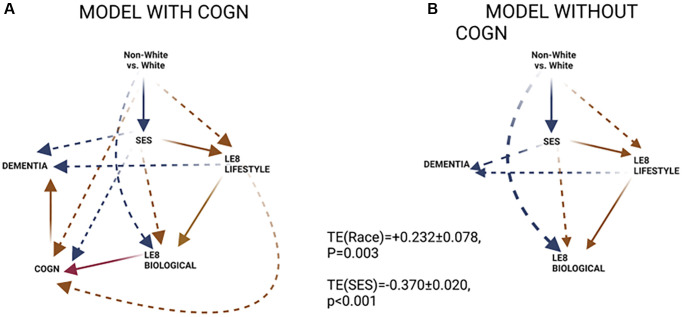
After ≤15 years, 5,491 all-cause dementia cases were diagnosed. Racial minority status (RACE_ETHN, Non-White vs. White) increased dementia risk by 24% (HR = 1.24, 95% CI: 1.07-1.45, = 0.005), an association attenuated by socio-economic status (SES), (HR = 1.12, 95% CI: 0.96-1.31). Total race-dementia effect was mediated through both SES and Life's Essential 8 lifestyle sub-score (LE8), combining diet, smoking, physical activity, and sleep factors. SES was inversely related to dementia risk (HR = 0.69, 95% CI: 0.67, 0.72, < 0.001). Pathways explaining excess dementia risk among racial minorities included 'RACE_ETHN(-) → SES(-) → DEMENTIA', 'RACE_ETHN(-) → SES(-) → Poor cognitive performance, COGN(+) → DEMENTIA' and 'RACE_ETHN(-) → SES(+) → LE8(-) → DEMENTIA'.
Pending future interventions, lifestyle factors including diet, smoking, physical activity, and sleep are crucial for reducing racial and socio-economic disparities in dementia.
解释痴呆风险中种族/民族差异的途径尚未得到充分评估。
我们使用一系列 Cox 比例风险和广义结构方程模型(GSEM)来检查英国生物库研究参与者(50-74 岁,n=323483;3.6%的非白人少数民族)中的这些差异及其相关途径。
在≤15 年内,诊断出 5491 例全因痴呆病例。少数民族地位(RACE_ETHN,非白人与白人)使痴呆风险增加 24%(HR=1.24,95%CI:1.07-1.45,P=0.005),这一关联通过社会经济地位(SES)减弱(HR=1.12,95%CI:0.96-1.31)。总的种族与痴呆之间的关联通过 SES 和生活基本 8 项生活方式子评分(LE8)共同的饮食、吸烟、身体活动和睡眠因素来介导。SES 与痴呆风险呈负相关(HR=0.69,95%CI:0.67,0.72,P<0.001)。解释少数民族中额外痴呆风险的途径包括“RACE_ETHN(-)→SES(-)→痴呆症”、“RACE_ETHN(-)→SES(-)→认知表现差,COGN(+)→痴呆症”和“RACE_ETHN(-)→SES(+)→LE8(-)→痴呆症”。
在未来的干预措施中,包括饮食、吸烟、身体活动和睡眠在内的生活方式因素对于减少痴呆症中的种族和社会经济差异至关重要。