Lewis Joseph M, Savage Richard S, Beeching Nicholas J, Beadsworth Mike B J, Feasey Nicholas, Covington James A
Tropical and Infectious Disease Unit, Royal Liverpool University Hospital, Liverpool, United Kingdom.
Wellcome Trust Liverpool Glasgow Centre for Global Health Research, Liverpool, United Kingdom.
PLoS One. 2017 Dec 18;12(12):e0188879. doi: 10.1371/journal.pone.0188879. eCollection 2017.
New point of care diagnostics are urgently needed to reduce the over-prescription of antimicrobials for bacterial respiratory tract infection (RTI). We performed a pilot cross sectional study to assess the feasibility of gas-capillary column ion mobility spectrometer (GC-IMS), for the analysis of volatile organic compounds (VOC) in exhaled breath to diagnose bacterial RTI in hospital inpatients.
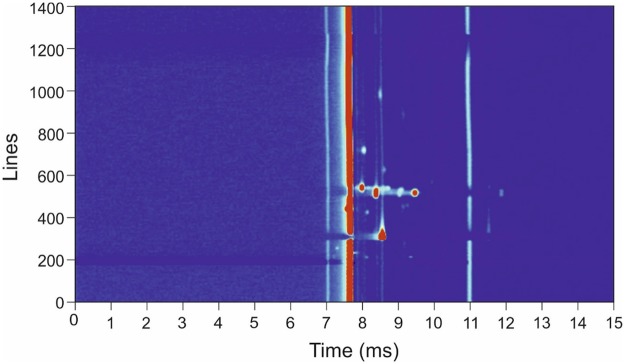
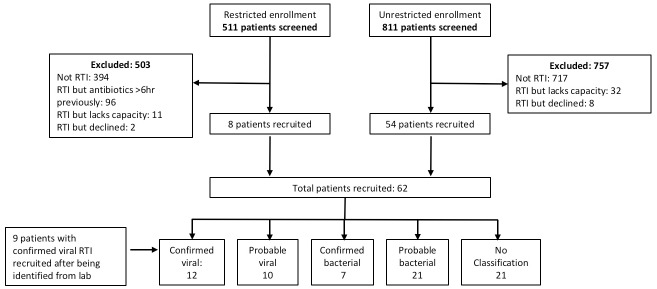
71 patients were prospectively recruited from the Acute Medical Unit of the Royal Liverpool University Hospital between March and May 2016 and classified as confirmed or probable bacterial or viral RTI on the basis of microbiologic, biochemical and radiologic testing. Breath samples were collected at the patient's bedside directly into the electronic nose device, which recorded a VOC spectrum for each sample. Sparse principal component analysis and sparse logistic regression were used to develop a diagnostic model to classify VOC spectra as being caused by bacterial or non-bacterial RTI.
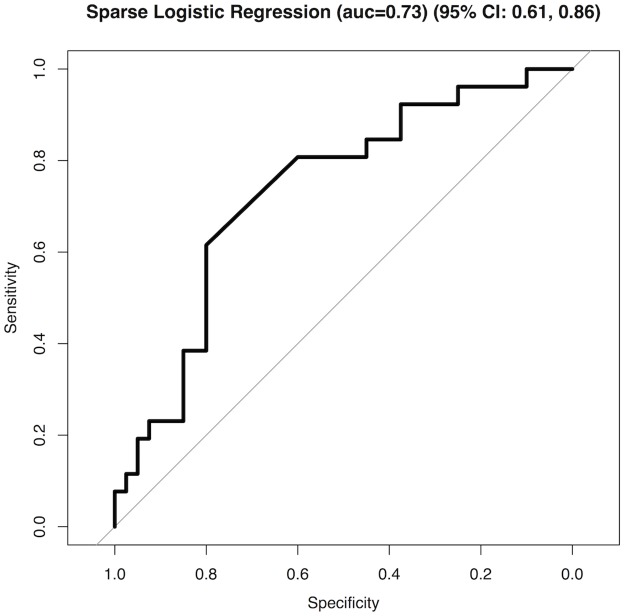
Summary area under the receiver operator characteristic curve was 0.73 (95% CI 0.61-0.86), summary sensitivity and specificity were 62% (95% CI 41-80%) and 80% (95% CI 64-91%) respectively (p = 0.00147).
GC-IMS analysis of exhaled VOC for the diagnosis of bacterial RTI shows promise in this pilot study and further trials are warranted to assess this technique.
迫切需要新的即时诊断方法,以减少细菌性呼吸道感染(RTI)抗菌药物的过度处方。我们进行了一项试点横断面研究,以评估气-毛细管柱离子迁移谱仪(GC-IMS)分析呼出气中挥发性有机化合物(VOC)以诊断医院住院患者细菌性RTI的可行性。
2016年3月至5月期间,从皇家利物浦大学医院急性医疗科前瞻性招募了71名患者,并根据微生物学、生物化学和放射学检测将其分类为确诊或可能的细菌性或病毒性RTI。在患者床边将呼气样本直接采集到电子鼻设备中,该设备记录每个样本的VOC谱。使用稀疏主成分分析和稀疏逻辑回归建立诊断模型,以将VOC谱分类为由细菌性或非细菌性RTI引起。
受试者操作特征曲线下的汇总面积为0.73(95%CI 0.61-0.86),汇总敏感性和特异性分别为62%(95%CI 41-80%)和80%(95%CI 64-91%)(p = 0.00147)。
在这项试点研究中,GC-IMS分析呼出气VOC用于诊断细菌性RTI显示出前景,有必要进行进一步试验来评估这项技术。