Tumor Angiogenesis laboratory, Georgia Cancer Center, Department of Biochemistry and Molecular Biology, Augusta University, Augusta, GA 30912, USA.
Int J Mol Sci. 2017 Dec 16;18(12):2732. doi: 10.3390/ijms18122732.
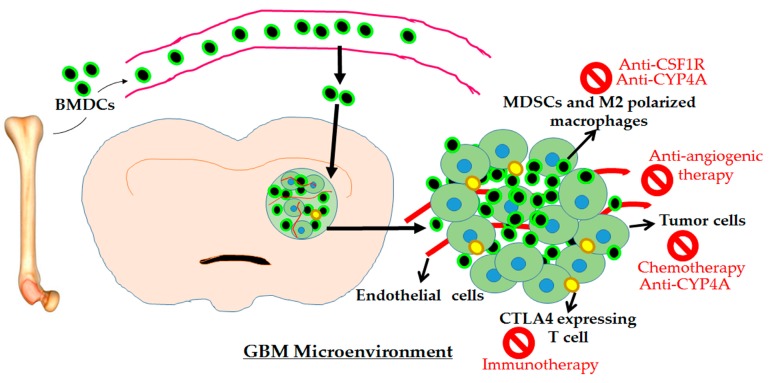
Glioblastoma (GBM) is considered one of the most malignant, genetically heterogeneous, and therapy-resistant solid tumor. Therapeutic options are limited in GBM and involve surgical resection followed by chemotherapy and/or radiotherapy. Adjuvant therapies, including antiangiogenic treatments (AATs) targeting the VEGF-VEGFR pathway, have witnessed enhanced infiltration of bone marrow-derived myeloid cells, causing therapy resistance and tumor relapse in clinics and in preclinical models of GBM. This review article is focused on gathering previous clinical and preclinical reports featuring major challenges and lessons in GBM. Potential combination therapies targeting the tumor microenvironment (TME) to overcome the myeloid cell-mediated resistance problem in GBM are discussed. Future directions are focused on the use of TME-directed therapies in combination with standard therapy in clinical trials, and the exploration of novel therapies and GBM models for preclinical studies. We believe this review will guide the future of GBM research and therapy.
胶质母细胞瘤(GBM)被认为是最恶性、遗传异质性最强、治疗耐药性最高的实体肿瘤之一。GBM 的治疗选择有限,包括手术切除,然后进行化疗和/或放疗。辅助治疗,包括针对 VEGF-VEGFR 通路的抗血管生成治疗(AATs),已经观察到骨髓来源的髓样细胞的浸润增强,导致临床和 GBM 的临床前模型中出现治疗耐药和肿瘤复发。这篇综述文章集中收集了以前的临床和临床前报告,重点介绍了 GBM 面临的主要挑战和经验教训。讨论了针对肿瘤微环境(TME)的潜在联合治疗方法,以克服 GBM 中髓样细胞介导的耐药问题。未来的方向集中在临床试验中使用 TME 靶向治疗与标准治疗相结合,以及探索新的治疗方法和 GBM 模型进行临床前研究。我们相信,这篇综述将指导 GBM 研究和治疗的未来。