Bahlani Sonia, Moldwin Robert
The Smith Institute for Urology, North Shore-Long Island Jewish Health System, New Hyde Park, NY, USA.
Asian J Urol. 2015 Jan;2(1):59-62. doi: 10.1016/j.ajur.2015.04.008. Epub 2015 Apr 16.
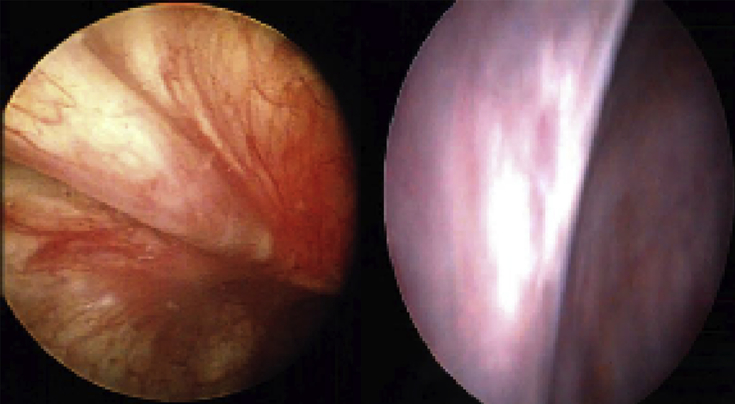
Five to ten percent of interstitial cystitis/bladder pain syndrome (IC/BPS) patients have Hunner's lesions (HL), areas of non-specific inflammation and scarring. The poor quality of life of patients with HL is entwined in associated pain and loss of bladder capacity. Although the decrease in bladder capacity is usually dependent on pain, it may also be dependent upon scarring and associated compliance changes produced by the inflammatory process. This report reviews the potential role of endoscopic scar lysis using the holmium laser in the management of these patients whose only other therapeutic option is urinary diversion.
Two patients with HL and "end stage" bladders who underwent holmium laser division of bladder wall scar/tethering were identified. Clinical data were reviewed with emphasis on safety and efficacy.
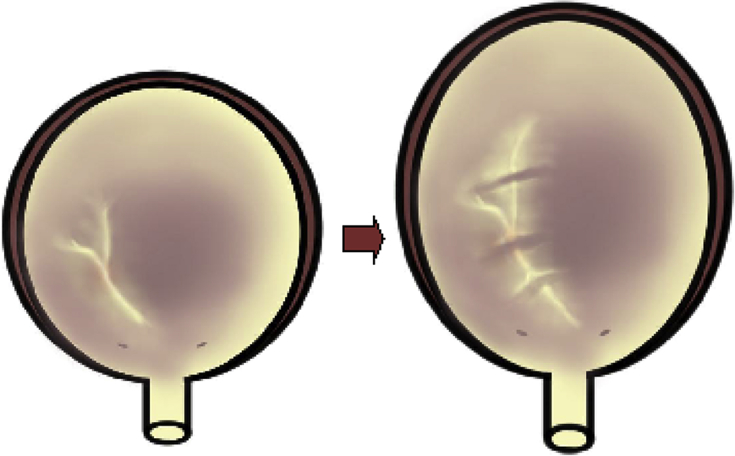
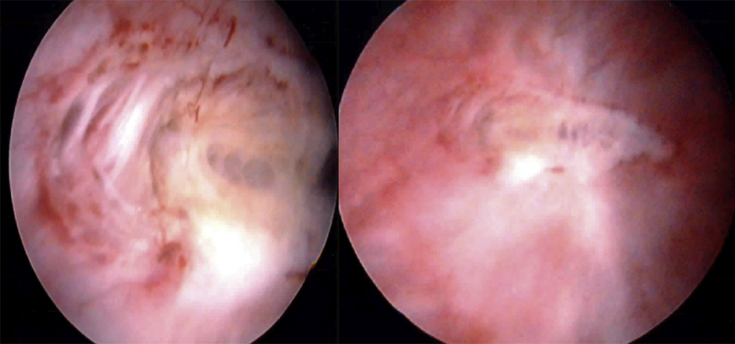
Both patients selected for this procedure underwent holmium laser lysis of known scar tissue in an effort to increase bladder capacity and improve symptoms of urinary frequency and pain with bladder filling. The median age of patients who underwent the procedure was 63 (59-67) years. Incisions were made with the holmium laser at frequencies of 3-10 Hz of 300-700 J along the region of scarring. All procedures were performed by the same practitioner. There was an increase in bladder capacity by 58.3% (50.0%-66.7%). During a mean follow-up of 4.2 years, there appeared to be a significant improvement with an increase in interval time between voids and a decrease in pain with bladder filling.
Patients with IC/BPS may be severely debilitated by a clinically significant decrease in their bladder capacity, especially in the face of HL. The use of the holmium laser to incise regions of scar and bladder wall tethering may produce a clinically significant and durable increase in bladder capacity. The use of this technique as a means of treating bladder scarring poses an excellent adjunct to existing treatment strategies.
5%至10%的间质性膀胱炎/膀胱疼痛综合征(IC/BPS)患者存在Hunner病变(HL),即非特异性炎症和瘢痕形成区域。HL患者生活质量差与相关疼痛及膀胱容量丧失密切相关。尽管膀胱容量的减少通常取决于疼痛,但也可能取决于瘢痕形成以及炎症过程引起的相关顺应性变化。本报告回顾了钬激光内镜下瘢痕松解术在这些患者管理中的潜在作用,这些患者唯一的其他治疗选择是尿流改道。
确定了两名患有HL和“终末期”膀胱的患者,他们接受了钬激光膀胱壁瘢痕/束缚松解术。回顾临床数据,重点关注安全性和有效性。
选择接受该手术的两名患者均接受了钬激光已知瘢痕组织松解术,以增加膀胱容量并改善膀胱充盈时的尿频和疼痛症状。接受该手术患者的中位年龄为63(59 - 67)岁。沿瘢痕区域用钬激光以3 - 10赫兹、300 - 700焦耳的频率进行切开。所有手术均由同一位医生进行。膀胱容量增加了58.3%(50.0% - 66.7%)。在平均4.2年的随访期间,排尿间隔时间增加,膀胱充盈时疼痛减轻,似乎有显著改善。
IC/BPS患者可能因膀胱容量临床上的显著减少而严重衰弱,尤其是面对HL时。使用钬激光切开瘢痕和膀胱壁束缚区域可能会使膀胱容量在临床上显著且持久地增加。将该技术用作治疗膀胱瘢痕形成的手段是现有治疗策略的极佳辅助方法。