Health, Medical and Neuropsychology Unit, Leiden University, The Netherlands.
Leiden Institute for Brain and Cognition, Leiden University, The Netherlands.
Eur J Pain. 2018 Apr;22(4):774-783. doi: 10.1002/ejp.1163. Epub 2017 Dec 20.
Placebo effects on pain have been found to vary in size for different routes of medication administration (e.g. oral vs. injection). This has important implications for both clinical research and practice. To enhance our understanding of these differential placebo effects, research on the underlying expectations about multiple routes and symptoms other than pain is vital.
A cross-sectional, Internet-based survey was conducted in a representative sample of the Dutch population (n = 508). Respondents rated the expected effectiveness of pain- and itch-relieving medication in six forms, representing oral, injection and topical routes of administration.
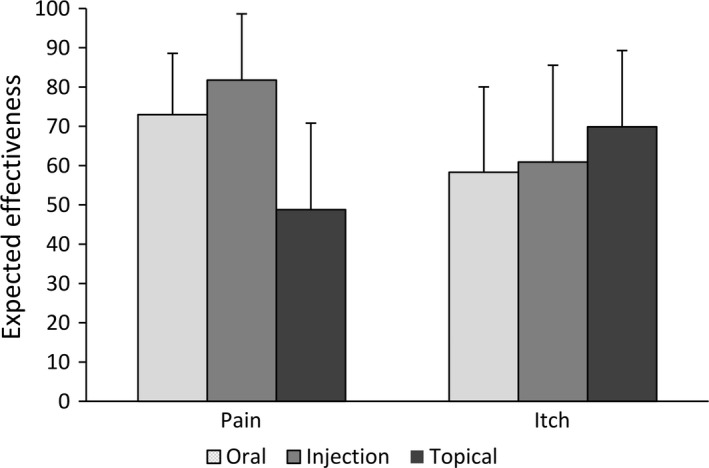
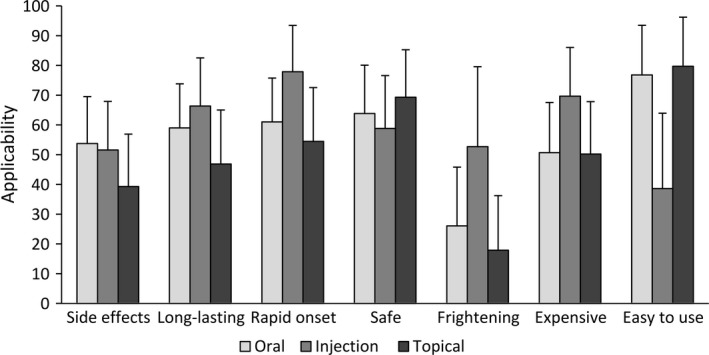
Injected medication was expected to be most effective for relieving pain, and topical medication for relieving itch. Furthermore, exploratory analyses showed that injections were expected to have the most rapid onset and long-lasting effects, and to be most frightening and expensive, while topical medication was expected to be the safest and the easiest to use, and oral medication was expected to have the most side effects. Higher expected effectiveness was moderately associated with expectations of more rapid onset and long-lasting effects, and better safety and ease of use. Associations of expected effectiveness with respondent characteristics (e.g. medication use and personality characteristics) were statistically small or nonsignificant.
Expected effectiveness of medication differed depending on route of administration and targeted symptom. These findings have important implications for the design and interpretation of clinical trials and suggest that medication effects might be enhanced by prescribing medicine via the route that patients expect to be most effective for their complaint.
Differences in the expected effectiveness of medication depend on the route of administration (oral, injection, topical) and targeted symptom (pain, itch). These findings have important implications for clinical practice and the design and interpretation of clinical trials.
已发现药物给药途径(例如口服与注射)的不同会导致疼痛的安慰剂效应大小有所差异。这对临床研究和实践都具有重要意义。为了增进我们对这些差异明显的安慰剂效应的理解,研究针对多种途径和除疼痛以外的症状的潜在预期至关重要。
在荷兰人群的代表性样本中(n=508)进行了一项横断面、基于互联网的调查。受访者对六种形式的止痛和止痒药物的预期有效性进行了评分,这些形式代表了口服、注射和局部给药途径。
注射药物被认为在缓解疼痛方面最有效,而局部用药则在缓解瘙痒方面最有效。此外,探索性分析表明,注射被认为起效最快且效果持续时间最长,最令人恐惧且昂贵,而局部用药则被认为最安全且最容易使用,口服药物被认为副作用最多。更高的预期有效性与更快的起效和更持久的效果以及更好的安全性和易用性预期适度相关。预期有效性与受访者特征(例如用药情况和人格特征)的相关性在统计学上较小或不显著。
药物的预期有效性取决于给药途径和目标症状。这些发现对临床试验的设计和解释具有重要意义,并表明通过患者认为对其病情最有效的途径开具药物可能会增强药物的疗效。
药物预期有效性的差异取决于给药途径(口服、注射、局部)和目标症状(疼痛、瘙痒)。这些发现对临床实践以及临床试验的设计和解释具有重要意义。