Department of Environmental Health and Engineering, Johns Hopkins Bloomberg School of Public Health, Baltimore, MD, USA; Department of Epidemiology and Health Services Research, Geisinger, Danville, PA, USA.
Department of Environmental Health and Engineering, Johns Hopkins Bloomberg School of Public Health, Baltimore, MD, USA.
Int J Hyg Environ Health. 2018 Mar;221(2):323-333. doi: 10.1016/j.ijheh.2017.12.005. Epub 2017 Dec 15.
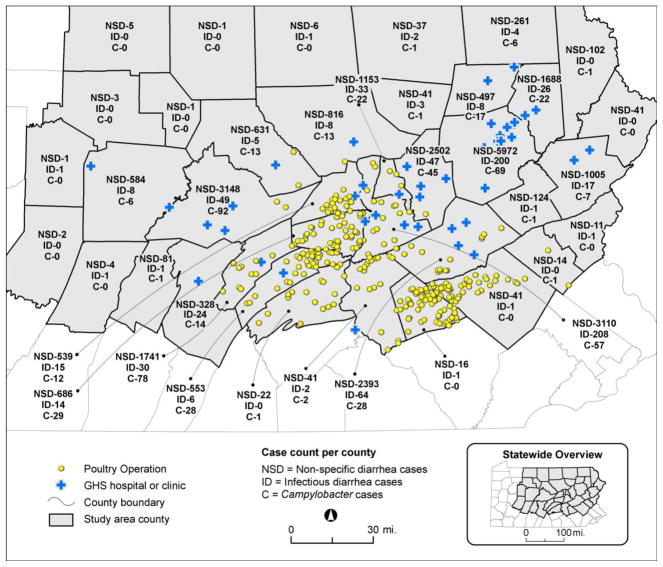
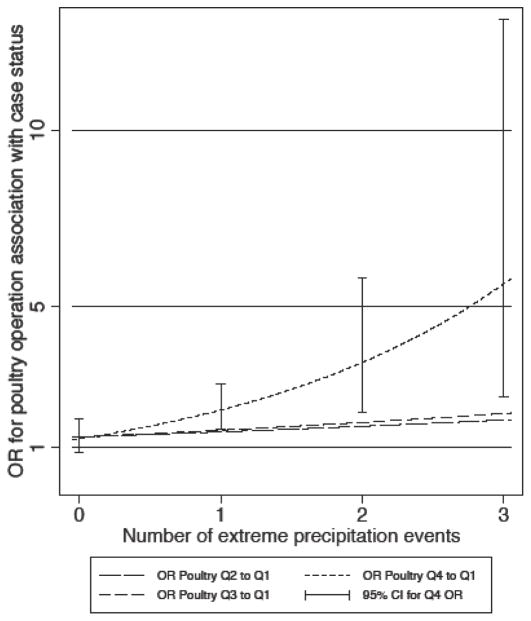
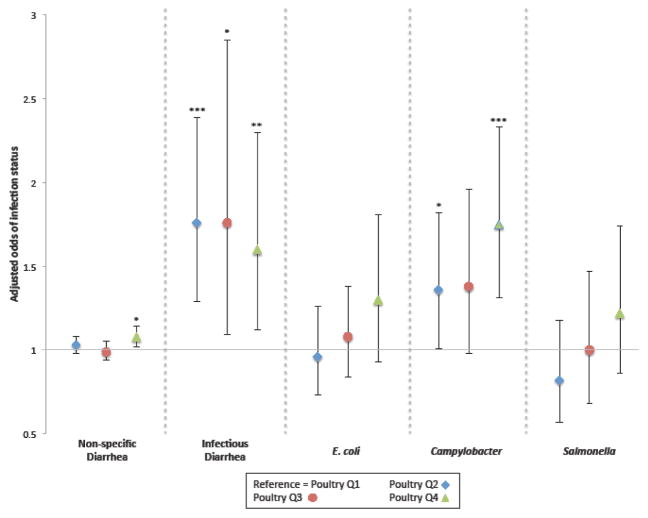
Poultry carry zoonotic bacteria that can cause gastroenteritis in humans. Environmental transmission of pathogens from poultry operations may increase gastrointestinal infection risk in surrounding communities. To evaluate associations between residential proximity to high-density poultry operations and individual-level diarrheal illnesses, we conducted a nested case-control study among 514,488 patients in Pennsylvania (2006-2015). Using electronic health records, we identified cases of five gastrointestinal outcomes: three pathogen-specific infections, including Escherichia coli (n = 1425), Campylobacter (n = 567), and Salmonella (n = 781); infectious diarrhea (n = 781); and non-specific diarrhea (2012-2015; n = 28,201). We estimated an inverse-distance squared activity metric for poultry operations based on farm and patient addresses. Patients in the second and fourth (versus first) quartiles of the poultry operation activity metric had increased odds of Campylobacter (AOR [CI], Q2: 1.36 [1.01, 1.82]; Q3: 1.38 [0.98, 1.96]; Q4: 1.75 [1.31, 2.33]). Patients in the second, third, and fourth quartiles had increased odds of infectious diarrhea (Q2: 1.76 [1.29, 2.39]; Q3: 1.76 [1.09, 2.85]; Q4: 1.60 [1.12, 2.30]). Stratification revealed stronger relations of fourth quartile and both Campylobacter and infectious diarrhea in townships, the most rural community type in the study geography. Increasing extreme rainfall in the week prior to diagnosis strengthened fourth quartile Campylobacter associations. The poultry operation activity metric was largely unassociated with E. coli, Salmonella, and non-specific diarrhea. Findings suggest high-density poultry operations may be associated with campylobacteriosis and infectious diarrhea in nearby communities, highlighting additional public health concerns of industrial agriculture.
家禽携带的人畜共患细菌可导致人类患肠胃炎。从家禽养殖场传播的病原体可能会增加周边社区的胃肠道感染风险。为了评估居住在高密度家禽养殖场附近与个体患腹泻病之间的关系,我们对宾夕法尼亚州 514488 名患者(2006-2015 年)进行了嵌套病例对照研究。我们使用电子健康记录,确定了五种胃肠道疾病的病例:三种病原体特异性感染,包括大肠杆菌(n=1425)、弯曲杆菌(n=567)和沙门氏菌(n=781);感染性腹泻(n=781);和非特异性腹泻(2012-2015 年;n=28201)。我们根据农场和患者的地址,为家禽养殖场制定了一个基于距离平方的活动度量。家禽养殖场活动度量第二和第四(与第一相比)四分位数的患者感染弯曲杆菌的几率更高(OR[CI],四分位 2:1.36[1.01,1.82];四分位 3:1.38[0.98,1.96];四分位 4:1.75[1.31,2.33])。第二、第三和第四四分位数的患者感染传染性腹泻的几率更高(四分位 2:1.76[1.29,2.39];四分位 3:1.76[1.09,2.85];四分位 4:1.60[1.12,2.30])。分层分析表明,在研究区域中最农村的乡镇,第四四分位数与弯曲杆菌和传染性腹泻的关系更强。在诊断前一周内,极端降雨的增加加强了第四四分位数与弯曲杆菌的关联。家禽养殖场活动度量与大肠杆菌、沙门氏菌和非特异性腹泻的关联不大。研究结果表明,高密度家禽养殖场可能与附近社区的弯曲杆菌病和传染性腹泻有关,这突出了工业农业的其他公共卫生问题。