Henske John K, Gilmore Sean P, Knop Doriv, Cunningham Francis J, Sexton Jessica A, Smallwood Chuck R, Shutthanandan Vaithiyalingam, Evans James E, Theodorou Michael K, O'Malley Michelle A
Department of Chemical Engineering, University of California, Santa Barbara, CA 93106 USA.
Environmental Molecular Sciences Laboratory, Pacific Northwest National Laboratory, Richland, WA 99354 USA.
Biotechnol Biofuels. 2017 Dec 20;10:305. doi: 10.1186/s13068-017-0997-4. eCollection 2017.
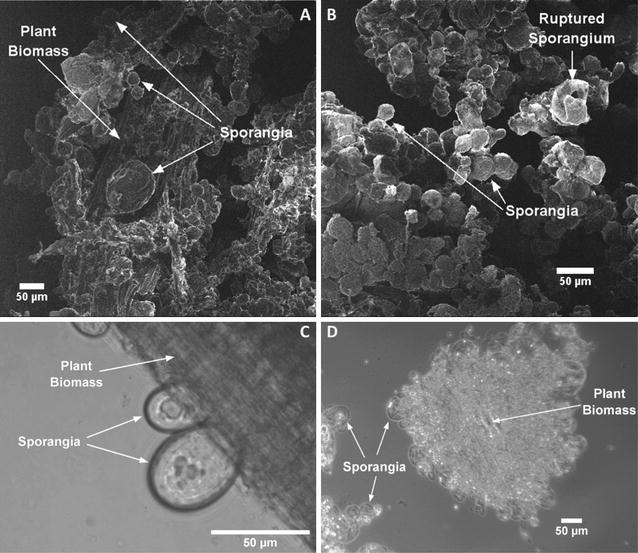
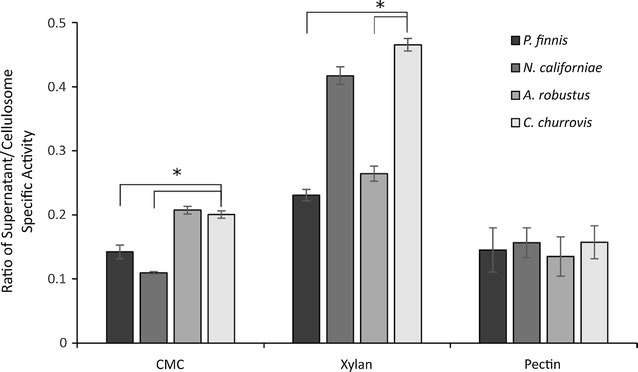
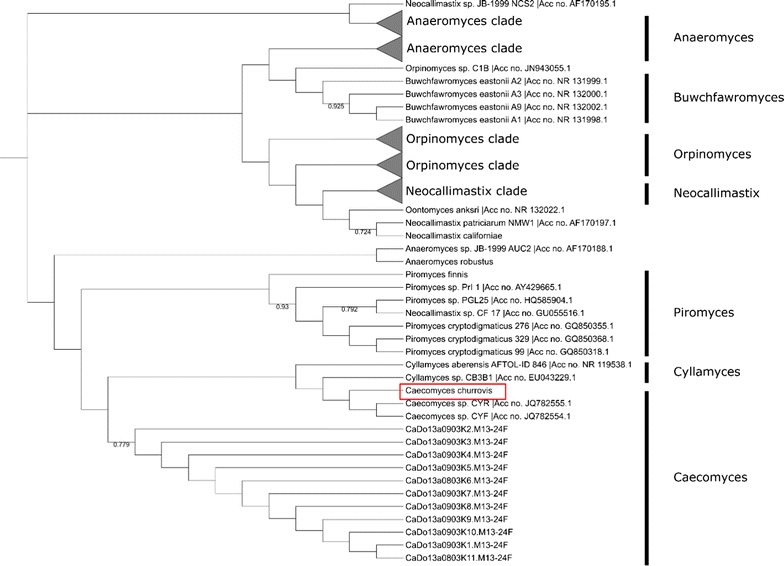
Anaerobic gut fungi are the primary colonizers of plant material in the rumen microbiome, but are poorly studied due to a lack of characterized isolates. While most genera of gut fungi form extensive rhizoidal networks, which likely participate in mechanical disruption of plant cell walls, fungi within the genus do not possess these rhizoids. Here, we describe a novel fungal isolate, , which forms spherical sporangia with a limited rhizoidal network yet secretes a diverse set of carbohydrate active enzymes (CAZymes) for plant cell wall hydrolysis. Despite lacking an extensive rhizoidal system, is capable of growth on fibrous substrates like switchgrass, reed canary grass, and corn stover, although faster growth is observed on soluble sugars. Gut fungi have been shown to use enzyme complexes (fungal cellulosomes) in which CAZymes bind to non-catalytic scaffoldins to improve biomass degradation efficiency. However, transcriptomic analysis and enzyme activity assays reveal that relies more on free enzymes compared to other gut fungal isolates. Only 15% of CAZyme transcripts contain non-catalytic dockerin domains in , compared to 30% in rhizoid-forming fungi. Furthermore, is enriched in GH43 enzymes that provide complementary hemicellulose degrading activities, suggesting that a wider variety of these activities are required to degrade plant biomass in the absence of an extensive fungal rhizoid network. Overall, molecular characterization of a non-rhizoid-forming anaerobic fungus fills a gap in understanding the roles of CAZyme abundance and associated degradation mechanisms during lignocellulose breakdown within the rumen microbiome.
厌氧肠道真菌是瘤胃微生物群中植物材料的主要定殖者,但由于缺乏特征明确的分离株,对其研究较少。虽然大多数肠道真菌属形成广泛的根状网络,这可能参与植物细胞壁的机械破坏,但该属内的真菌不具有这些根状结构。在这里,我们描述了一种新型真菌分离株,它形成具有有限根状网络的球形孢子囊,但分泌多种碳水化合物活性酶(CAZymes)用于植物细胞壁水解。尽管缺乏广泛的根状系统,但该分离株能够在柳枝稷、芦苇雀麦和玉米秸秆等纤维底物上生长,尽管在可溶性糖上观察到更快的生长。肠道真菌已被证明使用酶复合物(真菌纤维小体),其中CAZymes与非催化支架蛋白结合以提高生物质降解效率。然而,转录组分析和酶活性测定表明,与其他肠道真菌分离株相比,该分离株更多地依赖游离酶。在该分离株中,只有15%的CAZyme转录本含有非催化dockerin结构域,而在形成根状结构的真菌中这一比例为30%。此外,该分离株富含提供互补半纤维素降解活性的GH43酶,这表明在没有广泛的真菌根状网络的情况下,需要更广泛的这些活性来降解植物生物质。总体而言,对一种不形成根状结构的厌氧真菌的分子表征填补了在理解瘤胃微生物群中木质纤维素分解过程中CAZyme丰度和相关降解机制的作用方面的空白。