Institute of Landscape Architecture, College of Agriculture & Biotechnology, Zhejiang University, Hangzhou, 310058, China.
Research & Development Centre of Flower, Zhejiang Academy of Agricultural Sciences, Hangzhou, 311202, China.
BMC Plant Biol. 2017 Dec 22;17(1):262. doi: 10.1186/s12870-017-1205-1.
The artificial enlargement of the planting area and ecological amplitude of ornamentals for horticultural and landscape applications are significant. Herbaceous peony (Paeonia lactiflora Pall.) is a world-famous ornamental with attractive and fragrant flowers and is mainly planted in temperate and cool areas. Comparatively higher winter temperatures in the subtropical and tropical Northern Hemisphere result in a deficit of chilling accumulation for bud dormancy release, which severely hinders "The southward plantation of herbaceous peony". Studies on the dormancy, chilling requirement (CR) and relevant molecular mechanisms of peony are needed to enhance our ability to extend the range of this valuable horticultural species.
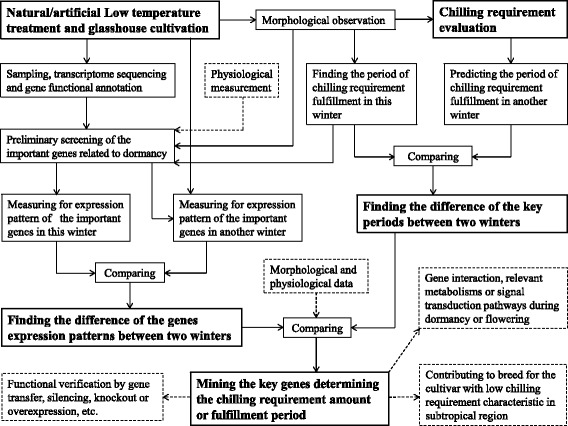
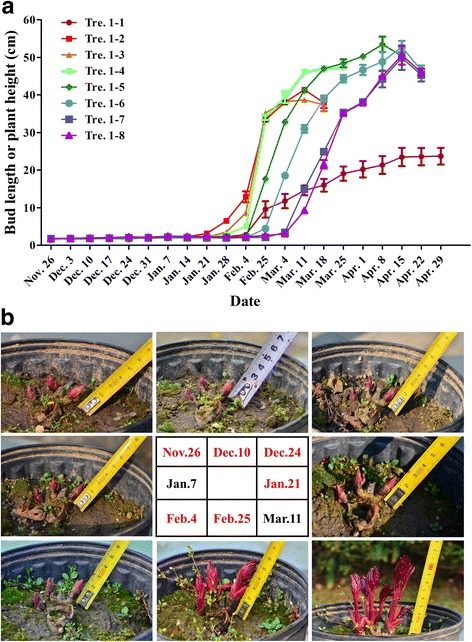
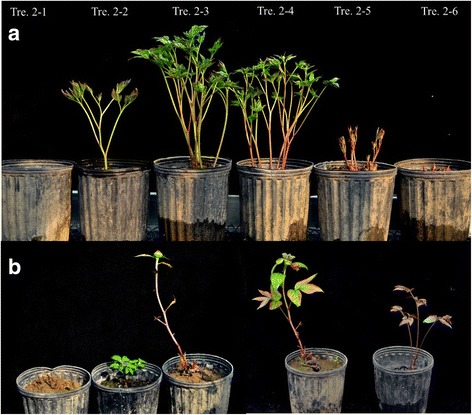
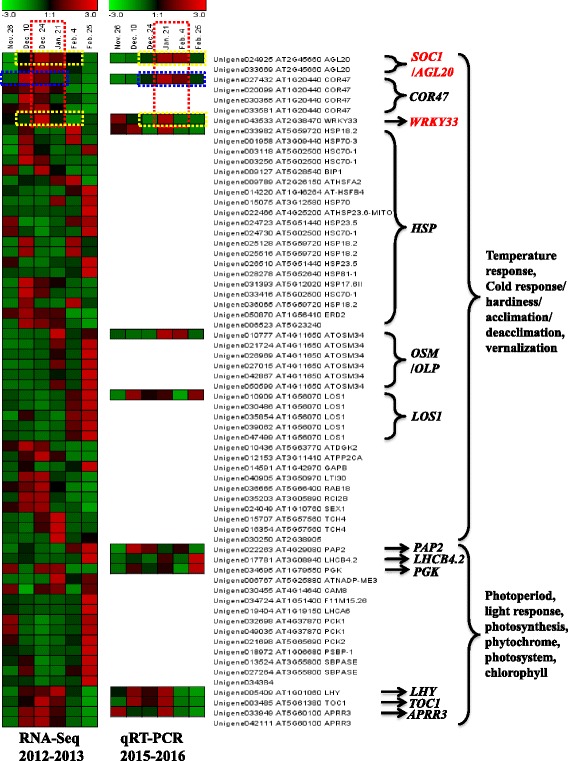
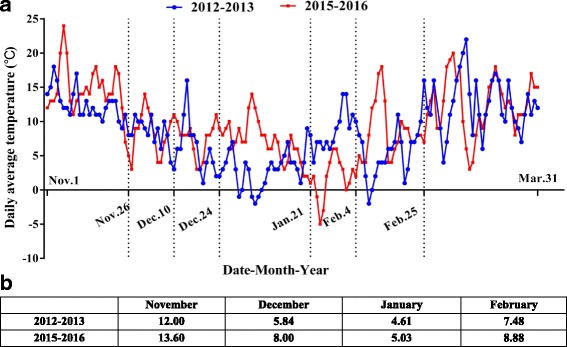
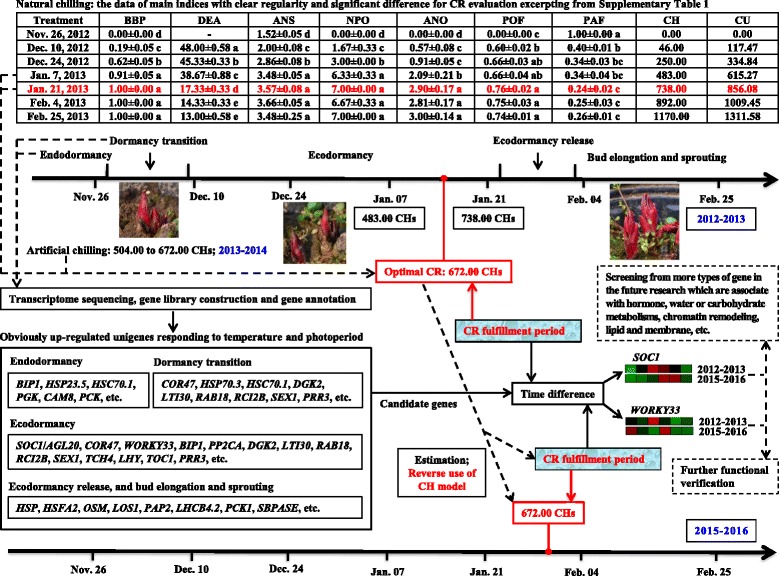
Based on natural and artificial chilling experiments, and chilling hour (CH) and chilling unit (CU) evaluation systems, the lowest CR of 'Hang Baishao' was between 504.00 and 672.00 CHs and the optimal CR was 672.00 CHs and 856.08 CUs for achieving strong sprouting, growth and flowering performance. Transcriptome sequencing and gene identification by RNA-Seq were performed on 'Hang Baishao' buds during the dormancy and sprouting periods. Six gene libraries were constructed, and 66 temperature- and photoperiod-associated unigenes were identified as the potential candidate genes that may regulate or possibly determine CR characteristics. The difference in the expression patterns of SUPPRESSPOR OF OVEREXPRESSION OF CONSTANS1 (SOC1) between the winters of 2012-2013 and 2015-2016, and the difference of CR fulfillment periods also between these two winters represented the interesting congruent relationships. This correlation was also observed for WRKY DNA-BINDING PROTEIN 33 (WRKY 33).
Combined with the results acquired from all of experiments, 'Hang Baishao' was confirmed to be a superb peony resource that have significantly low CR characteristics. The two genes of SOC1 and WRKY33 are likely involved in determining the CR amount and fulfillment period of 'Hang Baishao'. HEAT SHOCK PROTEIN, OSMOTIN and TIMING OF CAB EXPRESSION 1 also deserve attention for the CR research. This study could contribute to the knowledge of the deep factors and mechanisms that regulate CR characteristics, and may be beneficial for breeding new germplasms that have low CRs for landscape or horticulture applications in subtropical regions.
为了园艺和景观应用,人工扩大花卉的种植面积和生态幅度是很重要的。芍药(Paeonia lactiflora Pall.)是一种世界著名的观赏花卉,具有迷人的花朵和芳香,主要种植在温带和凉爽地区。在北半球的亚热带和热带地区,冬季温度相对较高,导致休眠芽解除休眠所需的冷积累不足,这严重阻碍了“芍药南移种植”。因此,研究芍药休眠、需冷量(CR)及其相关分子机制,对于提高将这一宝贵园艺品种推广到更广泛地区的能力非常必要。
基于自然和人工低温处理实验,以及低温小时(CH)和低温单位(CU)评价系统,‘杭白芍’的最低需冷量(CR)在 504.00 到 672.00 CHs 之间,最佳 CR 为 672.00 CHs 和 856.08 CU,以实现旺盛的萌发、生长和开花表现。在休眠和萌发期间,通过 RNA-Seq 对‘杭白芍’芽进行转录组测序和基因鉴定。构建了六个基因文库,鉴定了 66 个与温度和光周期相关的基因,它们可能是调节或决定 CR 特征的潜在候选基因。2012-2013 年和 2015-2016 年冬季之间 SOC1 和 WRKY33 表达模式的差异,以及这两个冬季之间 CR 满足期的差异,代表了有趣的一致性关系。WRKY33 和 SOC1 基因之间也存在这种相关性。
结合所有实验结果,证实‘杭白芍’是一种具有显著低 CR 特征的优良芍药资源。SOC1 和 WRKY33 这两个基因可能参与决定‘杭白芍’的 CR 量和满足期。热休克蛋白、渗透素和 CAB 表达 1 的定时(TIMING OF CAB EXPRESSION 1)也值得关注,因为它们与 CR 研究有关。本研究有助于深入了解调控 CR 特征的因素和机制,可能有助于培育出具有低 CR 的新种质资源,以满足亚热带地区景观或园艺应用的需求。