International Management Institute, School of Management and Law, Zurich University of Applied Sciences, Winterthur, Switzerland.
Winterthur Institute of Health Economics, School of Management and Law, Zurich University of Applied Sciences, Winterthur, Switzerland.
J Med Internet Res. 2020 Oct 22;22(10):e18801. doi: 10.2196/18801.
The advancement of wearable devices and growing demand of consumers to monitor their own health have influenced the medical industry. Health care providers, insurers, and global technology companies intend to develop more wearable devices incorporating medical technology and to target consumers worldwide. However, acceptance of these devices varies considerably among consumers of different cultural backgrounds. Consumer willingness to use health care wearables is influenced by multiple factors that are of varying importance in various cultures. However, there is insufficient knowledge of the extent to which social and cultural factors affect wearable technology acceptance in health care.
The aims of this study were to examine the influential factors on the intention to adopt health care wearables, and the differences in the underlying motives and usage barriers between Chinese and Swiss consumers.
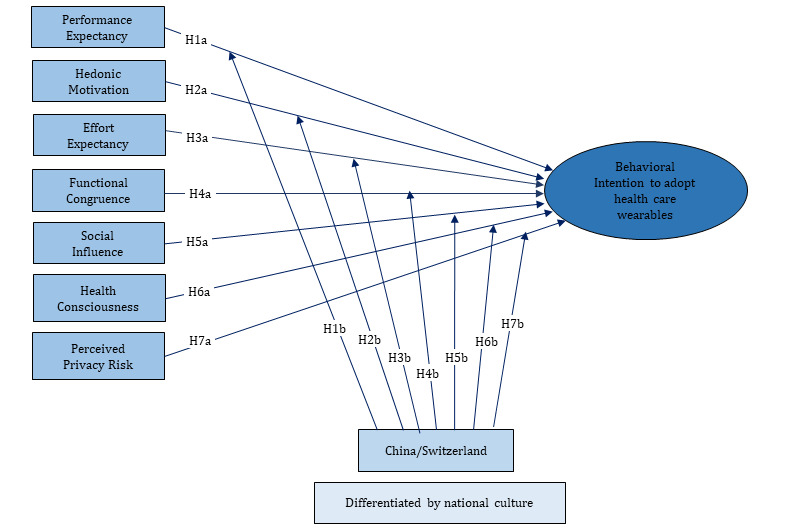
A new model for acceptance of health care wearables was conceptualized by incorporating predictors of different theories such as technology acceptance, health behavior, and privacy calculus based on an existing framework. To verify the model, a web-based survey in both the Chinese and German languages was conducted in China and Switzerland, resulting in 201 valid Chinese and 110 valid Swiss respondents. A multigroup partial least squares path analysis was applied to the survey data.
Performance expectancy (β=.361, P<.001), social influence (β=.475, P<.001), and hedonic motivation (β=.111, P=.01) all positively affected the behavioral intention of consumers to adopt wearables, whereas effort expectancy, functional congruence, health consciousness, and perceived privacy risk did not demonstrate a significant impact on behavioral intention. The group-specific path coefficients indicated health consciousness (β=.150, P=.01) as a factor positively affecting only the behavior intention of the Chinese respondents, whereas the factors affecting only the behavioral intention of the Swiss respondents proved to be effort expectancy (β=.165, P=.02) and hedonic motivation (β=.212, P=.02). Performance expectancy asserted more of an influence on the behavioral intention of the Swiss (β=.426, P<.001) than the Chinese (β=.271, P<.001) respondents, whereas social influence had a greater influence on the behavioral intention of the Chinese (β=.321, P<.001) than the Swiss (β=.217, P=.004) respondents. Overall, the Chinese consumers displayed considerably higher behavioral intention (P<.001) than the Swiss. These discrepancies are explained by differences in national culture.
This is one of the first studies to investigate consumers' intention to adopt wearables from a cross-cultural perspective. This provides a theoretical and methodological foundation for future research, as well as practical implications for global vendors and insurers developing and promoting health care wearables with appropriate features in different countries. The testimonials and support by physicians, evidence of measurement accuracy, and easy handling of health care wearables would be useful in promoting the acceptance of wearables in Switzerland. The opinions of in-group members, involvement of employers, and multifunctional apps providing credible health care advice and solutions in cooperation with health care institutions would increase acceptance among the Chinese.
可穿戴设备的进步和消费者对自身健康监测需求的增长,影响了医疗行业。医疗服务提供者、保险公司和全球科技公司都希望开发更多将医疗技术融入其中的可穿戴设备,并面向全球消费者。然而,不同文化背景的消费者对这些设备的接受程度差异很大。消费者使用医疗保健可穿戴设备的意愿受到多种因素的影响,这些因素在不同文化中的重要性也各不相同。然而,我们对社会和文化因素在多大程度上影响医疗保健领域可穿戴技术的接受程度知之甚少。
本研究旨在考察影响消费者采用医疗保健可穿戴设备意愿的因素,以及中瑞消费者在潜在动机和使用障碍方面的差异。
通过纳入基于现有框架的不同理论(如技术接受、健康行为和隐私计算)的预测因子,对医疗保健可穿戴设备的接受模型进行了概念化。为了验证该模型,我们在中国和瑞士以中文和德文进行了在线调查,共获得 201 名中国有效受访者和 110 名瑞士有效受访者。采用多群组偏最小二乘路径分析对调查数据进行分析。
表现预期(β=.361,P<.001)、社会影响(β=.475,P<.001)和享乐动机(β=.111,P=.01)均对消费者采用可穿戴设备的行为意愿产生积极影响,而努力预期、功能一致性、健康意识和感知隐私风险则对行为意愿没有显著影响。群组特定路径系数表明,健康意识(β=.150,P=.01)仅对中国受访者的行为意愿产生积极影响,而仅对瑞士受访者的行为意愿产生影响的因素则是努力预期(β=.165,P=.02)和享乐动机(β=.212,P=.02)。表现预期对瑞士(β=.426,P<.001)的行为意愿的影响大于中国(β=.271,P<.001)受访者,而社会影响对中国(β=.321,P<.001)受访者的行为意愿的影响大于瑞士(β=.217,P=.004)受访者。总体而言,中国消费者表现出的行为意愿明显高于瑞士消费者(P<.001)。这些差异可以用民族文化的差异来解释。
这是从跨文化角度研究消费者采用可穿戴设备意愿的首批研究之一。这为未来的研究提供了理论和方法基础,同时也为在不同国家开发和推广具有适当功能的医疗保健可穿戴设备的全球供应商和保险公司提供了实际意义。医生的证明和支持、测量准确性的证据以及医疗保健可穿戴设备的易于操作,将有助于在瑞士推广可穿戴设备的接受度。中国方面,群体内成员的意见、雇主的参与以及提供可靠医疗保健建议和解决方案的多功能应用程序,与医疗机构合作,将增加可穿戴设备的接受度。
