Nam Hui, Guinan John J
Eaton-Peabody Lab, Mass. Eye and Ear Infirmary, 243 Charles St., Boston, MA 02114, USA; Harvard-MIT HST Speech and Hearing Bioscience and Technology Program, Cambridge, MA, USA.
Eaton-Peabody Lab, Mass. Eye and Ear Infirmary, 243 Charles St., Boston, MA 02114, USA; Harvard-MIT HST Speech and Hearing Bioscience and Technology Program, Cambridge, MA, USA; Harvard Medical School, Dept. of Otolaryngology, Boston, MA, USA.
Hear Res. 2018 Feb;358:1-9. doi: 10.1016/j.heares.2017.12.008. Epub 2017 Dec 14.
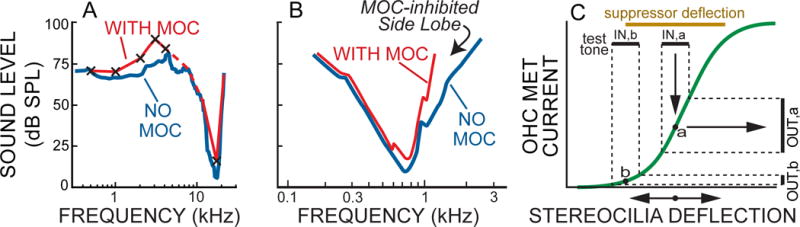
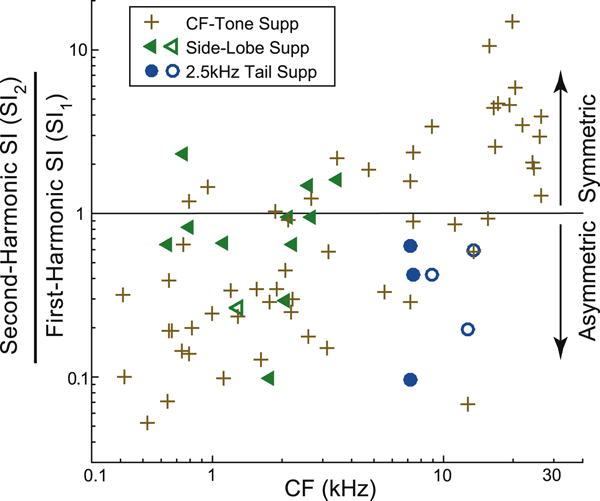
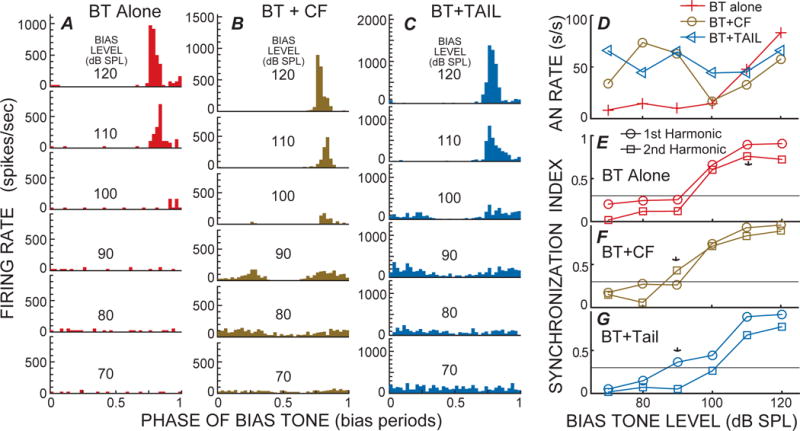
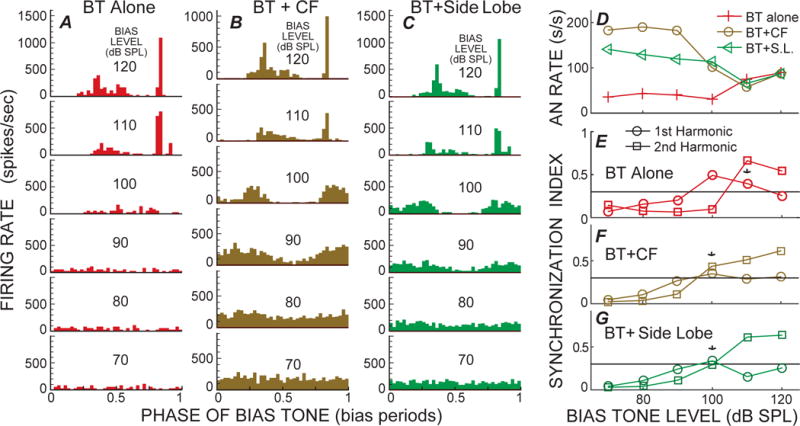
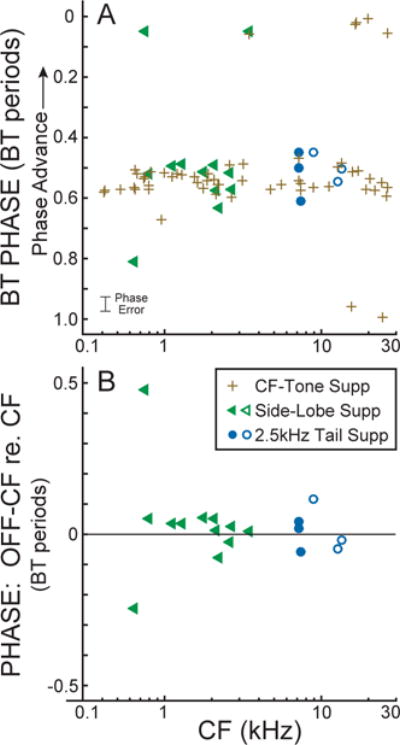
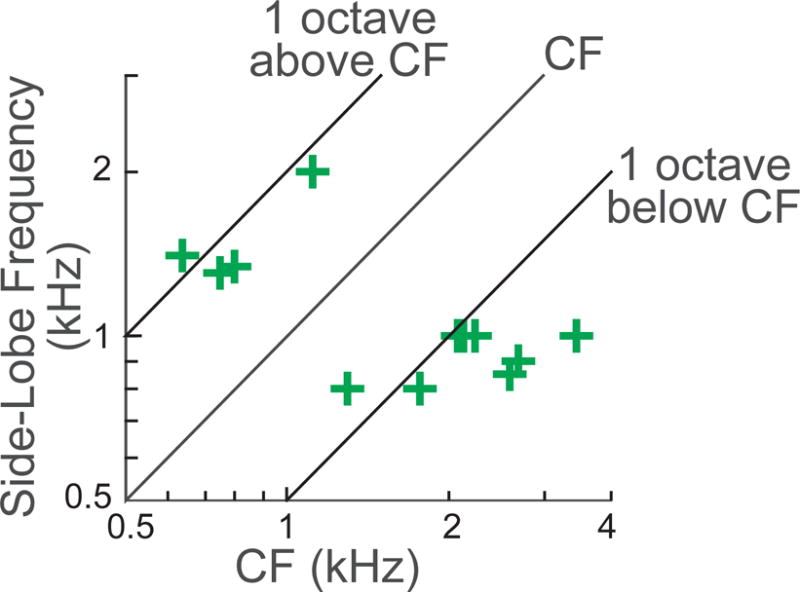
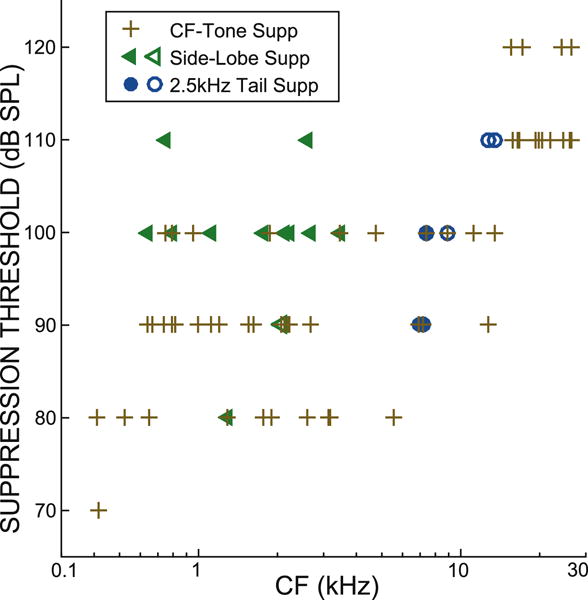
Recent cochlear mechanical measurements show that active processes increase the motion response of the reticular lamina (RL) at frequencies more than an octave below the local characteristic frequency (CF) for CFs above 5 kHz. A possible correlate is that in high-CF (>5 kHz) auditory-nerve (AN) fibers, responses to frequencies 1-3 octaves below CF ("tail" frequencies) can be inhibited by medial olivocochlear (MOC) efferents. These results indicate that active processes enhance the sensitivity of tail-frequency RL and AN responses. Perhaps related is that some apical low-CF AN fibers have tuning-curve (TC) "side-lobe" response areas at frequencies above and below the TC-tip that are MOC inhibited. We hypothesized that the tail and side-lobe responses are enhanced by the same active mechanisms as CF cochlear amplification. If responses to CF, tail-frequency, and TC-side-lobe tones are all enhanced by prestin motility controlled by outer-hair-cell (OHC) transmembrane voltage, then they should depend on OHC stereocilia position in the same way. To test this, we cyclically changed the OHC-stereocilia mechano-electric-transduction (MET) operating point with low-frequency "bias" tones (BTs) and increased the BT level until the BT caused quasi-static OHC MET saturation that reduced or "suppressed" the gain of OHC active processes. While measuring cat AN-fiber responses, 50 Hz BT level series, 70-120 dB SPL, were run alone and with CF tones, or 2.5 kHz tail-frequency tones, or side-lobe tones. BT-tone-alone responses were used to exclude BT sound levels that produced AN responses that might obscure BT suppression. Data were analyzed to show the BT phase that suppressed the tone responses at the lowest sound level. We found that AN responses to CF, tail-frequency, and side-lobe tones were suppressed at the same BT phase in almost all cases. The data are consistent with the enhancement of responses to CF, tail-frequency, and side-lobe tones all being due to the same OHC-stereocilia MET-dependent active process. Thus, OHC active processes enhance AN responses at frequencies outside of the cochlear-amplified TC-tip region in both high- and low-frequency cochlear regions. The data are consistent with the AN response enhancements being due to enhanced RL motion that drives IHC-stereocilia deflection by traditional RL-TM shear and/or by changing the RL-TM gap. Since tail-frequency basilar membrane (BM) motion is not actively enhanced, the tail-frequency IHC drive is from a vibrational mode little present on the BM, not a "second filter" of BM motion.
最近的耳蜗力学测量表明,对于高于5kHz的特征频率(CF),主动过程会在比局部CF低一个倍频程以上的频率增加网状板(RL)的运动响应。一个可能的关联是,在高CF(>5kHz)听神经(AN)纤维中,对低于CF 1 - 3个倍频程的频率(“尾”频率)的响应可被内侧橄榄耳蜗(MOC)传出神经抑制。这些结果表明,主动过程增强了尾频RL和AN响应的敏感性。可能相关的是,一些顶端低CF的AN纤维在TC尖端上方和下方的频率处有调谐曲线(TC)“旁瓣”响应区域,这些区域会被MOC抑制。我们假设尾瓣和旁瓣响应是由与CF耳蜗放大相同的主动机制增强的。如果对CF、尾频和TC旁瓣音调的响应都通过外毛细胞(OHC)跨膜电压控制的prestin运动性增强,那么它们应该以相同的方式依赖于OHC静纤毛位置。为了测试这一点,我们用低频“偏置”音调(BTs)周期性地改变OHC静纤毛机械电转导(MET)工作点,并增加BT水平,直到BT导致准静态OHC MET饱和,从而降低或“抑制”OHC主动过程的增益。在测量猫AN纤维响应时,单独运行50Hz的BT水平系列,70 - 120dB SPL,并与CF音调、2.5kHz尾频音调或旁瓣音调一起运行。单独的BT音调响应用于排除可能掩盖BT抑制的产生AN响应的BT声级。分析数据以显示在最低声级抑制音调响应的BT相位。我们发现,在几乎所有情况下,对CF、尾频和旁瓣音调的AN响应在相同的BT相位被抑制。这些数据与对CF、尾频和旁瓣音调的响应增强均归因于相同的依赖于OHC静纤毛MET的主动过程一致。因此,OHC主动过程在高频和低频耳蜗区域的耳蜗放大TC尖端区域之外的频率增强AN响应。这些数据与AN响应增强是由于RL运动增强一致,RL运动通过传统的RL - TM剪切和/或通过改变RL - TM间隙驱动IHC静纤毛偏转。由于尾频基底膜(BM)运动没有被主动增强,尾频IHC驱动来自BM上几乎不存在的振动模式,而不是BM运动的“第二个滤波器”。