Institute of Biomedical Research, Shandong University of Technology, Zibo 255000, Shandong, China.
Shandong Provincial Research Center for Bioinformatic Engineering and Technique, School of Life Sciences, Shandong University of Technology, Zibo 255000, Shandong, China.
Nutrients. 2017 Dec 28;10(1):28. doi: 10.3390/nu10010028.
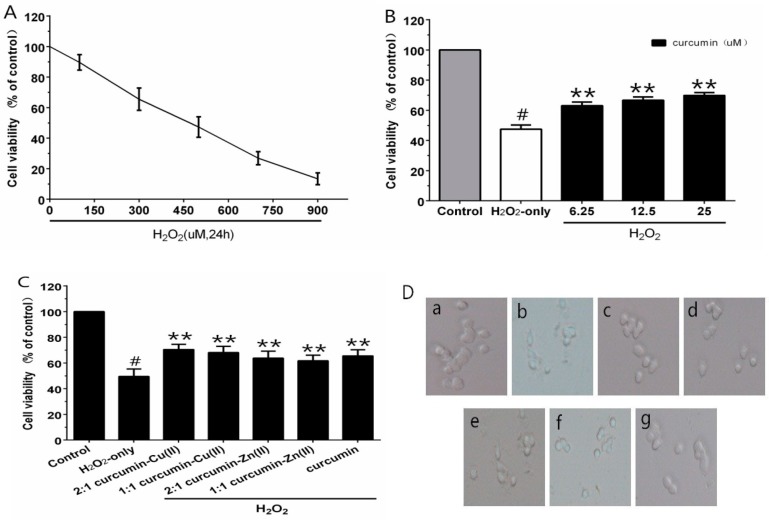
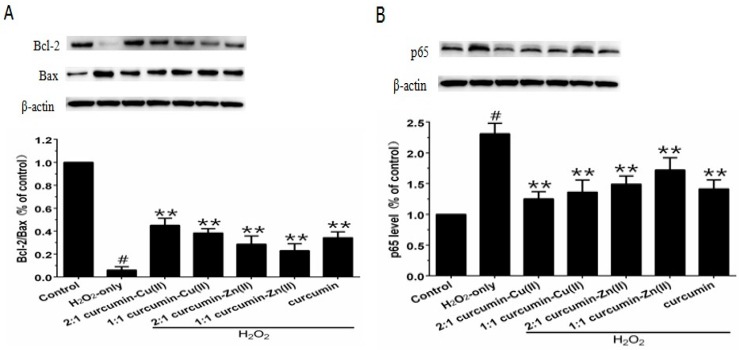
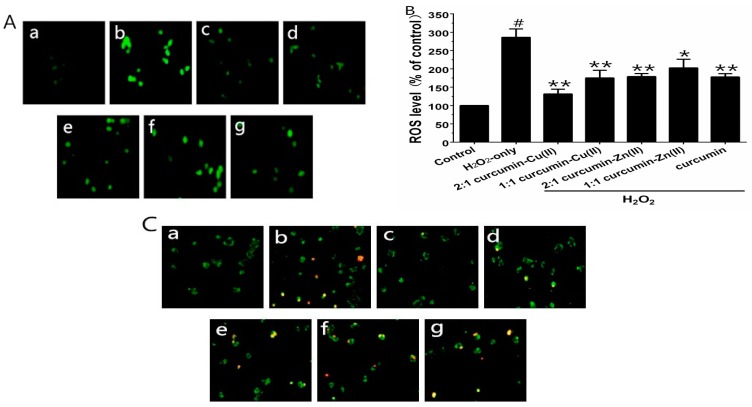
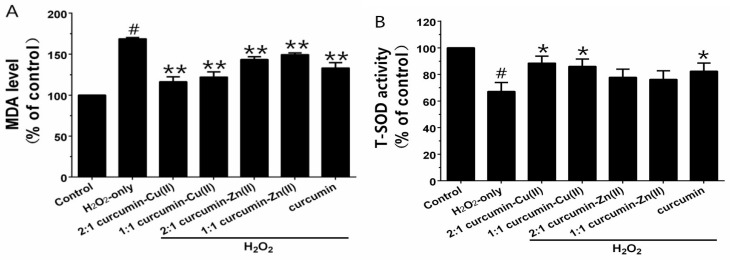
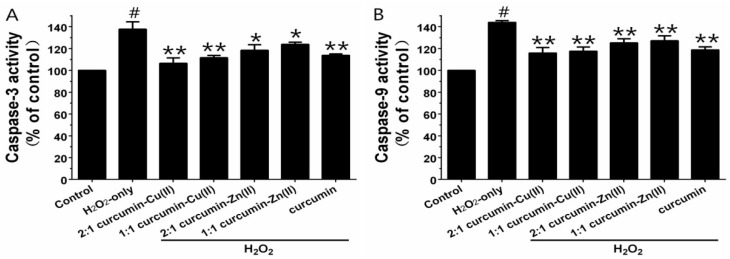
Alzheimer's disease (AD) is the main form of dementia and has a steadily increasing prevalence. As both oxidative stress and metal homeostasis are involved in the pathogenesis of AD, it would be interesting to develop a dual function agent, targeting the two factors. Curcumin, a natural compound isolated from the rhizome of , is an antioxidant and can also chelate metal ions. Whether the complexes of curcumin with metal ions possess neuroprotective effects has not been evaluated. Therefore, the present study was designed to investigate the protective effects of the complexes of curcumin with Cu(II) or Zn(II) on hydrogen peroxide (H₂O₂)-induced injury and the underlying molecular mechanisms. The use of rat pheochromocytoma (PC12) cells, a widely used neuronal cell model system, was adopted. It was revealed that curcumin-Cu(II) complexes systems possessed enhanced O₂-scavenging activities compared to unchelated curcumin. In comparison with unchelated curcumin, the protective effects of curcumin-Cu(II) complexes systems were stronger than curcumin-Zn(II) system. Curcumin-Cu(II) or -Zn(II) complexes systems significantly enhanced the superoxide dismutase, catalase, and glutathione peroxidase activities and attenuated the increase of malondialdehyde levels and caspase-3 and caspase-9 activities, in a dose-dependent manner. The curcumin-Cu(II) complex system with a 2:1 ratio exhibited the most significant effect. Further mechanistic study demonstrated that curcumin-Cu(II) or -Zn(II) complexes systems inhibited cell apoptosis via downregulating the nuclear factor κB (NF-κB) pathway and upregulating Bcl-2/Bax pathway. In summary, the present study found that curcumin-Cu(II) or -Zn(II) complexes systems, especially the former, possess significant neuroprotective effects, which indicates the potential advantage of curcumin as a promising agent against AD and deserves further study.
阿尔茨海默病(AD)是痴呆症的主要形式,其患病率呈稳步上升趋势。由于氧化应激和金属稳态都参与 AD 的发病机制,因此开发一种针对这两个因素的双重功能药物将是很有趣的。姜黄素是从姜黄根茎中分离出来的一种天然化合物,是一种抗氧化剂,也可以螯合金属离子。姜黄素与金属离子的配合物是否具有神经保护作用尚未得到评估。因此,本研究旨在探讨姜黄素与 Cu(II)或 Zn(II)形成的配合物对过氧化氢(H₂O₂)诱导损伤的保护作用及其潜在的分子机制。采用大鼠嗜铬细胞瘤(PC12)细胞作为一种广泛应用的神经元细胞模型系统。结果表明,与未配位的姜黄素相比,姜黄素-Cu(II)配合物体系具有增强的 O₂清除活性。与未配位的姜黄素相比,姜黄素-Cu(II)配合物体系的保护作用强于姜黄素-Zn(II)体系。姜黄素-Cu(II)或-Zn(II)配合物体系可显著增强超氧化物歧化酶、过氧化氢酶和谷胱甘肽过氧化物酶的活性,并在一定剂量范围内降低丙二醛水平和 caspase-3、caspase-9 的活性。2:1 比例的姜黄素-Cu(II)配合物体系作用最为显著。进一步的机制研究表明,姜黄素-Cu(II)或-Zn(II)配合物体系通过下调核因子 κB(NF-κB)通路和上调 Bcl-2/Bax 通路抑制细胞凋亡。综上所述,本研究发现姜黄素-Cu(II)或-Zn(II)配合物体系,尤其是前者,具有显著的神经保护作用,表明姜黄素作为一种有希望的抗 AD 药物具有潜在优势,值得进一步研究。