Research and Development Laboratory, Noble Pharma LLC, Menomonie, WI 54751, USA.
Research and Development Laboratory, Vets-Plus Inc, Menomonie, WI 54751, USA.
Int J Mol Sci. 2021 Jun 30;22(13):7094. doi: 10.3390/ijms22137094.
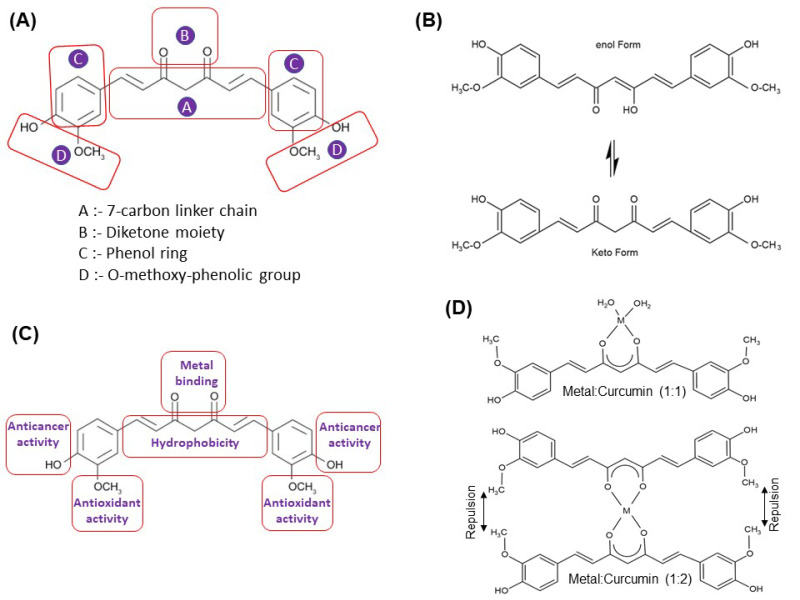
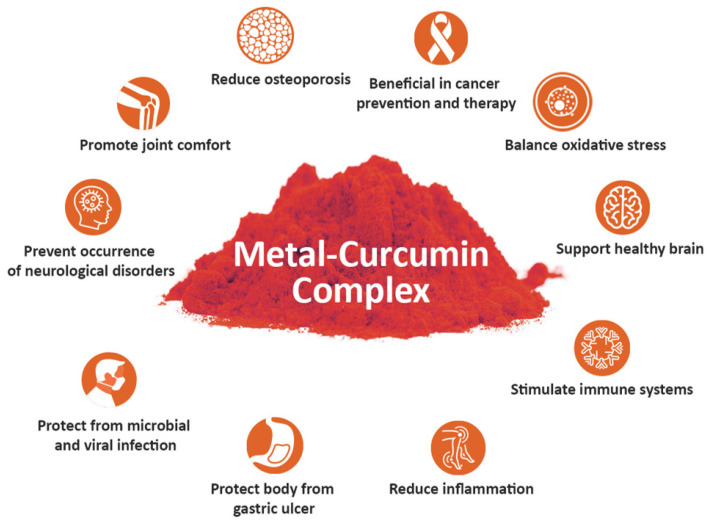
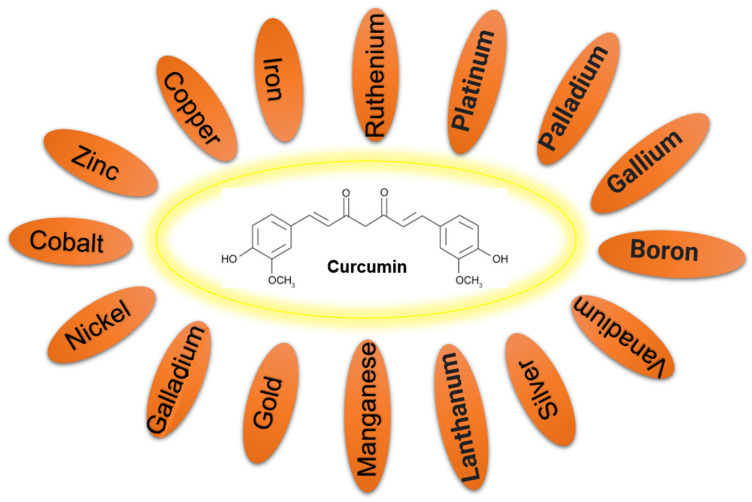
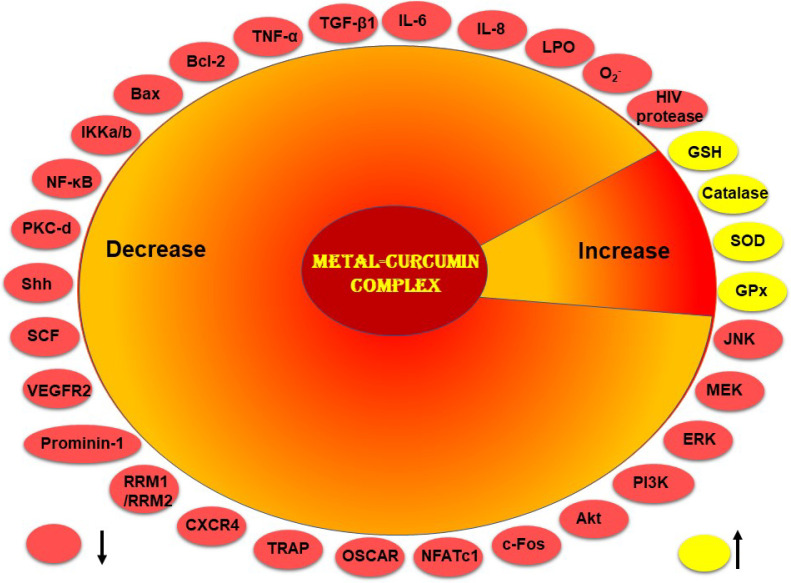
Curcumin, an active component of the rhizome turmeric, has gained much attention as a plant-based compound with pleiotropic pharmacological properties. It possesses anti-inflammatory, antioxidant, hypoglycemic, antimicrobial, neuroprotective, and immunomodulatory activities. However, the health-promoting utility of curcumin is constrained due to its hydrophobic nature, water insolubility, poor bioavailability, rapid metabolism, and systemic elimination. Therefore, an innovative stride was taken, and complexes of metals with curcumin have been synthesized. Curcumin usually reacts with metals through the β-diketone moiety to generate metal-curcumin complexes. It is well established that curcumin strongly chelates several metal ions, including boron, cobalt, copper, gallium, gadolinium, gold, lanthanum, manganese, nickel, iron, palladium, platinum, ruthenium, silver, vanadium, and zinc. In this review, the pharmacological, chemopreventive, and therapeutic activities of metal-curcumin complexes are discussed. Metal-curcumin complexes increase the solubility, cellular uptake, and bioavailability and improve the antioxidant, anti-inflammatory, antimicrobial, and antiviral effects of curcumin. Metal-curcumin complexes have also demonstrated efficacy against various chronic diseases, including cancer, arthritis, osteoporosis, and neurological disorders such as Alzheimer's disease. These biological activities of metal-curcumin complexes were associated with the modulation of inflammatory mediators, transcription factors, protein kinases, antiapoptotic proteins, lipid peroxidation, and antioxidant enzymes. In addition, metal-curcumin complexes have shown usefulness in biological imaging and radioimaging. The future use of metal-curcumin complexes may represent a new approach in the prevention and treatment of chronic diseases.
姜黄素是姜黄根茎中的一种活性成分,作为一种具有多种药理学特性的植物化合物而备受关注。它具有抗炎、抗氧化、降血糖、抗菌、神经保护和免疫调节作用。然而,由于其疏水性、水不溶性、生物利用度低、快速代谢和全身消除,姜黄素的促进健康的用途受到限制。因此,人们采取了一项创新举措,合成了金属与姜黄素的配合物。姜黄素通常通过β-二酮部分与金属反应生成金属-姜黄素配合物。已经证实,姜黄素可以强烈螯合包括硼、钴、铜、镓、钆、金、镧、锰、镍、铁、钯、铂、钌、银、钒和锌在内的多种金属离子。在这篇综述中,讨论了金属-姜黄素配合物的药理学、化学预防和治疗活性。金属-姜黄素配合物提高了姜黄素的溶解度、细胞摄取和生物利用度,并增强了其抗氧化、抗炎、抗菌和抗病毒作用。金属-姜黄素配合物还对各种慢性疾病表现出疗效,包括癌症、关节炎、骨质疏松症和神经退行性疾病如阿尔茨海默病。这些金属-姜黄素配合物的生物学活性与炎症介质、转录因子、蛋白激酶、抗凋亡蛋白、脂质过氧化和抗氧化酶的调节有关。此外,金属-姜黄素配合物在生物成像和放射成像方面也显示出有用性。未来使用金属-姜黄素配合物可能代表预防和治疗慢性疾病的新方法。