Leland Azadeh, Tavakol Kamran, Scholten Joel, Mathis Debra, Maron David, Bakhshi Simin
Physical Medicine and Rehabilitation Service, Veterans Affairs Medical Center. Washington, DC, USA.
School of Medicine, University of Maryland Baltimore. Baltimore, MD, USA.
Mater Sociomed. 2017 Dec;29(4):251-256. doi: 10.5455/msm.2017.29.251-256.
This study focussed on the effect of dual versus single tasking on balance, gait and cognition in veterans with mild traumatic brain injury (mTBI). We examined the correlation between these parameters, with responses to questions on community reintegration activities.
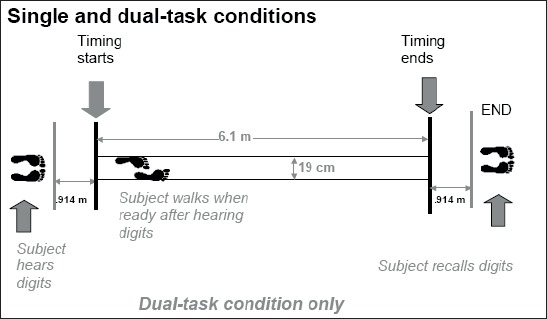
22 male and female veterans (aged 19-65) walked along a narrow and 6.1-meter long path, both at their self-selected and fastest but safe pace under single and dual tasking conditions. For dual tasking, participants were required to recall and vocalize a 5-digit number at the end of the path. The outcome measures were the accuracy, velocity, cadence, stride length, and number of steps off the path. We calculated the reliability and correlation coefficient values for the walking time compared with the stride length, velocity, and percentage of swing and stance.
Under dual task, the participants demonstrated slower gait, recalled shorter digit span and stepped off the path 12.6% more often than under single task. The stride length decreased by about 20% and the stride velocity increased by over 2% in dual compared with single tasking.
Dual tasking slows down the gait and reduces the attention span in patients with mTBI, which can negatively impact their community reintegration, at least early after their hospital discharge, hence the need for exercising caution with their community reintegration activities. Dual tasking may have the potential to improve balance, gait and attention span of the patients in the long-term, thus leading to safer community integration, if incorporated in the rehabilitation plans.
本研究聚焦于双重任务与单一任务对轻度创伤性脑损伤(mTBI)退伍军人平衡能力、步态和认知的影响。我们检查了这些参数之间的相关性,以及与社区重新融入活动相关问题的回答情况。
22名年龄在19至65岁之间的退伍军人(男女皆有)在单一任务和双重任务条件下,以自己选择的速度以及最快但安全的速度沿着一条6.1米长的狭窄路径行走。在双重任务中,要求参与者在路径终点回忆并说出一个5位数。测量的结果包括准确性、速度、步频、步长以及偏离路径的步数。我们计算了步行时间与步长、速度以及摆动和站立百分比之间的可靠性和相关系数值。
在双重任务下,参与者的步态较慢,回忆的数字跨度较短,偏离路径的次数比单一任务时多12.6%。与单一任务相比,双重任务时步长减少了约20%,步速增加了超过2%。
双重任务会使mTBI患者的步态减慢并缩短注意力持续时间,这至少在他们出院早期会对其社区重新融入产生负面影响,因此在他们的社区重新融入活动中需要谨慎行事。如果将双重任务纳入康复计划,从长期来看可能有潜力改善患者的平衡能力、步态和注意力持续时间,从而实现更安全的社区融入。