Granados-Guzmán Graciela, Salazar-Aranda Ricardo, Garza-Tapia Marsela, Castro-Ríos Rocío, Waksman de Torres Noemí
Universidad Autónoma de Nuevo León, Facultad de Medicina, Departamento de Química Analítica. Monterrey, N. L. México.
Curr Anal Chem. 2017 Dec;13(6):499-507. doi: 10.2174/1573411013666170118111516.
The search for new natural or synthetic products with antioxidant activity is commonly based on methods that involve reduction of either 2,2-diphenyl-1-picrylhydrazyl (DPPH) or 2-2-azino-bis(3-ethylbenzothiazoline-6-sulphonic acid) (ABTS). However, the reported values of the effective concentrations are highly variable, even in controls. Herein, we optimize and validate both meth-ods of determining antiradical activity.
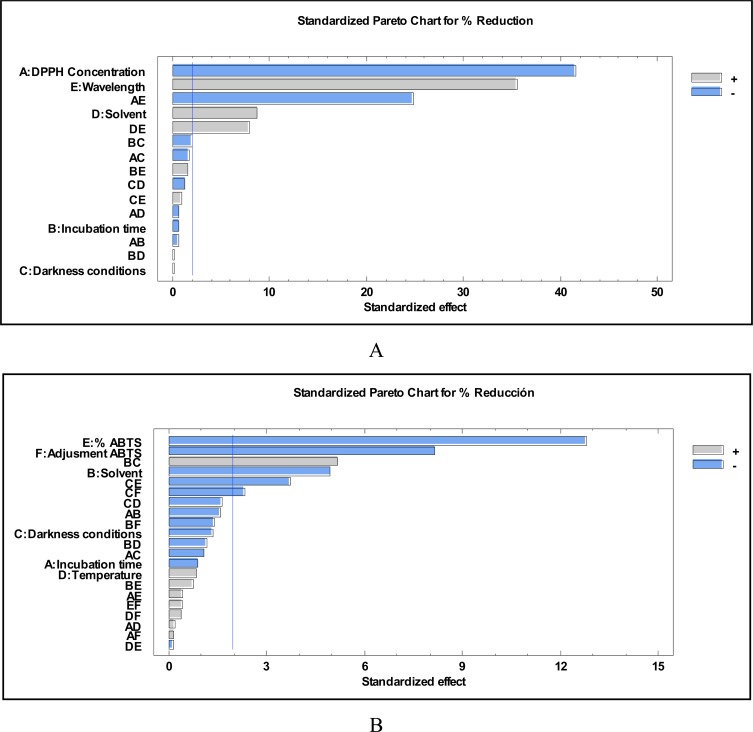
Optimization was carried out using both a fractionated factorial design and a basic sequential simplex method, by monitoring the reduction percentage. Quercetin or Trolox were used as positive con-trol. Furthermore, for each method, linearity, precision, accuracy, robustness, plate uniformity, signal variability, and Z factor, were established.
The optimized conditions for the DPPH method were: DPPH 280 μM in ethanol and 15 min of reaction time in the dark. The linear range was between 7 and 140 μM with an R2 value of 0.9987. The optimized conditions for the ABTS method were: ABTS adjusted to 0.7 absorbance units, 70% concen-tration in ethanol, and a reaction time of 6 min in the dark. The linear range was found to be between 1 and 70% with an R2 = 0.9991. For both methods, the accuracy and precision were within limits and the Z factor value was higher than 0.89. The applicability of each method was assessed by analyzing eight plant extracts.
The DPPH and ABTS reduction methods were optimized and validated on a microscale and could be expected to be implemented in any laboratory.
寻找具有抗氧化活性的新型天然或合成产品通常基于涉及还原2,2-二苯基-1-苦基肼(DPPH)或2,2'-联氮双(3-乙基苯并噻唑啉-6-磺酸)(ABTS)的方法。然而,即使在对照实验中,报道的有效浓度值也存在很大差异。在此,我们优化并验证了两种测定抗自由基活性的方法。
通过监测还原百分比,使用析因设计和基本序贯单纯形法进行优化。槲皮素或Trolox用作阳性对照。此外,针对每种方法,确定了线性、精密度、准确度、稳健性、板均匀性、信号变异性和Z因子。
DPPH法的优化条件为:乙醇中DPPH浓度为280 μM,黑暗中反应15分钟。线性范围为7至140 μM,R2值为0.9987。ABTS法的优化条件为:将ABTS调整至吸光度0.7单位,乙醇浓度70%,黑暗中反应6分钟。线性范围为1至70%,R2 = 0.9991。两种方法的准确度和精密度均在规定范围内,Z因子值高于0.89。通过分析八种植物提取物评估了每种方法的适用性。
DPPH和ABTS还原法在微量规模上进行了优化和验证,有望在任何实验室中实施。