CR-UK/MRC Oxford Institute for Radiation Oncology, Department of Oncology, University of Oxford, Oxford, United Kingdom.
Department of Physics and Astronomy, Agnes Scott College, Decatur, GA, United States of America.
Theranostics. 2018 Jan 1;8(1):292-303. doi: 10.7150/thno.22217. eCollection 2018.
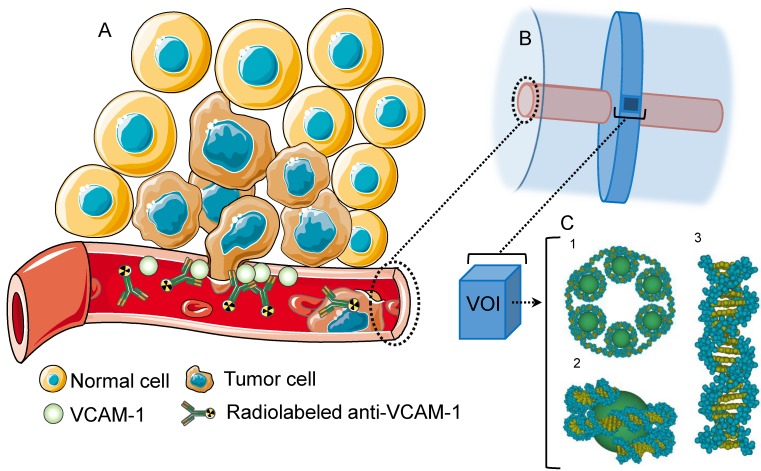
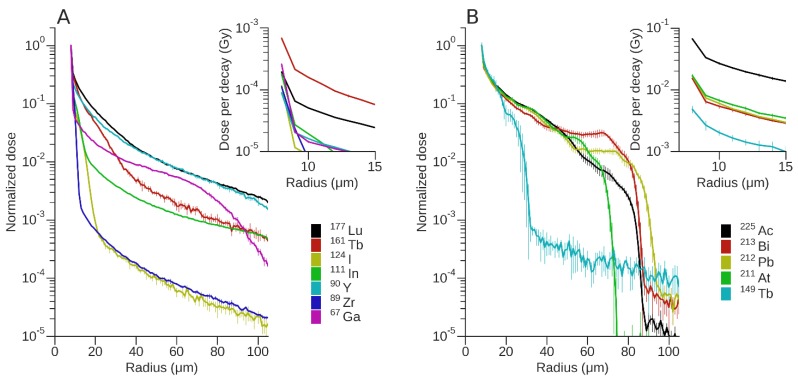
Brain metastases develop frequently in patients with breast cancer, and present a pressing therapeutic challenge. Expression of vascular cell adhesion molecule 1 (VCAM-1) is upregulated on brain endothelial cells during the early stages of metastasis and provides a target for the detection and treatment of early brain metastases. The aim of this study was to use a model of early brain metastasis to evaluate the efficacy of α-emitting radionuclides, Tb, At, Pb, Bi and Ac; β-emitting radionuclides, Y, Tb and Lu; and Auger electron (AE)-emitters Ga, Zr, In and I, for targeted radionuclide therapy (TRT).
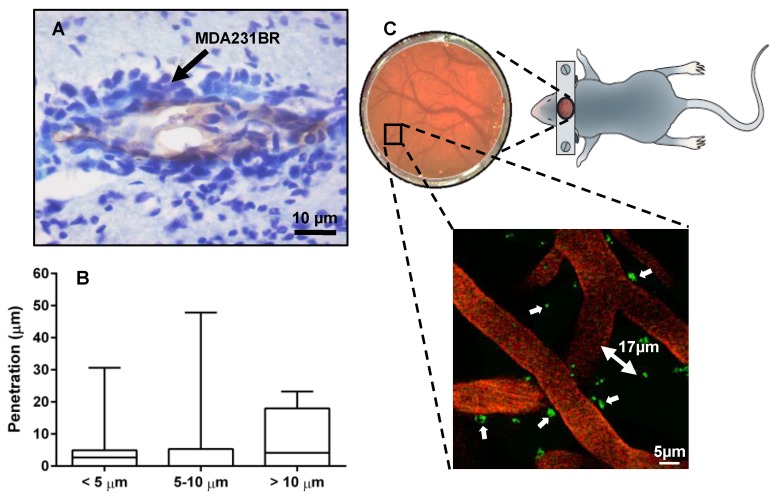
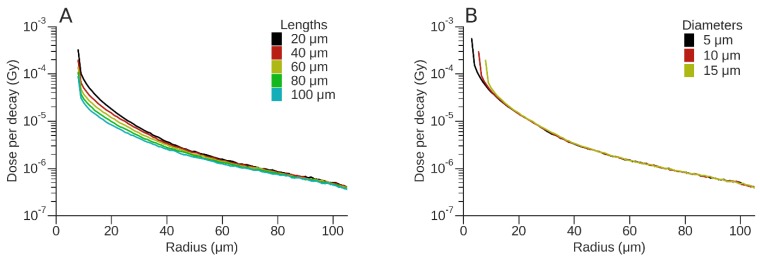
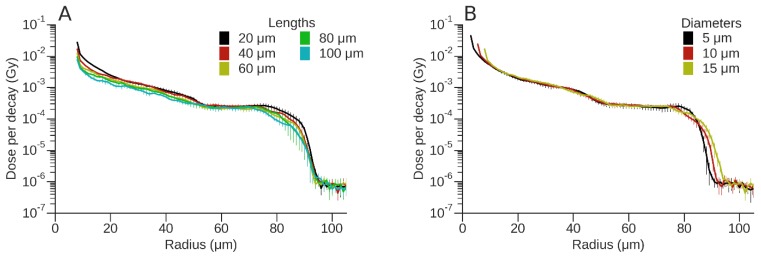
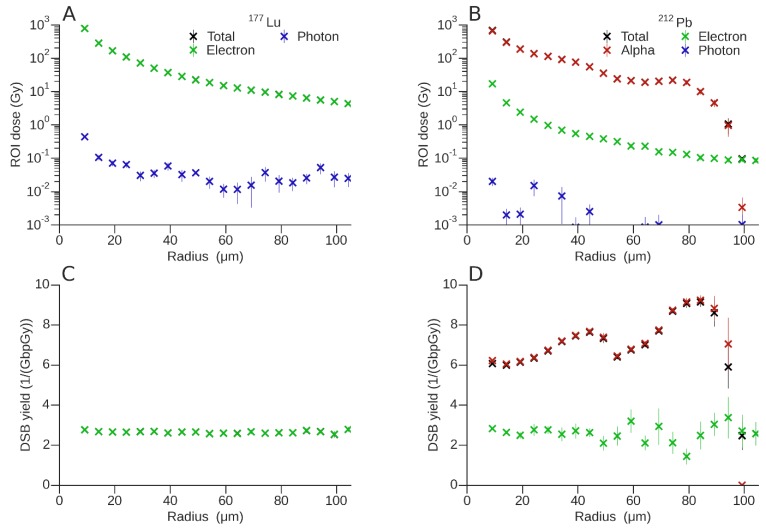
Histologic sections and two photon microscopy of mouse brain parenchyma were used to inform a cylindrical vessel geometry using the Geant4 general purpose Monte Carlo (MC) toolkit with the Geant4-DNA low energy physics models. Energy deposition was evaluated as a radial function and the resulting phase spaces were superimposed on a DNA model to estimate double-strand break (DSB) yields for representative β- and α-emitters, Lu and Pb. Relative biological effectiveness (RBE) values were determined by only evaluating DNA damage due to physical interactions.
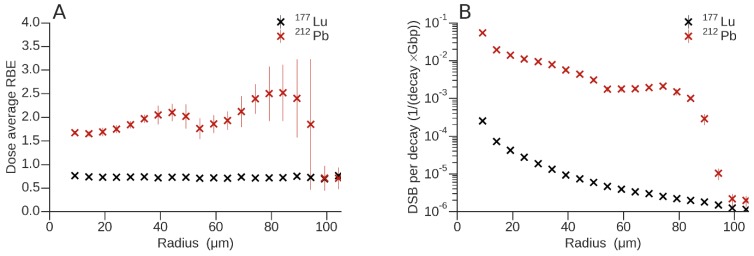
Lu produced 2.69 ± 0.08 DSB per GbpGy, without significant variation from the lumen of the vessel to a radius of 100 µm. The DSB yield of Pb included two local maxima produced by the 6.1 MeV and 8.8 MeV α-emissions from decay products, Bi and Po, with yields of 7.64 ± 0.12 and 9.15 ± 0.24 per GbpGy, respectively. Given its higher DSB yield Pb may be more effective for short range targeting of early micrometastatic lesions than Lu.
MC simulation of a model of early brain metastases provides invaluable insight into the potential efficacy of α-, β- and AE-emitting radionuclides for TRT. Pb, which has the attributes of a theranostic radionuclide since it can be used for SPECT imaging, showed a favorable dose profile and RBE.
乳腺癌患者常发生脑转移,这是一个迫切的治疗挑战。在转移的早期阶段,血管细胞粘附分子 1(VCAM-1)在脑内皮细胞中上调,为早期脑转移的检测和治疗提供了一个靶点。本研究旨在利用早期脑转移模型评估α发射放射性核素 Tb、At、Pb、Bi 和 Ac;β发射放射性核素 Y、Tb 和 Lu;以及俄歇电子(AE)发射体 Ga、Zr、In 和 I 用于靶向放射性核素治疗(TRT)的疗效。
使用蒙特卡罗(MC)工具包的圆柱形血管几何结构和双光子显微镜观察小鼠脑实质的组织学切片,该工具包使用 Geant4 通用蒙特卡罗(MC)工具包和 Geant4-DNA 低能物理模型。能量沉积被评估为一个径向函数,所得相空间被叠加到 DNA 模型上,以估算代表性β和α发射器 Lu 和 Pb 的双链断裂(DSB)产额。相对生物有效性(RBE)值仅通过评估由于物理相互作用引起的 DNA 损伤来确定。
Lu 产生 2.69 ± 0.08 DSB 每 GbpGy,从管腔到半径为 100 µm 的区域没有明显变化。Pb 的 DSB 产额包括由衰变产物 Bi 和 Po 的 6.1 MeV 和 8.8 MeV α发射产生的两个局部最大值,分别为 7.64 ± 0.12 和 9.15 ± 0.24 每 GbpGy。由于其较高的 DSB 产额,Pb 可能比 Lu 更有效地针对早期微转移病变进行短程靶向治疗。
早期脑转移模型的 MC 模拟为 α、β和 AE 发射放射性核素用于 TRT 的潜在疗效提供了宝贵的见解。由于 Pb 可用于 SPECT 成像,因此具有治疗放射性核素的特性,显示出有利的剂量分布和 RBE。