Department of Computational Science and Engineering, North Carolina A&T State University, Greensboro, NC, 27411, USA.
Faculty of Information Science and Electrical Engineering, Kyushu University, 744 Motooka, Nishi-ku, Fukuoka, 819-0395, Japan.
BMC Bioinformatics. 2017 Dec 28;18(Suppl 16):577. doi: 10.1186/s12859-017-1972-6.
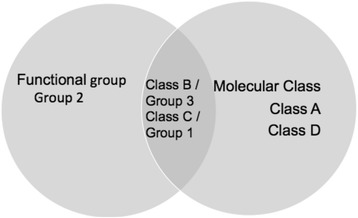
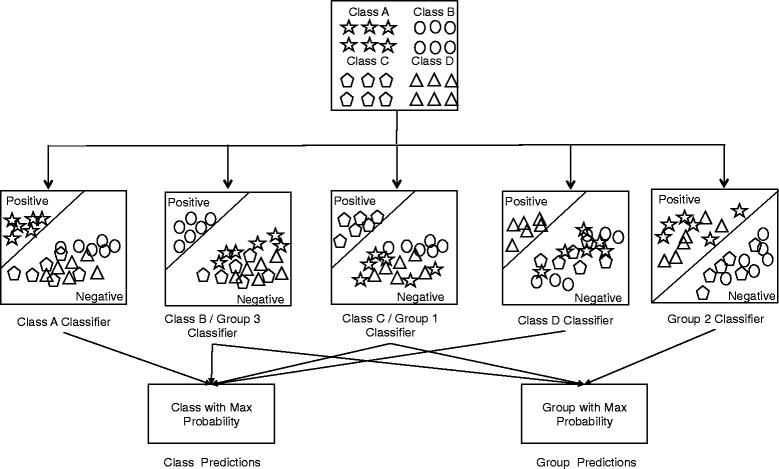
The β-Lactamase (BL) enzyme family is an important class of enzymes that plays a key role in bacterial resistance to antibiotics. As the newly identified number of BL enzymes is increasing daily, it is imperative to develop a computational tool to classify the newly identified BL enzymes into one of its classes. There are two types of classification of BL enzymes: Molecular Classification and Functional Classification. Existing computational methods only address Molecular Classification and the performance of these existing methods is unsatisfactory.
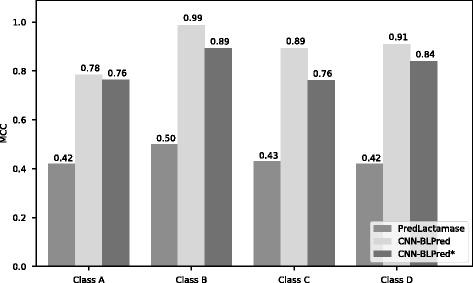
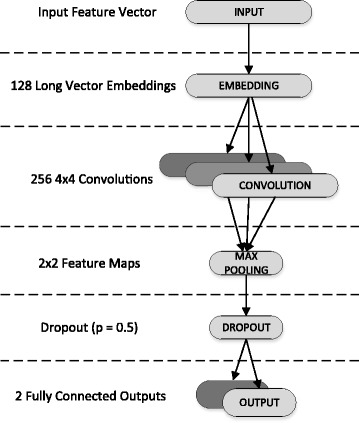
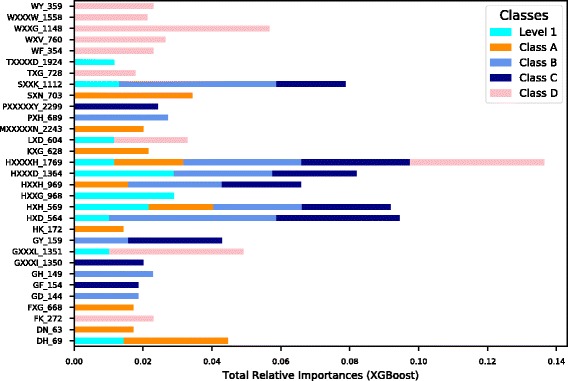
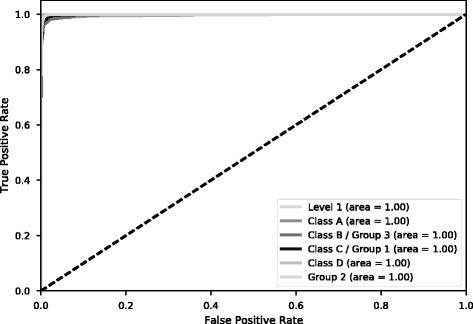
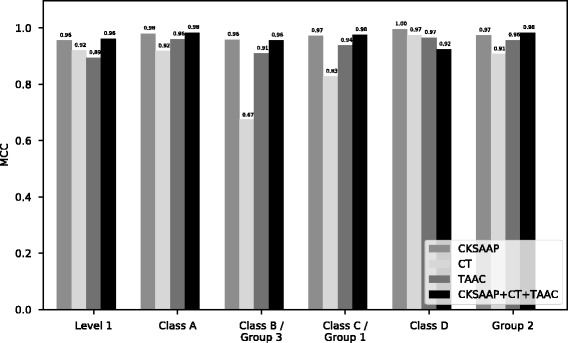
We addressed the unsatisfactory performance of the existing methods by implementing a Deep Learning approach called Convolutional Neural Network (CNN). We developed CNN-BLPred, an approach for the classification of BL proteins. The CNN-BLPred uses Gradient Boosted Feature Selection (GBFS) in order to select the ideal feature set for each BL classification. Based on the rigorous benchmarking of CCN-BLPred using both leave-one-out cross-validation and independent test sets, CCN-BLPred performed better than the other existing algorithms. Compared with other architectures of CNN, Recurrent Neural Network, and Random Forest, the simple CNN architecture with only one convolutional layer performs the best. After feature extraction, we were able to remove ~95% of the 10,912 features using Gradient Boosted Trees. During 10-fold cross validation, we increased the accuracy of the classic BL predictions by 7%. We also increased the accuracy of Class A, Class B, Class C, and Class D performance by an average of 25.64%. The independent test results followed a similar trend.
We implemented a deep learning algorithm known as Convolutional Neural Network (CNN) to develop a classifier for BL classification. Combined with feature selection on an exhaustive feature set and using balancing method such as Random Oversampling (ROS), Random Undersampling (RUS) and Synthetic Minority Oversampling Technique (SMOTE), CNN-BLPred performs significantly better than existing algorithms for BL classification.
β-内酰胺酶(BL)酶家族是一类重要的酶,在细菌对抗生素的耐药性中起着关键作用。随着新发现的 BL 酶数量的日益增加,开发一种计算工具将新发现的 BL 酶分类为其类别之一是当务之急。BL 酶有两种分类:分子分类和功能分类。现有的计算方法仅解决分子分类,这些现有方法的性能并不令人满意。
我们通过实施一种称为卷积神经网络(CNN)的深度学习方法来解决现有方法的性能不佳问题。我们开发了一种用于 BL 蛋白分类的方法 CNN-BLPred。CNN-BLPred 使用梯度提升特征选择(GBFS)来为每个 BL 分类选择理想的特征集。基于使用留一法交叉验证和独立测试集对 CCN-BLPred 的严格基准测试,CCN-BLPred 的性能优于其他现有算法。与其他 CNN 架构、递归神经网络和随机森林相比,只有一层卷积的简单 CNN 架构表现最佳。在特征提取后,我们能够使用梯度提升树去除约 95%的 10912 个特征。在 10 折交叉验证中,我们将经典 BL 预测的准确率提高了 7%。我们还将 Class A、Class B、Class C 和 Class D 的性能平均提高了 25.64%。独立测试结果也呈现出类似的趋势。
我们实施了一种称为卷积神经网络(CNN)的深度学习算法,以开发一种 BL 分类分类器。结合对详尽特征集的特征选择以及使用随机过采样(ROS)、随机欠采样(RUS)和合成少数过采样技术(SMOTE)等平衡方法,CNN-BLPred 在 BL 分类方面的性能明显优于现有算法。