Institute of Cytology and Genetics, Siberian Branch, Russian Academy of Sciences, Novosibirsk, Russia.
Novosibirsk State University, Novosibirsk, Russia.
BMC Plant Biol. 2017 Dec 28;17(Suppl 2):256. doi: 10.1186/s12870-017-1190-4.
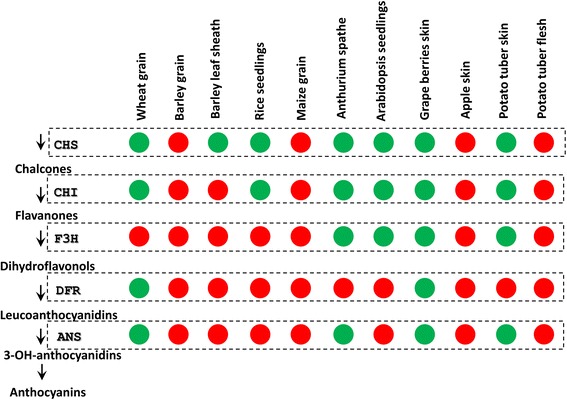
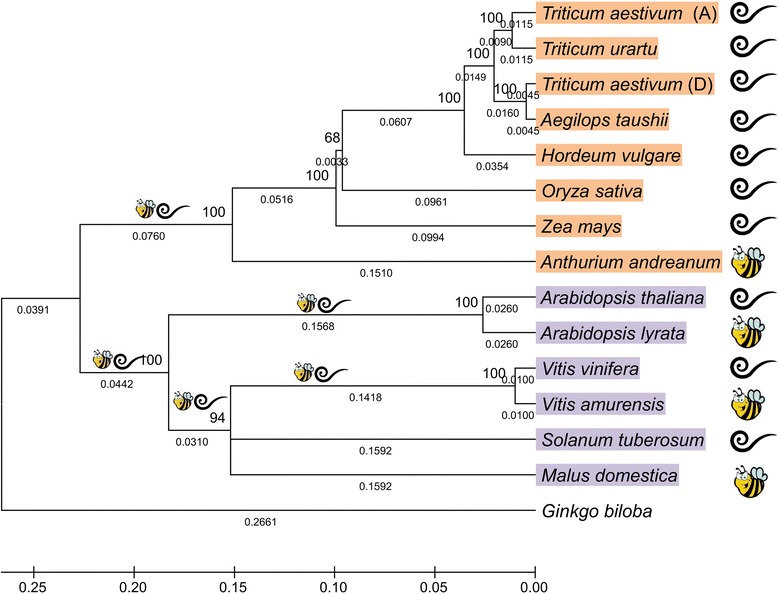
The available data demonstrate that even in universal metabolic pathways, some species-specific regulatory features of structural genes are present. For instance, in the anthocyanin biosynthesis pathway (ABP), genes may be regulated by ABP-specific regulatory factors, and their expression levels may be strongly associated with anthocyanin pigmentation, or they may be expressed independently of pigmentation. A dataset of orthologous ABP genes (Chs, Chi, F3h, F3'h, Dfr, Ans) from monocot and dicot plant species that have distinct gene regulation patterns and different types of pollination was constructed to test whether these factors affect the evolution of the genes.
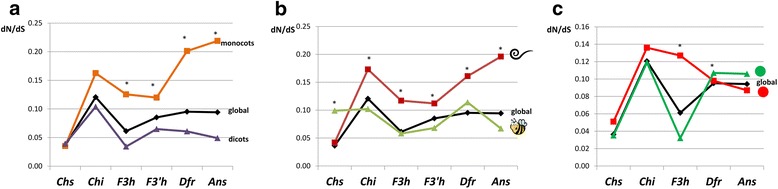
Using a maximum likelihood approach, we demonstrated that although the whole set of the ABP genes is under purifying selection, with greater selection acting on the upstream genes than on the downstream genes, genes from distinct groups of plant species experienced different strengths of selective pressure. The selective pressure on the genes was higher in dicots than in monocots (F3h and further downstream genes) and in pollinator-dependent plants than in pollinator-independent species (Chi and further downstream genes), suggesting an important role of pollination type in the evolution of the anthocyanin biosynthesis gene network. Contrasting effects of the regulation patterns on evolution were detected for the F3h and Dfr genes, with greater selective pressure on the F3h gene in plant species where the gene expression was not strongly associated with pigmentation and greater selective pressure on Dfr in plant species where the gene expression was associated with pigmentation.
We demonstrated the effects of pollination type and patterns of regulation on the evolution of the ABP genes, but the evolution of some of the genes could not be explained in the framework of these factors, such as the weaker selective pressure acting on Chs in species that attract pollinators or the stronger selective pressure on F3h in plant species where the gene expression was not associated with pigmentation. The observations suggest that additional factors could affect the evolution of these genes. One such factor could be an effect of gene duplication with further division of functions among gene copies and relaxed selective pressure acting on them. Additional tests with an appropriate dataset combining data on duplicated gene sequences and their functions in the flavonoid biosynthesis pathway are required to test this hypothesis.
现有数据表明,即使在普遍的代谢途径中,也存在一些物种特异性的结构基因调控特征。例如,在花青素生物合成途径(ABP)中,基因可能受到 ABP 特异性调控因子的调控,其表达水平与花青素色素沉着强烈相关,或者它们可能独立于色素沉着表达。构建了来自具有不同基因调控模式和不同授粉类型的单子叶和双子叶植物物种的同源 ABP 基因(Chs、Chi、F3h、F3'h、Dfr、Ans)数据集,以检验这些因子是否影响基因的进化。
使用最大似然法,我们证明尽管整个 ABP 基因集受到纯化选择的作用,但上游基因受到的选择作用大于下游基因,来自不同植物物种群的基因经历了不同强度的选择压力。在双子叶植物中,F3h 和更下游的基因的选择压力高于单子叶植物,在依赖传粉者的植物中,Chi 和更下游的基因的选择压力高于不依赖传粉者的物种,这表明授粉类型在花青素生物合成基因网络的进化中起着重要作用。在 F3h 和 Dfr 基因中检测到调控模式对进化的对比影响,在基因表达与色素沉着不强烈相关的植物物种中,F3h 基因受到更大的选择压力,而在基因表达与色素沉着相关的植物物种中,Dfr 基因受到更大的选择压力。
我们证明了授粉类型和调控模式对 ABP 基因进化的影响,但在这些因素的框架内,无法解释一些基因的进化,例如在吸引传粉者的物种中 Chs 基因受到的选择压力较弱,或者在基因表达与色素沉着不相关的植物物种中 F3h 基因受到的选择压力较强。这些观察结果表明,其他因素可能影响这些基因的进化。其中一个因素可能是基因复制的影响,随着基因副本功能的进一步分化和对它们的选择压力的放松。需要进行额外的测试,使用包含黄酮类生物合成途径中重复基因序列及其功能数据的适当数据集来检验这一假设。