Department of Respiratory Disease, Thoracic Disease Center, The First Affiliated Hospital, College of Medicine, Zhejiang University, No. 79, Qingchun Road, Xiacheng District, Hangzhou, China.
Department of Medical Oncology, The First Affiliated Hospital, College of Medicine, Zhejiang University, No. 79, Qingchun Road, Shangcheng District, Hangzhou, China.
BMC Cancer. 2018 Jan 3;18(1):10. doi: 10.1186/s12885-017-3720-8.
To compare the efficacy of crizotinib, pemetrexed and other chemotherapy regimens as a first-line treatment in patients with anaplastic lymphoma kinase (ALK)-positive non-small cell lung cancer (NSCLC) in real world clinical use and to evaluate the +86-571-87,236,876 predictive clinical factors of the efficacy of crizotinib.
The 73 patients with ALK-positive advanced NSCLC were divided into three groups based on the first-line treatment: first-line crizotinib group (1-CRZ group, n = 32); first-line platinum-based pemetrexed treatment group (1-PP group, n = 28), and first-line chemotherapy platinum-based non-pemetrexed group (N1-PP, n = 12). Sixty eight of the 73 patients received crizotinib treatment and followed up in our hospital. Differences in the objective response rate (ORR), disease control rate (DCR) and progression-free survival (PFS) were compared in the different groups. The clinical factors were evaluated to predict the efficacy of crizotinib by the Kaplan-Meier survival analysis and Cox proportional hazards model.
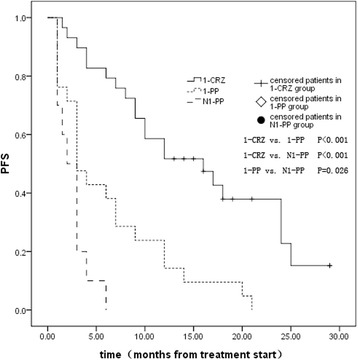
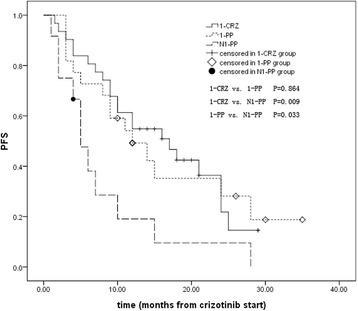
The PFS, ORR, DCR were 16.1 months, 78.1% (25/32) and 100% (32/32) in the 1-CRZ group; were 6.0 months, 17.9% (5/28) and 57.2% (16/28) in the 1-PP group; and were 2.9 months, 15.4% (2/13) and 46.2% (6/13) in the N1-PP group. The PFS of the 1-CRZ group was significantly longer than that of the 1-PP group (P < 0.001) and the N1-PP group (P < 0.001). The ORR and DCR of the 1-CRZ group was significantly greater than that of the 1-PP group and the N1-PP group (all the P < 0.001). Higher Eastern Cooperative Oncology Group (ECOG) performance status score (> = 2) (HR 2.345, 95% CI 1.137-4.834, P = 0.021) and patients received crizotinib after N1-PP chemotherapy (HR 2.345, 95% CI 1.137-4.834, P = 0.021) were two factors associated with shorter PFS after crizotinib treatment.
In patients with ALK-positive NSCLC who did not receive previous treatment, crizotinib was superior to standard chemotherapy for the longer PFS and greater ORR and DCR. Higher ECOG score (> = 2) and patients received crizotinib after N1-PP chemotherapy predict poor efficacy of crizotinib.
比较克唑替尼、培美曲塞和其他化疗方案作为一线治疗在真实世界的临床应用中在间变性淋巴瘤激酶(ALK)阳性非小细胞肺癌(NSCLC)患者中的疗效,并评估克唑替尼疗效的+86-571-87,236,876 个预测临床因素。
根据一线治疗将 73 例 ALK 阳性晚期 NSCLC 患者分为三组:一线克唑替尼组(1-CRZ 组,n=32);一线含铂培美曲塞治疗组(1-PP 组,n=28),以及一线含铂非培美曲塞化疗组(N1-PP 组,n=12)。73 例患者中有 68 例接受了克唑替尼治疗并在我院进行了随访。比较不同组之间的客观缓解率(ORR)、疾病控制率(DCR)和无进展生存期(PFS)的差异。通过 Kaplan-Meier 生存分析和 Cox 比例风险模型评估临床因素对克唑替尼疗效的预测作用。
1-CRZ 组的 PFS、ORR、DCR 分别为 16.1 个月、78.1%(25/32)和 100%(32/32);1-PP 组分别为 6.0 个月、17.9%(5/28)和 57.2%(16/28);N1-PP 组分别为 2.9 个月、15.4%(2/13)和 46.2%(6/13)。1-CRZ 组的 PFS 明显长于 1-PP 组(P<0.001)和 N1-PP 组(P<0.001)。1-CRZ 组的 ORR 和 DCR 明显大于 1-PP 组和 N1-PP 组(均 P<0.001)。更高的东部肿瘤协作组(ECOG)体能状态评分(≥2)(HR 2.345,95%CI 1.137-4.834,P=0.021)和患者在 N1-PP 化疗后接受克唑替尼治疗(HR 2.345,95%CI 1.137-4.834,P=0.021)是克唑替尼治疗后 PFS 较短的两个相关因素。
在未接受过治疗的 ALK 阳性 NSCLC 患者中,克唑替尼在 PFS、ORR 和 DCR 方面优于标准化疗。更高的 ECOG 评分(≥2)和患者在 N1-PP 化疗后接受克唑替尼治疗预测克唑替尼疗效不佳。