Centre for Research in Environmental Epidemiology (CREAL), ISGlobal, Barcelona, Spain.
Universitat Pompeu Fabra (UPF), Barcelona, Spain.
Thorax. 2018 Apr;73(4):376-384. doi: 10.1136/thoraxjnl-2017-210947. Epub 2018 Jan 6.
We assessed associations between physical activity and lung function, and its decline, in the prospective population-based European Community Respiratory Health Survey cohort.
FEV and FVC were measured in 3912 participants at 27-57 years and 39-67 years (mean time between examinations=11.1 years). Physical activity frequency and duration were assessed using questionnaires and used to identify active individuals (physical activity ≥2 times and ≥1 hour per week) at each examination. Adjusted mixed linear regression models assessed associations of regular physical activity with FEV and FVC.
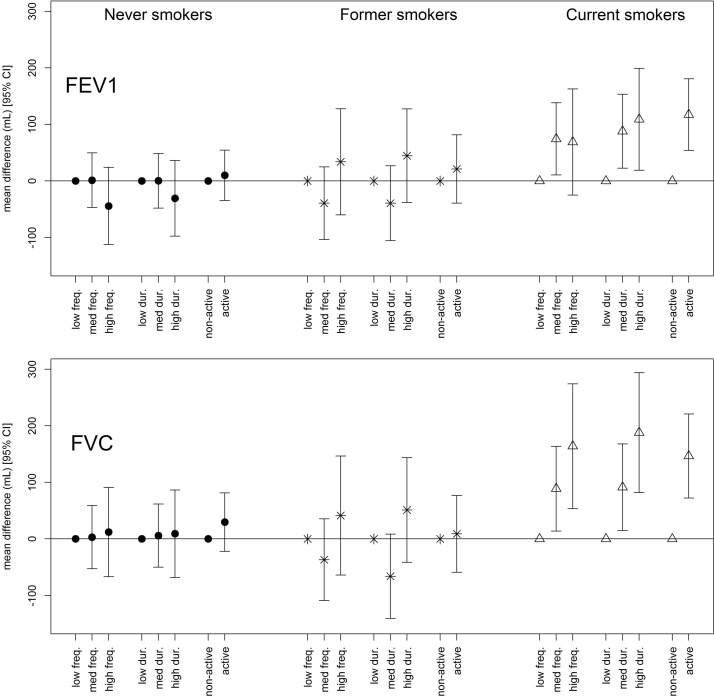
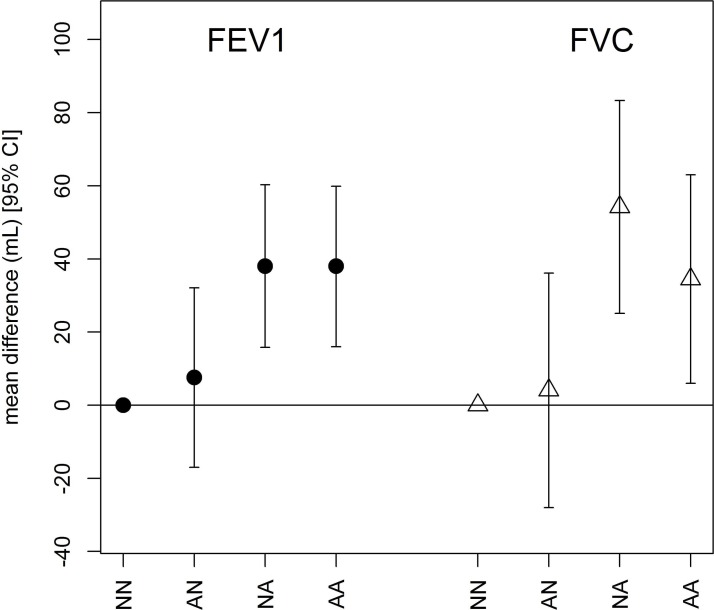
Physical activity frequency and duration increased over the study period. In adjusted models, active individuals at the first examination had higher FEV (43.6 mL (95% CI 12.0 to 75.1)) and FVC (53.9 mL (95% CI 17.8 to 89.9)) at both examinations than their non-active counterparts. These associations appeared restricted to current smokers. In the whole population, FEV and FVC were higher among those who changed from inactive to active during the follow-up (38.0 mL (95% CI 15.8 to 60.3) and 54.2 mL (95% CI 25.1 to 83.3), respectively) and who were consistently active, compared with those consistently non-active. No associations were found for lung function decline.
Leisure-time vigorous physical activity was associated with higher FEV and FVC over a 10-year period among current smokers, but not with FEV and FVC decline.
我们评估了欧洲社区呼吸健康调查队列中前瞻性人群的体力活动与肺功能及其下降之间的关联。
在 27-57 岁和 39-67 岁时(两次检查之间的平均时间为 11.1 年),对 3912 名参与者测量了 FEV 和 FVC。使用问卷评估体力活动的频率和持续时间,并用于在每次检查时识别活跃个体(体力活动≥2 次且每周≥1 小时)。调整后的混合线性回归模型评估了定期体力活动与 FEV 和 FVC 的关联。
在研究期间,体力活动的频率和持续时间增加。在调整后的模型中,首次检查时的活跃个体在两次检查时的 FEV(43.6mL(95%CI 12.0 至 75.1))和 FVC(53.9mL(95%CI 17.8 至 89.9))均高于非活跃个体。这些关联似乎仅限于当前吸烟者。在整个人群中,与在随访期间从不活跃变为活跃的个体相比(分别为 38.0mL(95%CI 15.8 至 60.3)和 54.2mL(95%CI 25.1 至 83.3)),FEV 和 FVC 更高,与始终不活跃的个体相比。没有发现与肺功能下降相关的关联。
在 10 年内,闲暇时间剧烈的体力活动与当前吸烟者的 FEV 和 FVC 升高相关,但与 FEV 和 FVC 下降无关。