Cherrez Ojeda I, Vanegas E, Felix M, Mata V, Cherrez S, Simancas-Racines D, Greiding L, Cano J, Cherrez A, Calderon Juan Carlos
Universidad Espíritu Santo, Km. 2.5 vía La Puntilla, Código postal: 0901-952 Samborondón, Ecuador.
Respiralab, Respiralab Research Group, Guayaquil, Ecuador.
World Allergy Organ J. 2018 Jan 3;11(1):1. doi: 10.1186/s40413-017-0181-0. eCollection 2018.
The purpose of this study was to identify chronic urticaria (CU) etiologies and treatment modalities in Ecuador. We propose that the sample distribution fits the expected one, and that there is an association between the etiology and its treatment.
We performed a retrospective study involving 112 patients diagnosed with CU using a Checklist for a complete chronic urticaria medical history. Demographic and clinical variables were collected. The etiology of CU was classified using the EAACI/GA2LEN/EDF/WAO guideline. Descriptive analyses were performed for demographical and clinical variables. Chi square tests were applied to analyze the fit of distribution and the independence of variables. values less than 0.05 were considered significant.
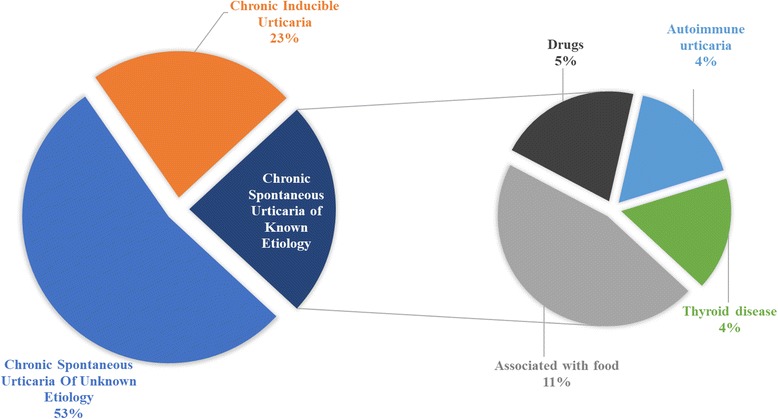
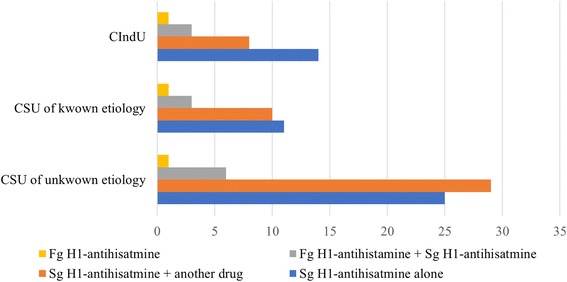
Among all the patients, 76.8% were diagnosed with chronic spontaneous urticaria (CSU), of which 22.3% had a known etiology or possible exacerbating condition. Food allergy was identified as the most common accompanying condition in patients with CSU (10.7%) ( < 0.01).. On the other hand, 23.2% inducible urticarias (CIndU) were indentified; dermographism was the most common (10.7%) ( < 0.01).Regarding treatment regimens, sg-H1-antihistamines alone represented the highest proportion (44.6%). The combination of any H1-antihistamine plus other drug was a close second (42.0%) ( < 0.01). Almost 48% of CSUs of unknown etiology were treated with any antihistamine plus another drug. In patients with known etiology, sg-antihistamines alone (44.0%) was the most common management. In addition, 53.8% of CIndUs were treated with sg-antihistamines alone. Though, these associations were not statistically significant.
CSU is the most frequent subtype of CU. Modern non-sedating antihistamines in licensed doses are the drug of choice. Nevertheless, a great proportion of patients require the addition of another type of medication.
本研究旨在确定厄瓜多尔慢性荨麻疹(CU)的病因及治疗方式。我们提出样本分布符合预期分布,且病因与其治疗之间存在关联。
我们进行了一项回顾性研究,纳入112例使用慢性荨麻疹完整病史检查表诊断为CU的患者。收集人口统计学和临床变量。根据欧洲变态反应和临床免疫学会(EAACI)/全球变态反应和哮喘欧洲网络(GA2LEN)/欧洲皮肤病学论坛(EDF)/世界变态反应组织(WAO)指南对CU的病因进行分类。对人口统计学和临床变量进行描述性分析。应用卡方检验分析分布拟合情况和变量的独立性。P值小于0.05被认为具有统计学意义。
在所有患者中,76.8%被诊断为慢性自发性荨麻疹(CSU),其中22.3%有已知病因或可能的加重因素。食物过敏被确定为CSU患者中最常见的伴随情况(10.7%)(P<0.01)。另一方面,确定了23.2%的诱导性荨麻疹(CIndU);皮肤划痕症最常见(10.7%)(P<0.01)。关于治疗方案,单独使用第二代H1抗组胺药的比例最高(44.6%)。任何H1抗组胺药与其他药物联合使用紧随其后(42.0%)(P<0.01)。几乎48%病因不明的CSU患者接受了任何抗组胺药加另一种药物的治疗。在病因已知的患者中,单独使用第二代抗组胺药(44.0%)是最常见的治疗方法。此外,53.8%的CIndU患者单独使用第二代抗组胺药治疗。不过,这些关联无统计学意义。
CSU是CU最常见的亚型。许可剂量的现代非镇静抗组胺药是首选药物。然而,很大一部分患者需要加用另一种药物。