National Laboratory for Physical Sciences at the Microscale.
School of Life Sciences.
J Neurosci. 2018 Feb 7;38(6):1493-1510. doi: 10.1523/JNEUROSCI.1548-17.2017. Epub 2018 Jan 8.
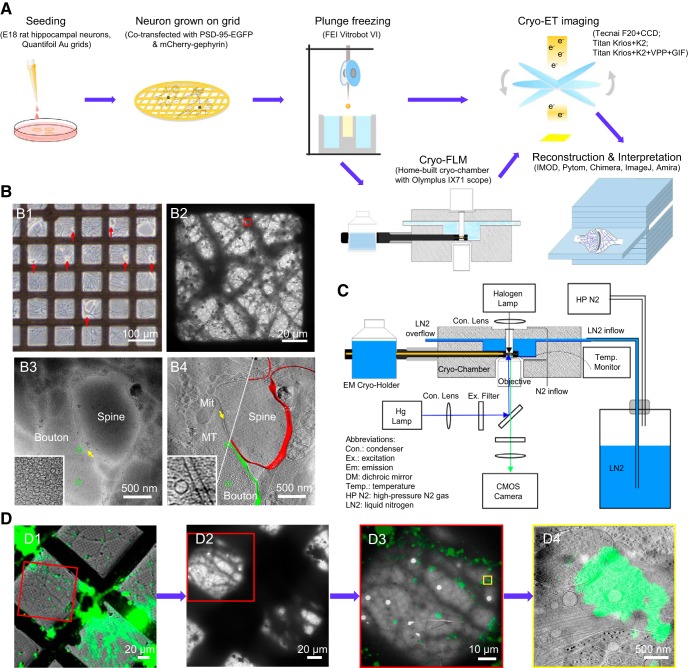
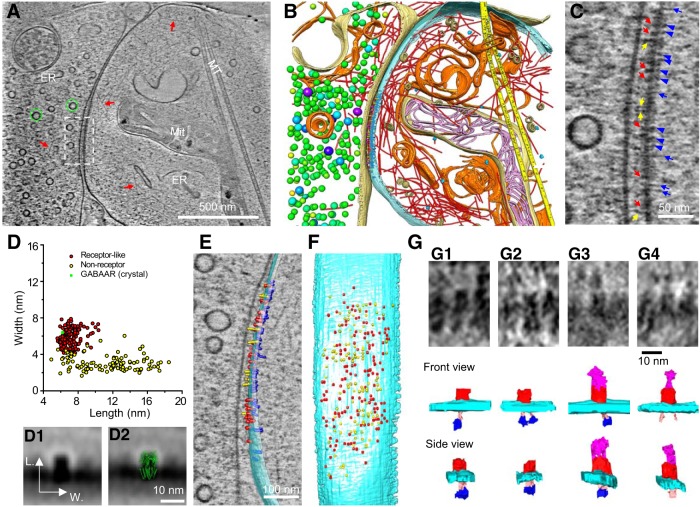
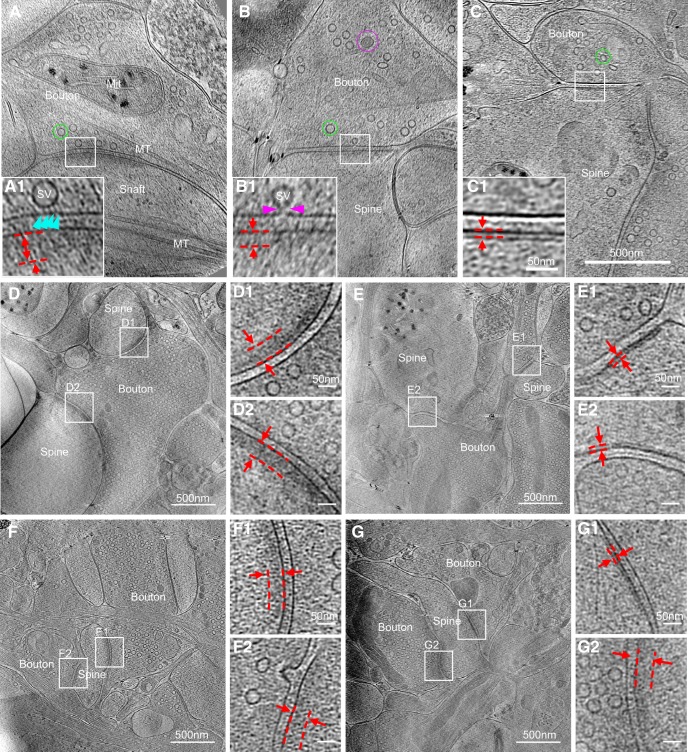
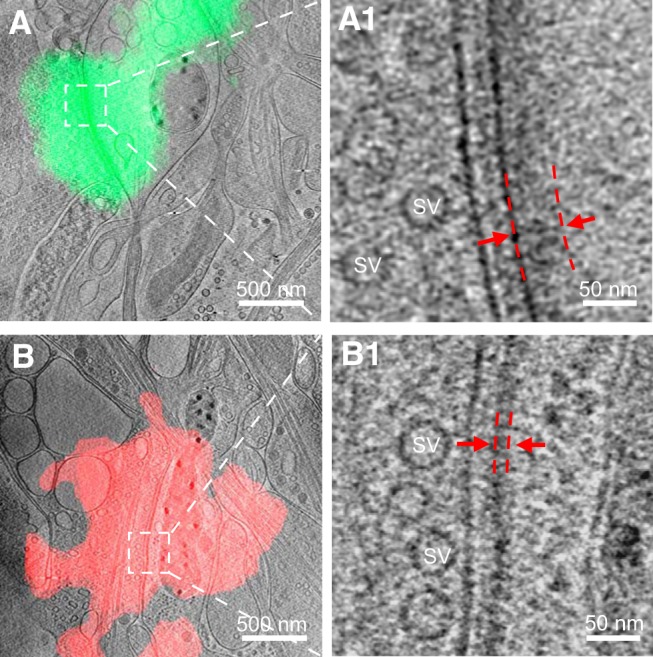
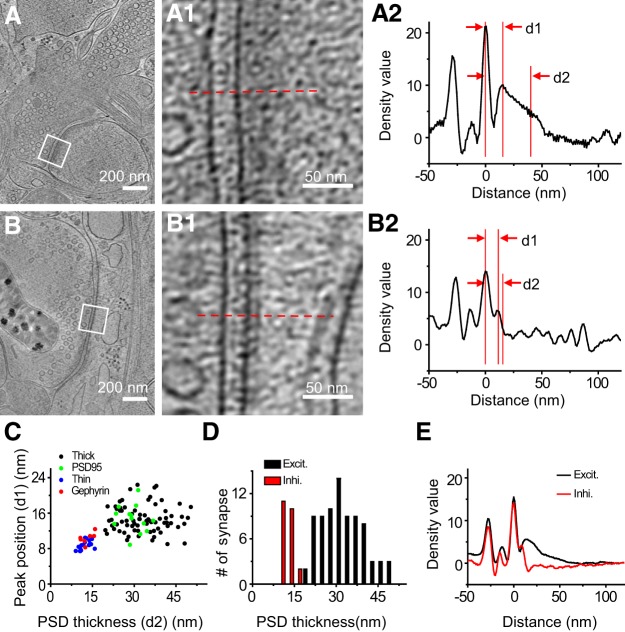
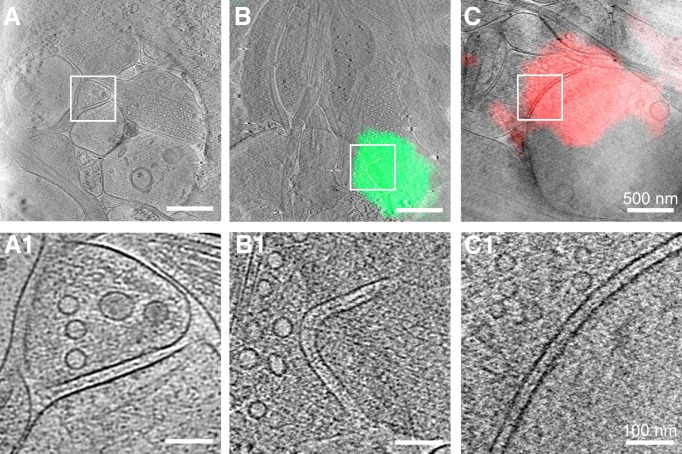
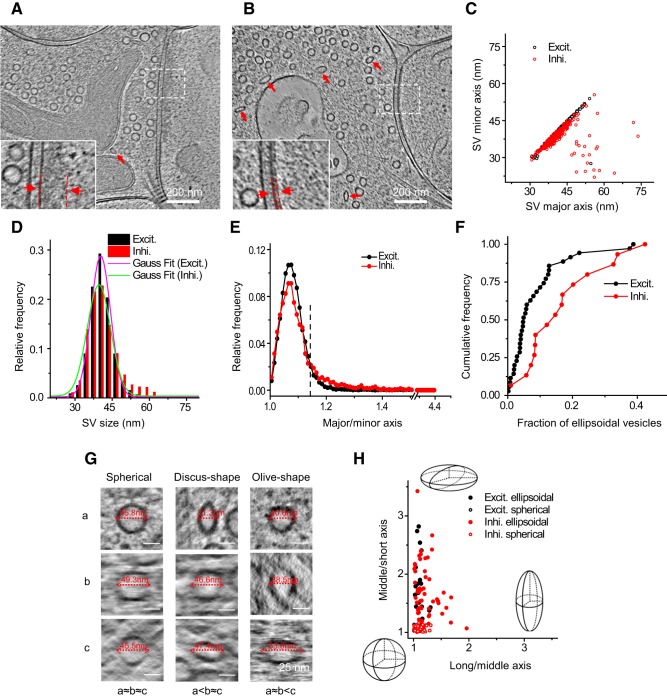
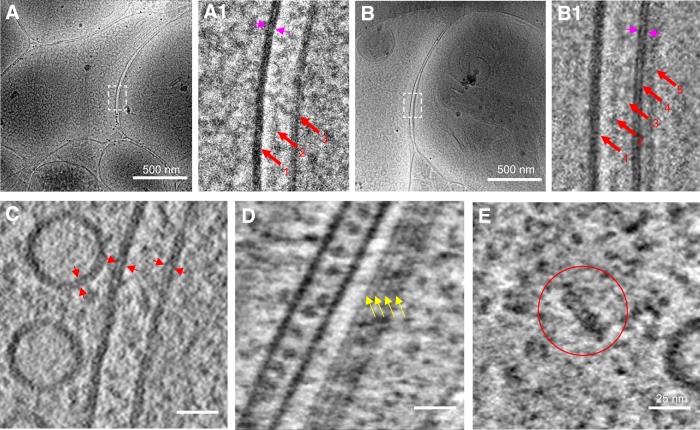
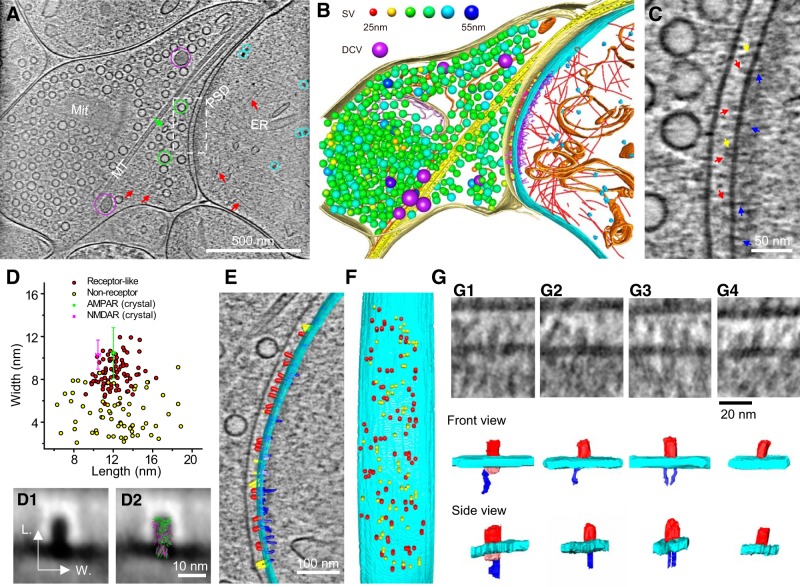
As key functional units in neural circuits, different types of neuronal synapses play distinct roles in brain information processing, learning, and memory. Synaptic abnormalities are believed to underlie various neurological and psychiatric disorders. Here, by combining cryo-electron tomography and cryo-correlative light and electron microscopy, we distinguished intact excitatory and inhibitory synapses of cultured hippocampal neurons, and visualized the 3D organization of synaptic organelles and macromolecules in their native state. Quantitative analyses of >100 synaptic tomograms reveal that excitatory synapses contain a mesh-like postsynaptic density (PSD) with thickness ranging from 20 to 50 nm. In contrast, the PSD in inhibitory synapses assumes a thin sheet-like structure ∼12 nm from the postsynaptic membrane. On the presynaptic side, spherical synaptic vesicles (SVs) of 25-60 nm diameter and discus-shaped ellipsoidal SVs of various sizes coexist in both synaptic types, with more ellipsoidal ones in inhibitory synapses. High-resolution tomograms obtained using a Volta phase plate and electron filtering and counting reveal glutamate receptor-like and GABA receptor-like structures that interact with putative scaffolding and adhesion molecules, reflecting details of receptor anchoring and PSD organization. These results provide an updated view of the ultrastructure of excitatory and inhibitory synapses, and demonstrate the potential of our approach to gain insight into the organizational principles of cellular architecture underlying distinct synaptic functions. To understand functional properties of neuronal synapses, it is desirable to analyze their structure at molecular resolution. We have developed an integrative approach combining cryo-electron tomography and correlative fluorescence microscopy to visualize 3D ultrastructural features of intact excitatory and inhibitory synapses in their native state. Our approach shows that inhibitory synapses contain uniform thin sheet-like postsynaptic densities (PSDs), while excitatory synapses contain previously known mesh-like PSDs. We discovered "discus-shaped" ellipsoidal synaptic vesicles, and their distributions along with regular spherical vesicles in synaptic types are characterized. High-resolution tomograms further allowed identification of putative neurotransmitter receptors and their heterogeneous interaction with synaptic scaffolding proteins. The specificity and resolution of our approach enables precise analysis of ultrastructural organization underlying distinct synaptic functions.
作为神经回路中的关键功能单位,不同类型的神经元突触在大脑信息处理、学习和记忆中发挥着不同的作用。突触异常被认为是各种神经和精神疾病的基础。在这里,我们通过结合冷冻电子断层扫描和冷冻相关的光和电子显微镜,区分了培养海马神经元中的完整兴奋性和抑制性突触,并在其天然状态下可视化了突触细胞器和大分子的 3D 组织。对>100 个突触断层扫描的定量分析表明,兴奋性突触包含具有 20 至 50nm 厚度的网格状突触后密度(PSD)。相比之下,抑制性突触中的 PSD 呈薄片状结构,距突触后膜约 12nm。在前突触侧,直径为 25-60nm 的球形突触小泡(SVs)和各种大小的碟状椭圆 SVs 共存于两种突触类型中,抑制性突触中的椭圆 SVs 更多。使用 Volta 相板和电子过滤和计数获得的高分辨率断层扫描显示了与假定支架和粘附分子相互作用的谷氨酸受体样和 GABA 受体样结构,反映了受体锚定和 PSD 组织的细节。这些结果提供了兴奋性和抑制性突触的超微结构的最新观点,并证明了我们的方法有潜力深入了解不同突触功能背后的细胞结构的组织原则。为了了解神经元突触的功能特性,最好在分子分辨率下分析其结构。我们开发了一种整合的方法,结合冷冻电子断层扫描和相关荧光显微镜,以可视化其天然状态下完整兴奋性和抑制性突触的 3D 超微结构特征。我们的方法表明,抑制性突触包含均匀的薄片状 PSD,而兴奋性突触包含先前已知的网格状 PSD。我们发现了“碟状”椭圆形突触小泡,并且其在突触类型中的分布与规则的球形小泡一起被表征。高分辨率断层扫描进一步允许鉴定假定的神经递质受体及其与突触支架蛋白的异质相互作用。我们方法的特异性和分辨率使对不同突触功能基础的超微结构组织进行精确分析成为可能。