Department of Psychology, University of Pennsylvania, Philadelphia, PA, USA.
Nat Neurosci. 2018 Feb;21(2):191-194. doi: 10.1038/s41593-017-0049-1. Epub 2018 Jan 8.
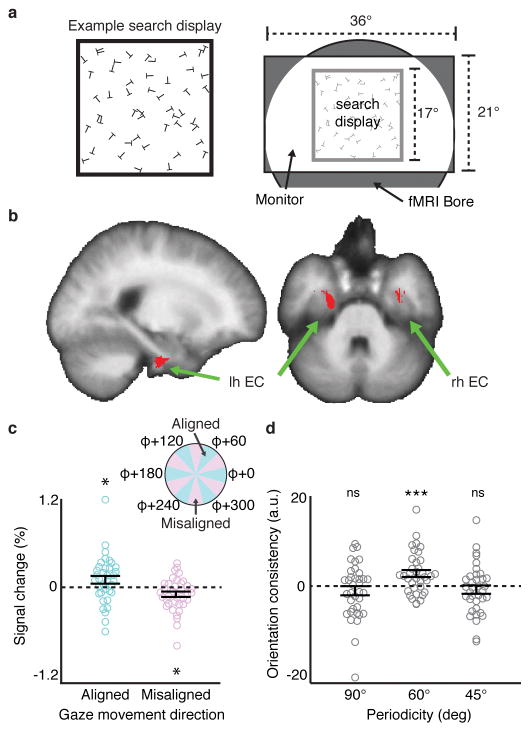
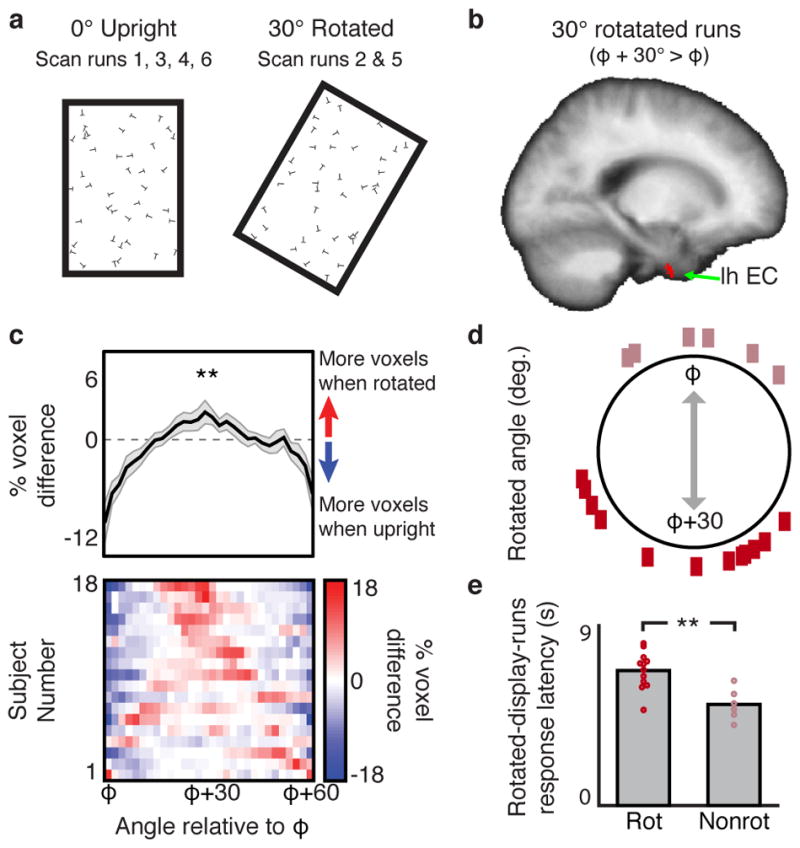
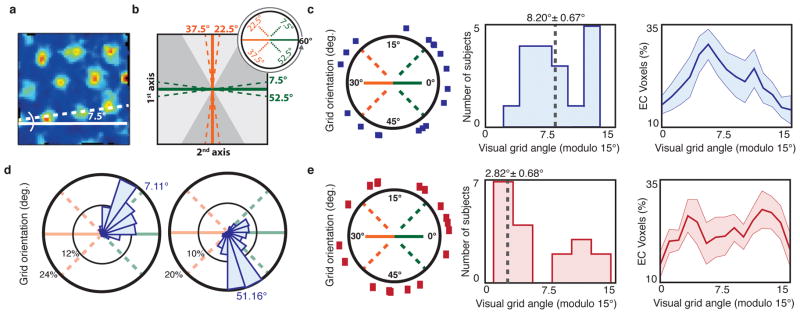
When participants performed a visual search task, functional MRI responses in entorhinal cortex exhibited a sixfold periodic modulation by gaze-movement direction. The orientation of this modulation was determined by the shape and orientation of the bounded search space. These results indicate that human entorhinal cortex represents visual space using a boundary-anchored grid, analogous to that used by rodents to represent navigable space.
当参与者执行视觉搜索任务时,内嗅皮层的功能磁共振成像响应表现出六倍于注视运动方向的周期性调制。这种调制的方向由有界搜索空间的形状和方向决定。这些结果表明,人类内嗅皮层使用边界锚定的网格来表示视觉空间,类似于啮齿动物用来表示可航行空间的网格。