Klymiuk Ingeborg, Bilgilier Ceren, Stadlmann Alexander, Thannesberger Jakob, Kastner Marie-Theres, Högenauer Christoph, Püspök Andreas, Biowski-Frotz Susanne, Schrutka-Kölbl Christiane, Thallinger Gerhard G, Steininger Christoph
Center for Medical Research, Medical University of Graz, Graz, Austria.
Division of Infectious Diseases, Department of Medicine I, Medical University of Vienna, Vienna, Austria.
Front Microbiol. 2017 Dec 14;8:2508. doi: 10.3389/fmicb.2017.02508. eCollection 2017.
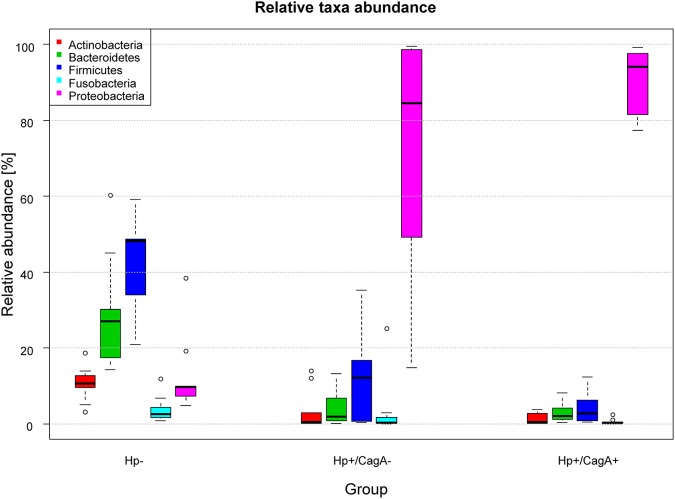
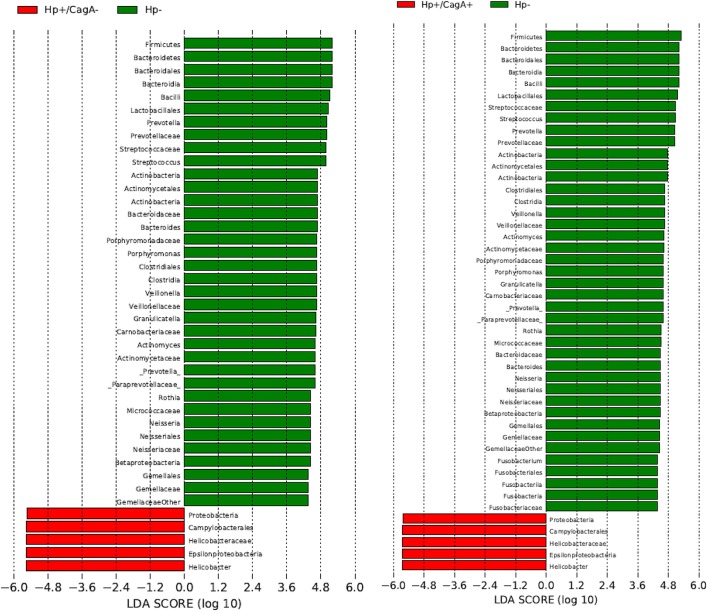
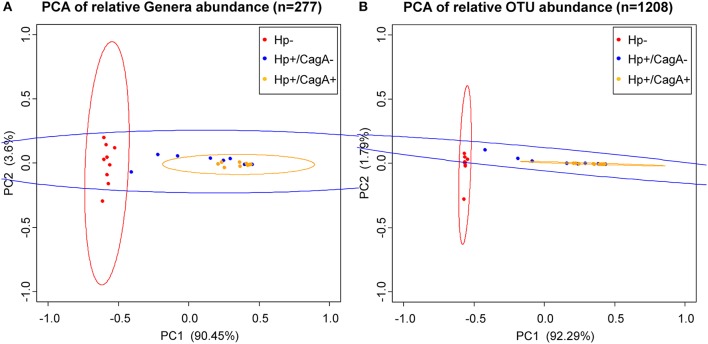
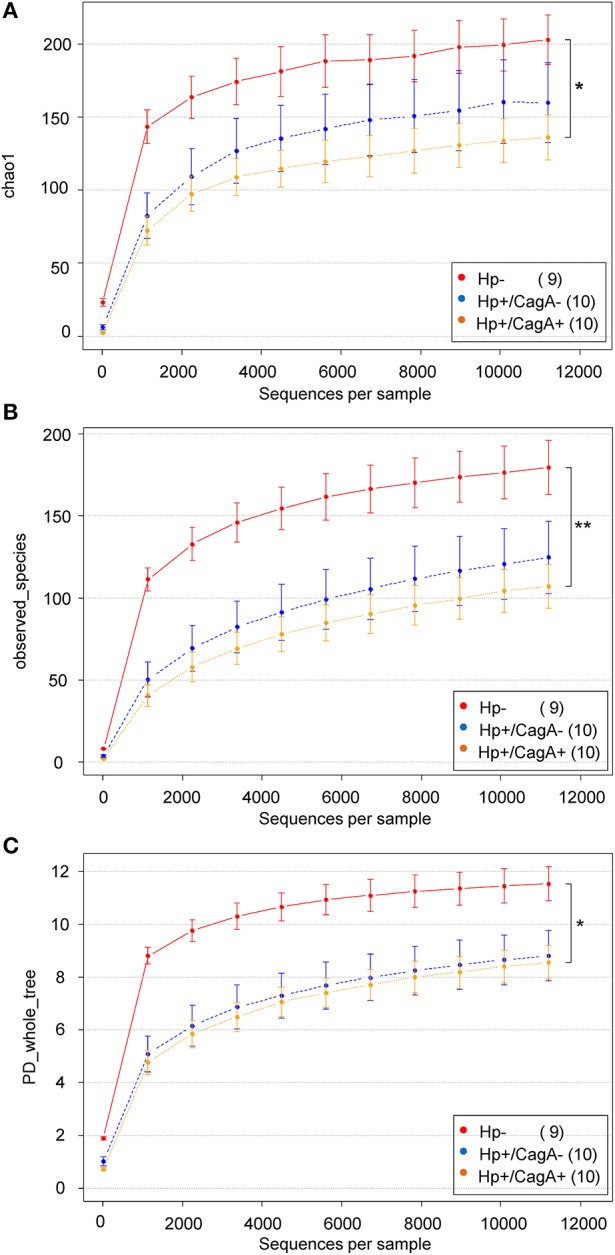
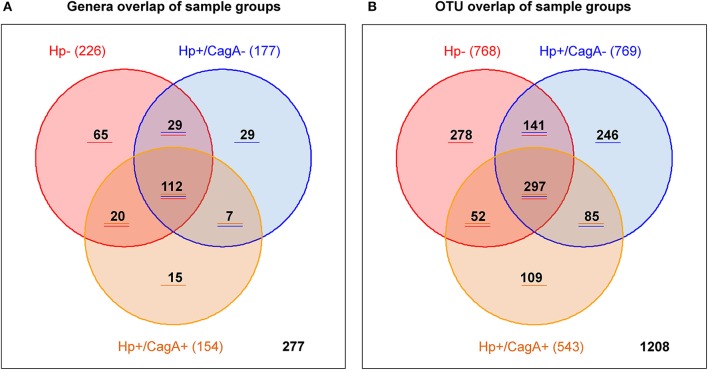
The human gastric lumen is one of the most hostile environments of the human body suspected to be sterile until the discovery of (H.p.). State of the art next generation sequencing technologies multiply the knowledge on H.p. functional genomics as well as on the colonization of supposed sterile human environments like the gastric habitat. Here we studied in a prospective, multicenter, clinical trial the 16S rRNA gene amplicon based bacterial microbiome in a total of 30 homogenized and frozen gastric biopsy samples from eight geographic locations. The evaluation of the samples for H.p. infection status was done by histopathology and a specific PCR assay. CagA status was determined by a CagA-specific PCR assay. Patients were grouped accordingly as H.p.-negative, H.p.-positive but CagA-negative and H.p.-positive and CagA-positive ( = 10, respectively). Here we show that H.p. infection of the gastric habitat dominates the gastric microbiota in most patients and is associated with a significant decrease of the microbial alpha diversity from H.p. negative to H.p. positive with CagA as a considerable factor. The genera , and are significantly different between the H.p.-positive and H.p.-negative sample groups. Differences in microbiota found between CagA-positive and CagA-negative patients were not statistically significant and need to be re-evaluated in larger sample cohorts. In conclusion, H.p. infection dominates the gastric microbiome in a multicentre cohort of patients with varying diagnoses.
在发现幽门螺杆菌(H.p.)之前,人类胃腔被认为是人体中最恶劣的环境之一,且被怀疑是无菌的。先进的下一代测序技术极大地增加了我们对H.p.功能基因组学以及对其在诸如胃栖息地等原本被认为无菌的人类环境中定殖情况的了解。在此,我们在一项前瞻性、多中心临床试验中,研究了来自八个地理位置的总共30份匀浆并冷冻保存的胃活检样本中基于16S rRNA基因扩增子的细菌微生物群。通过组织病理学和特异性PCR检测对样本进行H.p.感染状态评估。通过CagA特异性PCR检测确定CagA状态。患者相应地被分为H.p.阴性、H.p.阳性但CagA阴性以及H.p.阳性且CagA阳性三组(每组n = 10)。我们在此表明,在大多数患者中,胃栖息地的H.p.感染主导了胃微生物群,并且与微生物α多样性从H.p.阴性到H.p.阳性的显著降低相关,其中CagA是一个重要因素。在H.p.阳性和H.p.阴性样本组之间,[具体菌属名称缺失]属、[具体菌属名称缺失]属和[具体菌属名称缺失]属存在显著差异。在CagA阳性和CagA阴性患者之间发现的微生物群差异无统计学意义,需要在更大样本队列中重新评估。总之,在一个具有不同诊断的多中心患者队列中,H.p.感染主导了胃微生物组。