Eritja Núria, Jové Mariona, Fasmer Kristine Eldevik, Gatius Sònia, Portero-Otin Manuel, Trovik Jone, Krakstad Camilla, Sol Joaquim, Pamplona Reinald, Haldorsen Ingfrid S, Matias-Guiu Xavier
Department of Pathology and Molecular Genetics/Oncologic Pathology Group, Arnau de Vilanova University Hospital, University of Lleida, IRBLleida, Lleida, Spain.
Centro de Investigación Biomédica en Red de Oncología (CIBERONC), Madrid, Spain.
Oncotarget. 2017 Nov 20;8(65):109018-109026. doi: 10.18632/oncotarget.22558. eCollection 2017 Dec 12.
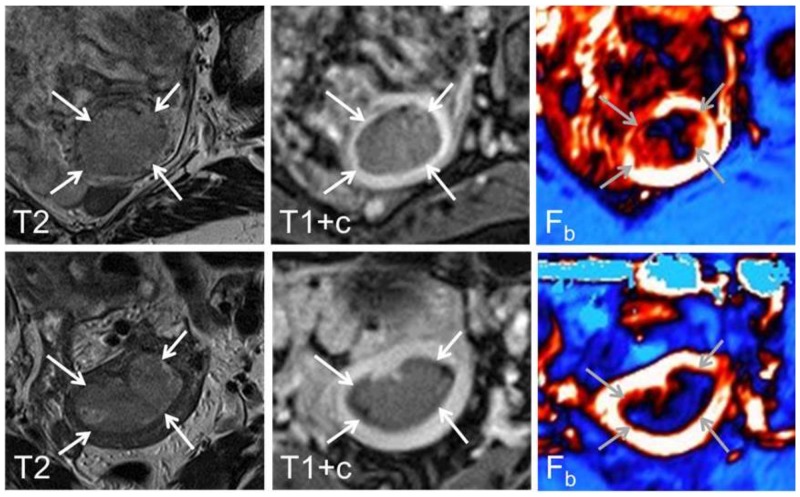
We aimed to study the potential influence of tumour blood flow -obtained from dynamic contrast-enhanced magnetic resonance imaging (DCE-MRI)- in the metabolomic profiles of endometrial tumours.
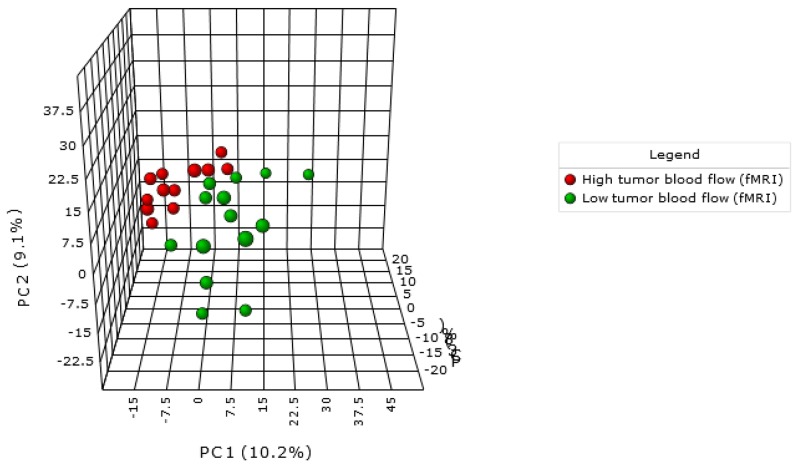
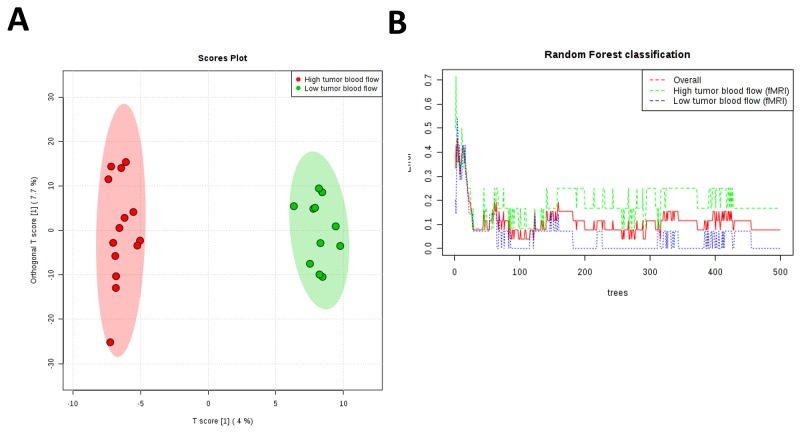
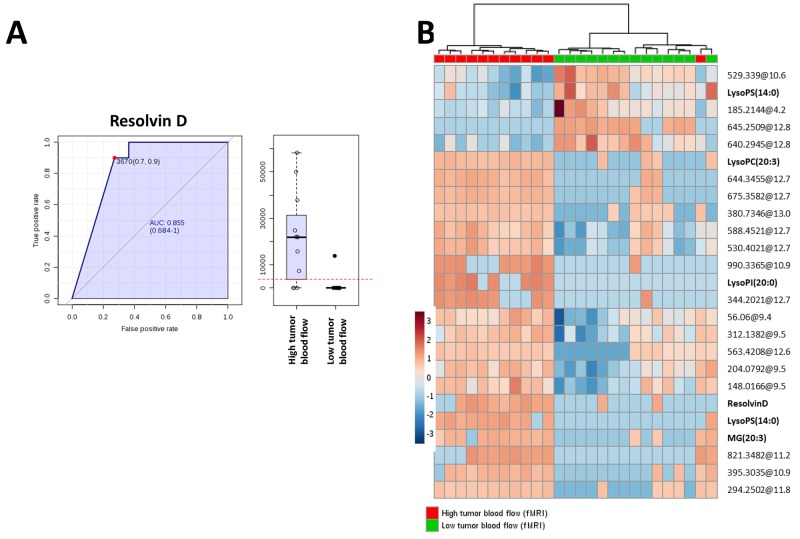
Liquid chromatography coupled to mass spectrometry established the metabolomic profile of endometrial cancer lesions exhibiting high (n=12) or low (n=14) tumour blood flow at DCE-MRI. Univariate and multivariate statistics (ortho-PLS-DA, a random forest (RF) classifier and hierarchical clustering) and receiver operating characteristic (ROC) curves were used to establish a panel for potentially discriminating tumours with high versus low blood flow.
Tumour blood flow is associated with specific metabolomic signatures. Ortho-PLS-DA and RF classifier resulted in well-defined clusters with an out-of-bag error lower than 8%. We found 28 statistically significant molecules (False Discovery Rate corrected p<0.05). Based on exact mass, retention time and isotopic distribution we identified 9 molecules including resolvin D and specific lysophospholipids associated with blood flow, and hence with a potentially regulatory role relevant in endometrial cancer.
Tumour flow parameters at DCE-MRI quantifying vascular tumour characteristics are reflected in corresponding metabolomics signatures and highlight disease mechanisms that may be targetable by novel therapies.
我们旨在研究通过动态对比增强磁共振成像(DCE-MRI)获得的肿瘤血流对子宫内膜肿瘤代谢组学特征的潜在影响。
液相色谱-质谱联用技术确定了在DCE-MRI中显示高肿瘤血流(n=12)或低肿瘤血流(n=14)的子宫内膜癌病变的代谢组学特征。使用单变量和多变量统计方法(正交偏最小二乘判别分析(ortho-PLS-DA)、随机森林(RF)分类器和层次聚类)以及受试者工作特征(ROC)曲线来建立一个区分高血流与低血流肿瘤的潜在判别指标。
肿瘤血流与特定的代谢组学特征相关。正交偏最小二乘判别分析和随机森林分类器产生了明确的聚类,袋外误差低于8%。我们发现了28个具有统计学意义的分子(错误发现率校正p<0.05)。基于精确质量、保留时间和同位素分布,我们鉴定出9种分子,包括与血流相关的消退素D和特定溶血磷脂,因此它们在子宫内膜癌中可能具有潜在的调节作用。
DCE-MRI中量化肿瘤血管特征的肿瘤血流参数反映在相应的代谢组学特征中,并突出了可能成为新疗法靶点的疾病机制。