Department of Microbiology and Immunology, Faculty of Pharmacy, October University for Modern Sciences and Arts (MSA), Giza, Egypt.
Department of Microbiology and Immunology, Faculty of Pharmacy, Al-Azhar University (Girls), Cairo, Egypt.
J Cell Mol Med. 2018 Mar;22(3):1972-1983. doi: 10.1111/jcmm.13496. Epub 2018 Jan 8.
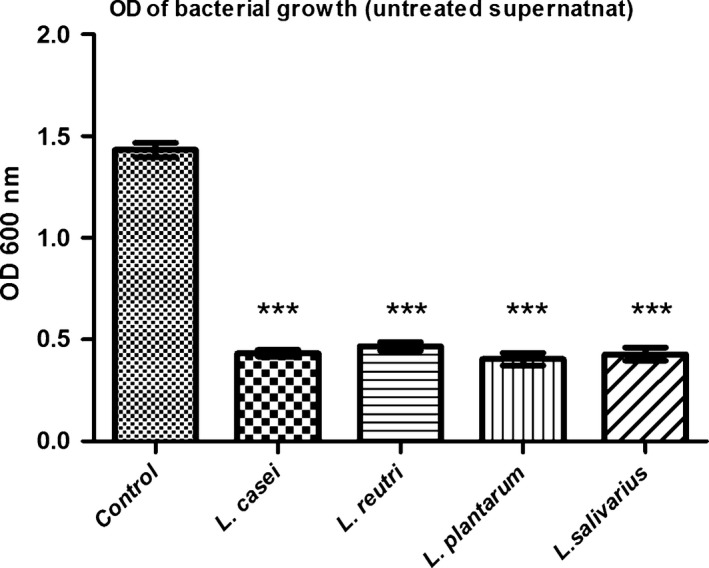
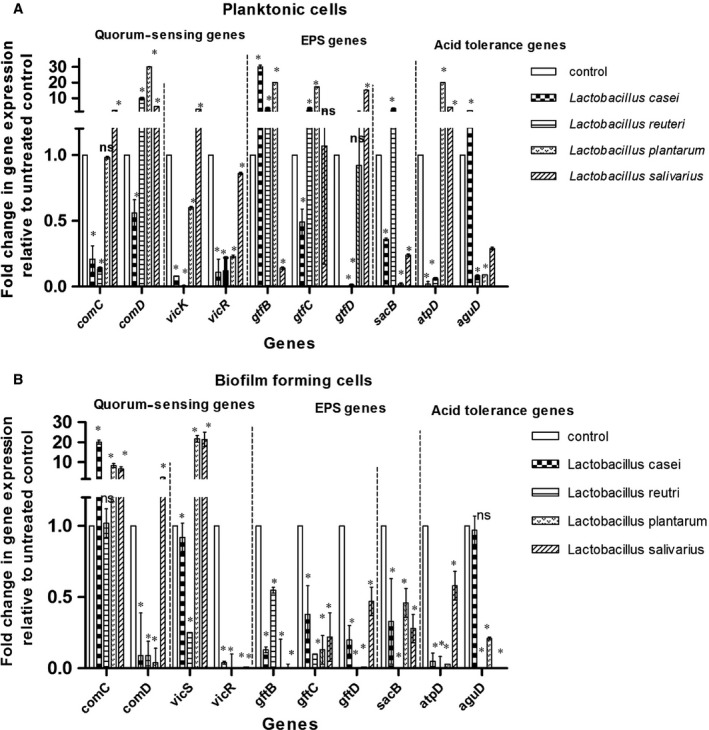
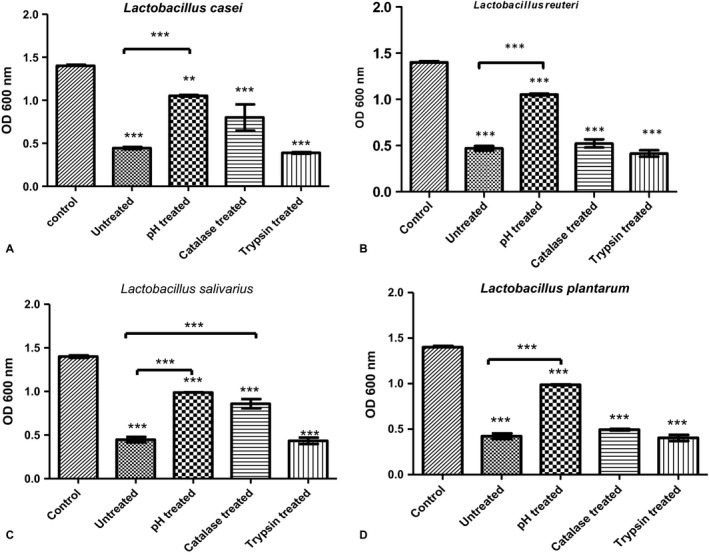
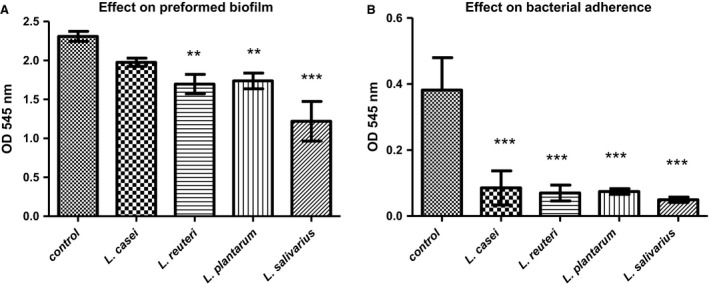
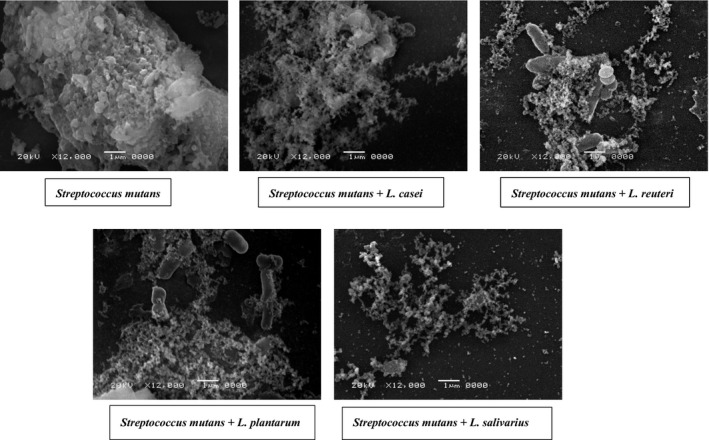
Streptococcus mutans contributes significantly to dental caries, which arises from homoeostasic imbalance between host and microbiota. We hypothesized that Lactobacillus sp. inhibits growth, biofilm formation and gene expression of Streptococcus mutans. Antibacterial (agar diffusion method) and antibiofilm (crystal violet assay) characteristics of probiotic Lactobacillus sp. against Streptococcus mutans (ATCC 25175) were evaluated. We investigated whether Lactobacillus casei (ATCC 393), Lactobacillus reuteri (ATCC 23272), Lactobacillus plantarum (ATCC 14917) or Lactobacillus salivarius (ATCC 11741) inhibit expression of Streptococcus mutans genes involved in biofilm formation, quorum sensing or stress survival using quantitative real-time polymerase chain reaction (qPCR). Growth changes (OD600) in the presence of pH-neutralized, catalase-treated or trypsin-treated Lactobacillus sp. supernatants were assessed to identify roles of organic acids, peroxides and bacteriocin. Susceptibility testing indicated antibacterial (pH-dependent) and antibiofilm activities of Lactobacillus sp. against Streptococcus mutans. Scanning electron microscopy revealed reduction in microcolony formation and exopolysaccharide structural changes. Of the oral normal flora, L. salivarius exhibited the highest antibiofilm and peroxide-dependent antimicrobial activities. All biofilm-forming cells treated with Lactobacillus sp. supernatants showed reduced expression of genes involved in exopolysaccharide production, acid tolerance and quorum sensing. Thus, Lactobacillus sp. can inhibit tooth decay by limiting growth and virulence properties of Streptococcus mutans.
变形链球菌(Streptococcus mutans)在宿主和微生物群落之间的稳态失衡中对龋齿的发生起着重要作用。我们假设乳杆菌(Lactobacillus sp.)可以抑制变形链球菌(Streptococcus mutans)的生长、生物膜形成和基因表达。评估了益生菌乳杆菌(Lactobacillus sp.)对变形链球菌(ATCC 25175)的抗菌(琼脂扩散法)和抗生物膜(结晶紫测定法)特性。我们研究了乳杆菌(Lactobacillus casei)(ATCC 393)、乳杆菌(Lactobacillus reuteri)(ATCC 23272)、植物乳杆菌(Lactobacillus plantarum)(ATCC 14917)或唾液乳杆菌(Lactobacillus salivarius)(ATCC 11741)是否通过定量实时聚合酶链反应(qPCR)抑制与生物膜形成、群体感应或应激生存相关的变形链球菌基因的表达。评估 pH 中和、过氧化氢酶处理或胰蛋白酶处理的乳杆菌(Lactobacillus sp.)上清液中存在时的生长变化(OD600),以确定有机酸、过氧化物和细菌素的作用。药敏试验表明乳杆菌(Lactobacillus sp.)对变形链球菌(Streptococcus mutans)具有抗菌(pH 依赖性)和抗生物膜活性。扫描电子显微镜显示,微菌落形成和胞外多糖结构变化减少。在口腔正常菌群中,唾液乳杆菌(Lactobacillus salivarius)表现出最高的抗生物膜和过氧化物依赖性抗菌活性。用乳杆菌(Lactobacillus sp.)上清液处理的所有生物膜形成细胞的基因表达均显示出参与胞外多糖产生、酸耐受性和群体感应的基因表达降低。因此,乳杆菌(Lactobacillus sp.)可以通过限制变形链球菌(Streptococcus mutans)的生长和毒力特性来抑制龋齿。