Department of Internal Medicine, Tampere University Hospital, Teiskontie 35, 33521, Tampere, Finland.
Department of Medicine, Central Finland Central Hospital, Jyväskylä, Finland.
Lipids Health Dis. 2018 Jan 10;17(1):10. doi: 10.1186/s12944-018-0655-2.
Alterations in lipoprotein size are associated with increased cardiovascular disease risk. Higher hemoglobin levels may indicate a higher risk of atherosclerosis and was previously associated with obesity, metabolic syndrome, and insulin resistance. No previous studies have investigated an association between hemoglobin concentration and lipoprotein particle size.
We conducted a population-based, cross-sectional study of 766 Caucasian, middle-aged subjects (341 men and 425 women) born in Pieksämäki, Finland, who were categorized into five age groups. The concentrations and sizes of lipoprotein subclass particles were analyzed by high-throughput nuclear magnetic resonance (NMR) spectroscopy.
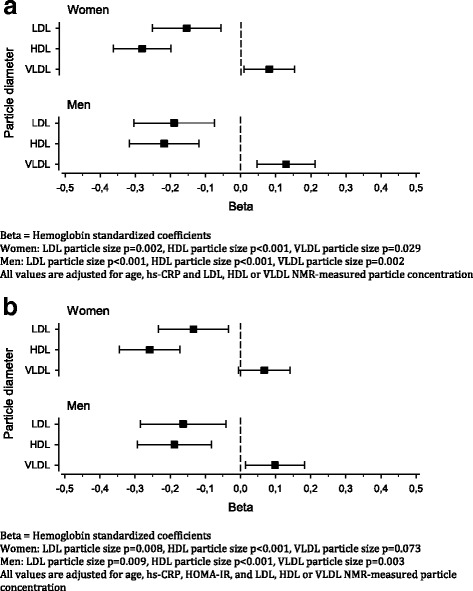
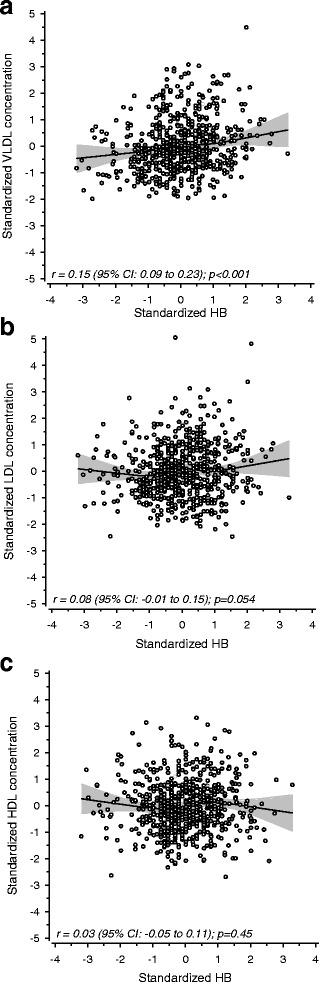
Larger very low density lipoprotein (VLDL) particle diameter was associated with higher hemoglobin concentrations in men (p = 0.003). There was a strong relationship between smaller high density lipoprotein (HDL) particle size and higher hemoglobin concentration in both men and women as well as with smaller low density lipoprotein (LDL) particle size and higher hemoglobin concentration in men and women (p < 0.001; p = 0.009, p = 0.008). VLDL particle concentration had a moderate positive correlation with hemoglobin concentration (r = 0.15; p < 0.001). LDL particle concentration showed a statistical trend suggesting increasing particle concentration with increasing hemoglobin levels (r = 0.08; p = 0.05).
Higher hemoglobin levels are associated with larger VLDL, smaller LDL, and smaller HDL particle sizes and increasing amounts of larger VLDL and smaller LDL particles. This suggests that a higher hemoglobin concentration is associated with an unfavorable lipoprotein particle profile that is part of states that increase cardiovascular disease risk like diabetes and metabolic syndrome.
脂蛋白大小的改变与心血管疾病风险的增加有关。较高的血红蛋白水平可能表明动脉粥样硬化的风险较高,并且以前与肥胖、代谢综合征和胰岛素抵抗有关。以前没有研究调查血红蛋白浓度与脂蛋白颗粒大小之间的关系。
我们对 766 名白种人、中年受试者(341 名男性和 425 名女性)进行了一项基于人群的横断面研究,这些受试者出生于芬兰皮克萨米基,他们被分为五个年龄组。采用高通量核磁共振(NMR)光谱法分析脂蛋白亚类颗粒的浓度和大小。
男性中较大的极低密度脂蛋白(VLDL)颗粒直径与较高的血红蛋白浓度相关(p=0.003)。男性和女性的高密度脂蛋白(HDL)颗粒尺寸较小与血红蛋白浓度较高,以及男性和女性的低密度脂蛋白(LDL)颗粒尺寸较小与血红蛋白浓度较高之间存在很强的关系(p<0.001;p=0.009;p=0.008)。VLDL 颗粒浓度与血红蛋白浓度呈中度正相关(r=0.15;p<0.001)。LDL 颗粒浓度显示出统计学趋势,表明随着血红蛋白水平的升高,颗粒浓度呈增加趋势(r=0.08;p=0.05)。
较高的血红蛋白水平与较大的 VLDL、较小的 LDL 和较小的 HDL 颗粒大小以及更大的 VLDL 和更小的 LDL 颗粒数量增加有关。这表明,较高的血红蛋白浓度与不利的脂蛋白颗粒谱有关,这是增加心血管疾病风险的状态的一部分,如糖尿病和代谢综合征。