Kimm Heejin, Mok Yejin, Lee Sun Ju, Lee Sunmi, Back Joung Hwan, Jee Sun Ha
Department of Epidemiology and Health Promotion, Institute for Health Promotion, Graduate School of Public Health, Yonsei University, Seoul, Korea.
Department of Epidemiology, Johns Hopkins Bloomberg School of Public Health, Baltimore, MD, USA.
Korean Circ J. 2018 Jan;48(1):36-47. doi: 10.4070/kcj.2017.0036.
The J-curve phenomenon between diastolic blood pressure (DBP) and mortality has been reported repeatedly in treated patients. However, the baseline risk of low DBP has not been fully explored. This study was to examine the relationship between DBP and risk of mortality from all-cause, atherosclerotic vascular diseases (ASCVD), and ischemic heart disease (IHD) using a prospective cohort of general population.
We analyzed 1,234,435 participants of the Korean Cancer Prevention Study cohort (789,255 men, 30-95 years of age) who had a medical evaluation from 1992 to 1995 using Cox proportional hazards models.
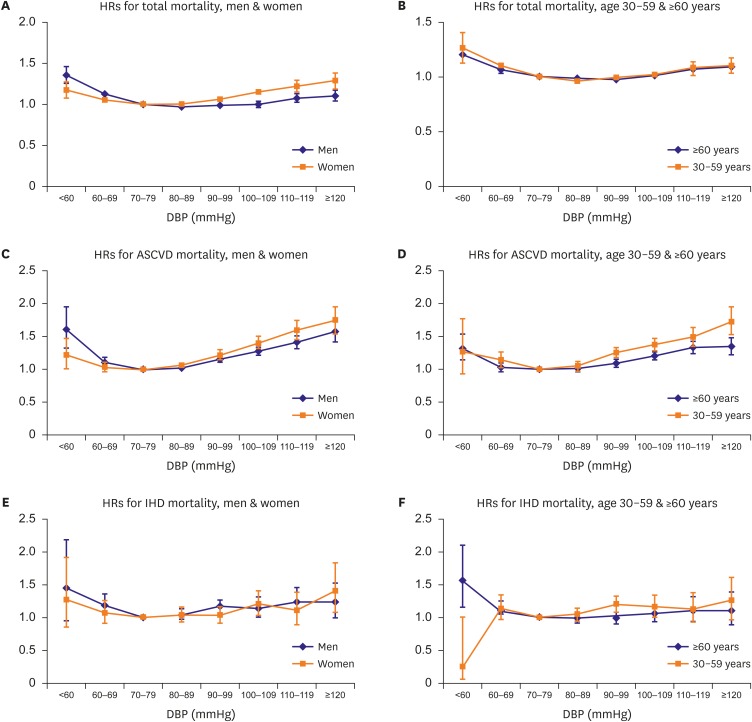
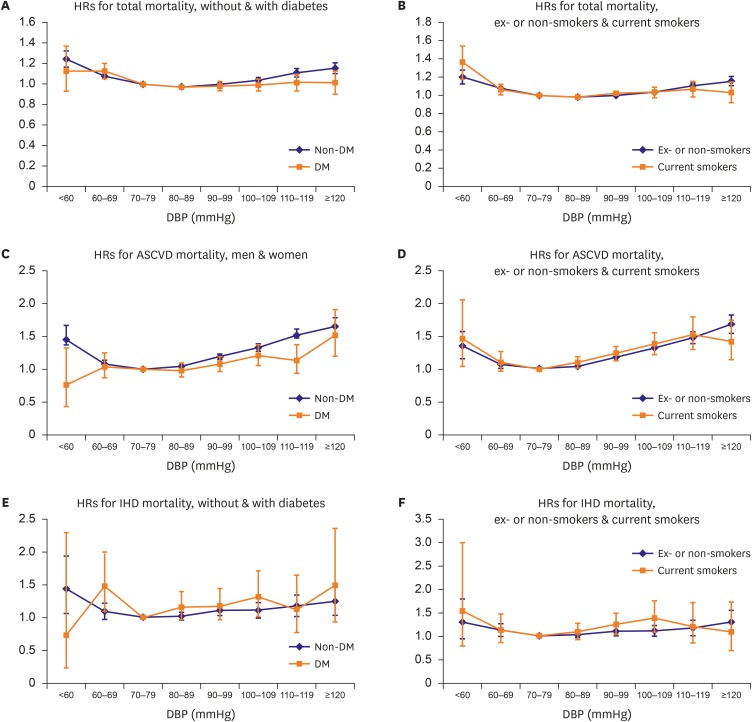
A total of 22.5 million person-years were followed up (mean age 46.6 years, deaths 193,903 cases). The hazard ratios of mortality from all-cause and ASCVD, among those with DBP <60 mmHg compared to 70-79 mmHg were 1.23 (95% confidence interval [CI], 1.16-1.30) and 1.37 (95% CI, 1.20-1.57), respectively, after adjustment for multivariable including systolic blood pressure. Increased risks of all-cause death in the lowest DBP category group were maintained in men or women, 30-59 or ≥60 years of age, smoker or non-smoker and diabetes mellitus (DM) or non-DM subgroups. The risk in DBP 60-69 mmHg groups increased in several subgroups. However, the risk for ASCVD death in 30-59 years and DM group, and risk for IHD death in most subgroups except for elderly (≥60 years) decreased.
A J-curve relationship between low DBP and all-cause death was found consistently. The baseline risk in the general population may be considered for risk assessment, particularly in case of interventions that lower DBP below 60 mmHg.
治疗患者中舒张压(DBP)与死亡率之间的J曲线现象已被多次报道。然而,低舒张压的基线风险尚未得到充分探究。本研究旨在使用普通人群的前瞻性队列研究来检验舒张压与全因死亡率、动脉粥样硬化性血管疾病(ASCVD)和缺血性心脏病(IHD)风险之间的关系。
我们使用Cox比例风险模型分析了韩国癌症预防研究队列中的1,234,435名参与者(789,255名男性,年龄在30至95岁之间),这些参与者在1992年至1995年期间接受了医学评估。
总共随访了2250万人年(平均年龄46.6岁,死亡193,903例)。在调整包括收缩压在内的多变量后,舒张压<60 mmHg者与70 - 79 mmHg者相比,全因死亡率和ASCVD死亡率的风险比分别为1.23(95%置信区间[CI],1.16 - 1.30)和1.37(95% CI,1.20 - 1.57)。最低舒张压类别组中全因死亡风险增加在男性或女性、30 - 59岁或≥60岁、吸烟者或非吸烟者以及糖尿病(DM)或非DM亚组中均持续存在。舒张压60 - 69 mmHg组的风险在几个亚组中有所增加。然而,30 - 59岁和DM组中ASCVD死亡风险以及除老年人(≥60岁)外大多数亚组中IHD死亡风险降低。
一致发现低舒张压与全因死亡之间存在J曲线关系。在进行风险评估时,尤其是在将舒张压降低至60 mmHg以下的干预措施中,可能需要考虑普通人群的基线风险。