Scott C E, Monks S A, Spracklen D V, Arnold S R, Forster P M, Rap A, Äijälä M, Artaxo P, Carslaw K S, Chipperfield M P, Ehn M, Gilardoni S, Heikkinen L, Kulmala M, Petäjä T, Reddington C L S, Rizzo L V, Swietlicki E, Vignati E, Wilson C
Institute for Climate and Atmospheric Science, School of Earth and Environment, University of Leeds, Leeds, UK.
Cooperative Institute for Research in Environmental Sciences, University of Colorado, Boulder, CO, USA.
Nat Commun. 2018 Jan 11;9(1):157. doi: 10.1038/s41467-017-02412-4.
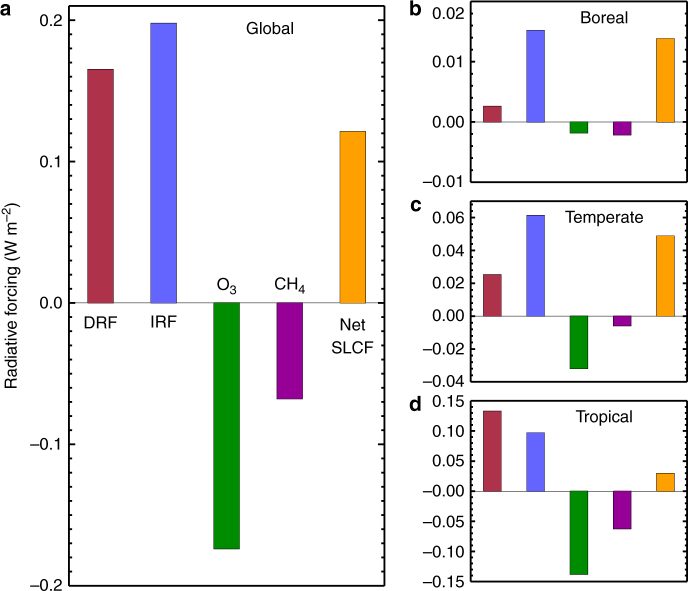
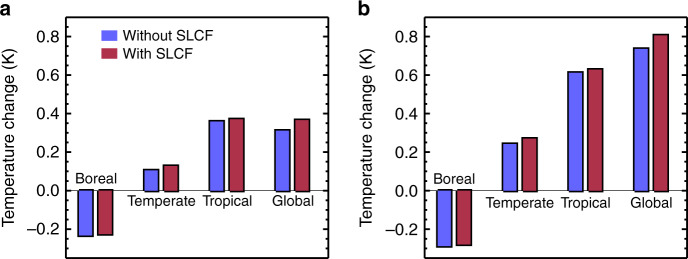
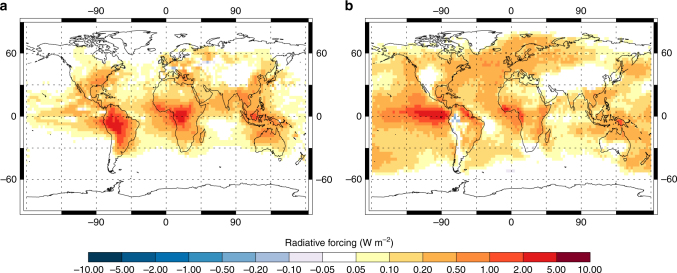
The climate impact of deforestation depends on the relative strength of several biogeochemical and biogeophysical effects. In addition to affecting the exchange of carbon dioxide (CO) and moisture with the atmosphere and surface albedo, vegetation emits biogenic volatile organic compounds (BVOCs) that alter the formation of short-lived climate forcers (SLCFs), which include aerosol, ozone and methane. Here we show that a scenario of complete global deforestation results in a net positive radiative forcing (RF; 0.12 W m) from SLCFs, with the negative RF from decreases in ozone and methane concentrations partially offsetting the positive aerosol RF. Combining RFs due to CO, surface albedo and SLCFs suggests that global deforestation could cause 0.8 K warming after 100 years, with SLCFs contributing 8% of the effect. However, deforestation as projected by the RCP8.5 scenario leads to zero net RF from SLCF, primarily due to nonlinearities in the aerosol indirect effect.
森林砍伐对气候的影响取决于多种生物地球化学和生物地球物理效应的相对强度。除了影响与大气和地表反照率之间的二氧化碳(CO)和水分交换外,植被还会释放生物源挥发性有机化合物(BVOCs),这些化合物会改变包括气溶胶、臭氧和甲烷在内的短期气候强迫因子(SLCFs)的形成。在此我们表明,全球森林完全砍伐的情景会导致SLCFs产生净正辐射强迫(RF;0.12 W m),其中臭氧和甲烷浓度降低所产生的负RF部分抵消了正的气溶胶RF。综合考虑因CO、地表反照率和SLCFs产生的RF表明,全球森林砍伐在100年后可能导致0.8 K的变暖,其中SLCFs贡献了8%的影响。然而,RCP8.5情景所预测的森林砍伐导致SLCF的净RF为零,这主要是由于气溶胶间接效应的非线性。