Wang Yifan, Hu Yanbo, Xu Jiaojing, Zhou Hongli, Lin Xiao, Du Xiaoxia, Dong Guangheng
Department of Psychology, Zhejiang Normal University, Jinhua, China.
School of Psychology and Cognitive Science, East China Normal University, Shanghai, China.
Front Psychiatry. 2017 Dec 13;8:287. doi: 10.3389/fpsyt.2017.00287. eCollection 2017.
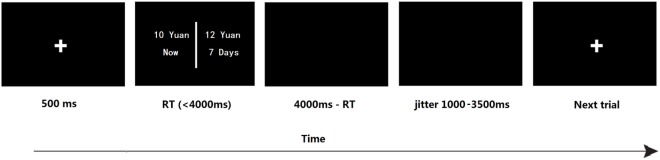
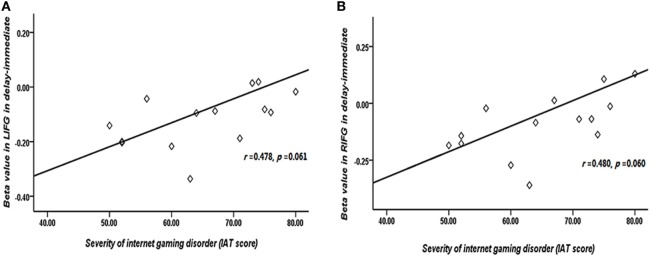
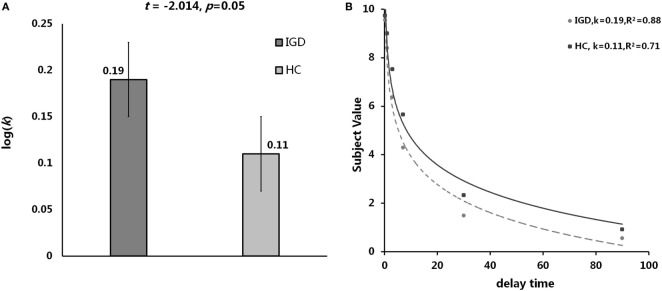
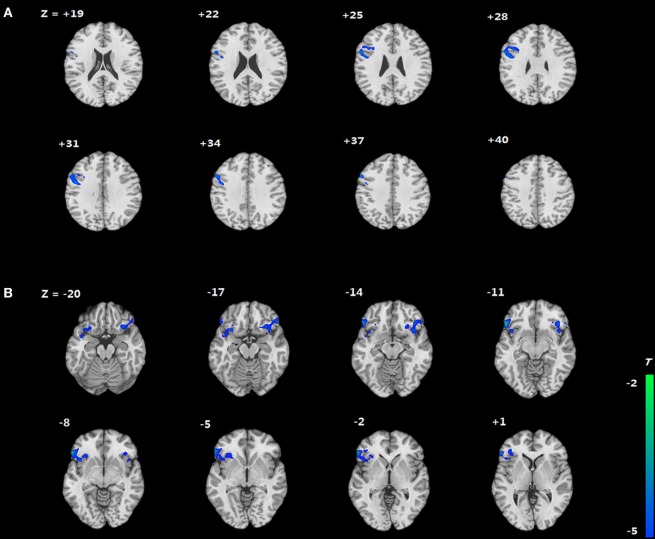
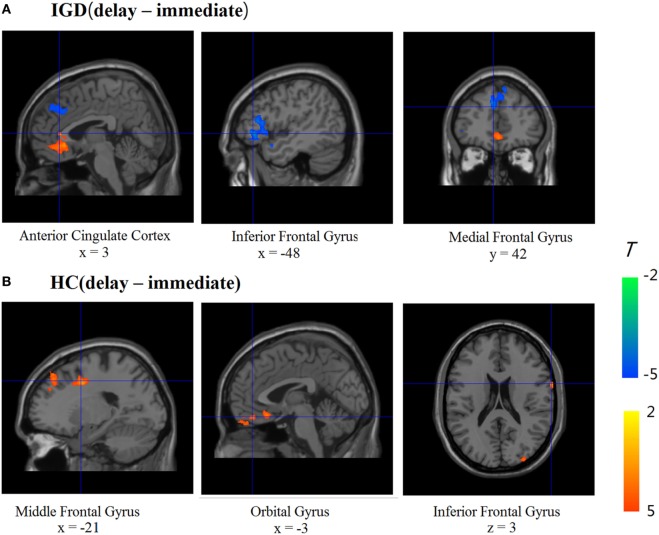
Internet gaming disorder (IGD), defined as the persistent use of online games with ignorance of adverse consequences, has increasingly raised widespread public concerns. This study aimed at elucidating the precise mechanisms underlying IGD by comparing intertemporal decision-making process between 18 IGD participants and 21 matched healthy controls (HCs). Both behavioral and fMRI data were recorded from a delay discounting task. At the behavioral level, the IGD showed a higher discount rate than HC; and in IGD group, both the reaction time (delay - immediate) and the discount rate were significantly positively correlated with the severity of IGD. At the neural level, the IGD exhibited reduced brain activations in the dorsolateral prefrontal cortex and bilateral inferior frontal gyrus compared to HC during performing delay trials relative to immediate ones. Taken together, the results suggested that IGD showed deficits in making decisions and tended to pursuit immediate satisfaction. The underlying mechanism arises from the deficient ability in evaluating between delayed reward and immediate satisfaction, and the impaired ability in impulse inhibition, which may be associated with the dysfunction of the prefrontal activation. These might be the reason why IGD continue playing online games in spite of facing severe negative consequences.
网络成瘾障碍(IGD)被定义为持续沉迷于网络游戏而忽视其不良后果,这一现象日益引起公众的广泛关注。本研究旨在通过比较18名网络成瘾障碍参与者和21名匹配的健康对照者(HCs)的跨期决策过程,阐明网络成瘾障碍背后的确切机制。行为数据和功能磁共振成像(fMRI)数据均来自一项延迟折扣任务。在行为层面,网络成瘾障碍者的折扣率高于健康对照者;在网络成瘾障碍组中,反应时间(延迟-即时)和折扣率均与网络成瘾障碍的严重程度显著正相关。在神经层面,与健康对照者相比,网络成瘾障碍者在进行延迟试验(相对于即时试验)时,背外侧前额叶皮层和双侧额下回的大脑激活减少。综上所述,结果表明网络成瘾障碍者在决策方面存在缺陷,倾向于追求即时满足。其潜在机制源于评估延迟奖励和即时满足之间的能力不足,以及冲动抑制能力受损,并可能与前额叶激活功能障碍有关。这些可能就是网络成瘾障碍者尽管面临严重负面后果仍继续玩网络游戏的原因。